

Double Counting, Matching Dependence, and Breakdown
A thermal EFT or resummation is useful only if it can fail visibly. Double counting occurs when two parts of a calculation include the same momentum region or self-energy insertion; breakdown occurs when a supposedly removed scale becomes dynamical, a local expansion becomes nonanalytic, or the retained theory loses its small parameter. Both problems are diagnosed at the level of observables, not repaired by tuning a convenient mass.
The logic of region expansion and overlap removal is formulated by Beneke and Smirnov 1998, §§ 2–3, pp. 325–337.
Required background. Thermal Modes, Matching, and EFT Power Counting supplies the mode partition. EFT Truncation Errors and Breakdown Diagnostics supplies general error logic. Helpful background. Gauge Dependence and Thermal Observables explains why gauge-parameter stability and physical matching are distinct tests.
Partition plus overlap subtraction
Section titled “Partition plus overlap subtraction”Suppose an observable receives hard and soft contributions separated by . A correct expansion has the schematic inclusion–exclusion form
Here is the expansion of either region in the scaling shared by both. In diagrammatic resummation it may be the fixed-order mass insertion already counted in ; in a method-of-regions calculation it is a zero-bin or overlap integral; in dimensional reduction it is the zero-mode subgraph reproduced by the three-dimensional theory.
Regulators can make an overlap integral vanish because it is scaleless. That does not remove the conceptual step: the scaleless cancellation also carries the ultraviolet/infrared pole assignment needed for consistent renormalization.
The factorization check is
Failure at a retained order identifies missing matching terms or inconsistent running. Passing the derivative test does not detect every common bias, so independent observables and alternative regulators remain important.
Resummation counterterms
Section titled “Resummation counterterms”An add–subtract reorganization writes
The propagator contains , while perturbative insertions of remove the terms already present in the original expansion. Truncating the dressed graphs and compensating insertions at different orders changes the theory at the very order being claimed.
For a field-dependent calculation, the subtraction must be carried through derivatives of the free energy as well. A pressure that is consistent while its susceptibility differentiates an untracked thermal mass is not a consistent matched prediction.
Five independent breakdown mechanisms
Section titled “Five independent breakdown mechanisms”Scale collision. If is not small, higher operators cease to be ordered. Varying a factorization scale cannot manufacture a hierarchy.
Emergent slow modes. Near a critical point, a chemical reaction threshold, or a nearly conserved charge, a mode previously integrated out can approach the retained timescale. It must be restored as a degree of freedom.
Nonlocality. A pole, cut, pinching pair, or long-time tail near the expansion point invalidates a local derivative expansion. Retain memory or the responsible mode.
Strong retained dynamics. Matching coefficients may be perturbative while the EFT matrix element is not, as in a critical scalar theory or the magnetostatic non-Abelian sector. Use a controlled nonperturbative method for the retained theory.
Symmetry inconsistency. Gauge identities, conserved charges, KMS relations, positivity, or causality can fail under an incomplete resummation. Numerical stability does not compensate for a violated identity.
A falsification workflow
Section titled “A falsification workflow”- Repeat the calculation at several values within an actual scale window.
- Verify the same observable in the full and EFT descriptions where both are valid.
- Change regulator or matching observable while transforming coefficients consistently.
- Add the first omitted operator and test whether its fitted or matched coefficient has the expected size.
- Search the full kernel for nearby poles, cuts, or vanishing relaxation rates.
- Check Ward identities, conservation laws, KMS, positivity, and causality appropriate to the problem.
- Compare alternative reorganizations only at matched perturbative order.
- Stop extrapolating when one of these tests fails; report the surviving, narrower claim.
The canonical matching and double-counting table provides the common record. It is most useful when completed before the final numerical result is known.
Common pitfalls
Section titled “Common pitfalls”Treating small scale variation as a full error bar. Correlated missing terms can be independent of . Operator estimates, scheme comparisons, and external benchmarks probe different directions.
Using a regulator as physics. A cutoff can expose a scale separation, but physical predictions must be independent of it after matching. A cutoff-sized remainder is evidence of incomplete cancellation.
The schematic below organizes the relationships used on this page. Inspect it with this question in mind: How do ring, daisy, screened, variational, and EFT reorganizations differ?
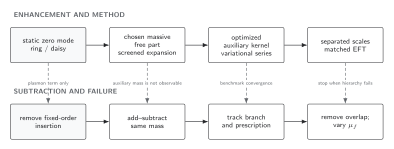
Each reorganization targets a named enhanced sector and must include its compensating subtraction; optimization, factorization-scale, gauge, and strong-soft-sector tests decide whether apparent convergence is meaningful. The method columns are alternatives or partially overlapping reorganizations, not a mandatory sequence: horizontal arrows organize increasing structural scope, while vertical dashed arrows pair each method with its subtraction or failure check. The diagram is schematic and not to scale.
The surrounding discussion supplies the relevant equations and checks in text form; the figure is a navigational summary.
Exercise
Section titled “Exercise”Let and . Show the scale cancellation and explain what a residual term implies.
Solution
The sum is , so its derivative with respect to vanishes. An additional unmatched term gives derivative . If occurs at a retained order, a matching coefficient, overlap subtraction, or running contribution is missing; if it first occurs beyond the truncation, its size is one estimate of the omitted order.
References
Section titled “References”- Beneke, M., and V. A. Smirnov. “Asymptotic Expansion of Feynman Integrals near Threshold.” Nuclear Physics B 522, nos. 1–2 (1998): 321–344. doi:10.1016/S0550-3213(98)00138-2.
- Braaten, Eric, and Agustín Nieto. “Effective Field Theory Approach to High Temperature Thermodynamics.” Physical Review D 51, no. 12 (1995): 6990–7006. doi:10.1103/PhysRevD.51.6990.
- Manohar, Aneesh V., and Iain W. Stewart. “The Zero-Bin and Mode Factorization in Quantum Field Theory.” Physical Review D 76, no. 7 (2007): 074002. doi:10.1103/PhysRevD.76.074002.