

Hard Probes and Jet–Medium Tomography
Jet–medium tomography begins with a factorized, infrared-and-collinear-safe vacuum or nuclear baseline and asks which additional medium interactions are identifiable from reconstructed observables. Energy loss is not itself an observable: radiation, elastic transfer, coherence, medium response, background subtraction, and hadronization combine with selection bias to produce the measured spectrum or jet.
Required background. QCD fields and the perturbative domain, hard–jet–soft factorization, collinear factorization, IRC safety, and jet algorithms and event shapes define the baseline. Helpful background. Gauge-theory EKT supplies weak-coupling collision physics, and bulk evolution supplies the medium history.
Evidence status on this page was checked through 10 August 2026.
Baseline before medium modification
Section titled “Baseline before medium modification”A hard cross section in nucleus–nucleus collisions starts schematically from
with perturbative order, factorization/renormalization scales, nuclear PDFs, fragmentation, and experimental selection specified. The nuclear modification factor
equals one only under a defined binary-scaling baseline. Initial-state nuclear modifications, isospin, centrality bias, and the reference covariance affect its interpretation.
Because the hard spectrum falls steeply, a modest downward energy shift can strongly suppress yield. Consequently does not invert uniquely to a mean energy loss.
Medium radiation, collisions, and coherence
Section titled “Medium radiation, collisions, and coherence”Weak-coupling descriptions separate virtuality-ordered shower evolution from medium-induced interactions only at a matching scale. A splitting with energy fraction has formation time
Scatterings during this time interfere. The LPM effect suppresses independent emissions, while color coherence determines when a medium resolves two subjets. Adding a vacuum shower and an independent sequence of medium emissions without overlap subtraction double counts part of phase space.
Elastic collisions transfer energy and momentum to medium constituents. The “lost” energy can reappear as broad, soft particles correlated with the jet. A model that removes energy from the shower but omits recoil and hydrodynamic wake cannot predict observables designed to capture medium response.
The transport parameter characterizes transverse broadening in a specified representation and scheme:
It has a Wilson-line operator definition in controlled limits, but phenomenological extractions also depend on shower virtuality, running coupling, finite energy, hydrodynamic background, and regulator. Values from different frameworks are not directly comparable until these conventions are matched.
Geometry, reconstruction, and selection
Section titled “Geometry, reconstruction, and selection”Production points follow the hard-scattering density, whereas path length and temperature follow a fluctuating event. Jet finding introduces radius , constituent cuts, grooming, subtraction, and response. Triggering on a surviving high- object biases toward harder fragmentation, favorable geometry, and smaller loss.
A useful hierarchy of observables is:
- inclusive hadron and jet , constraining integrated suppression but strongly spectrum-biased;
- azimuthal anisotropy at high , adding path-length information;
- photon/Z–jet and hadron–jet imbalance, improving knowledge of initial parton energy;
- groomed substructure and jet shapes, testing coherence and response but increasing sensitivity to reconstruction and hadronization;
- flavor-tagged jets, changing color, mass, and production biases.
No single observable measures . Identifiability comes from a common model and covariance across complementary measurements.
Current global constraints
Section titled “Current global constraints”The JET Collaboration’s multi-model analysis demonstrated that inclusive suppression data can constrain a conventionally defined while exposing sizable model spread Burke et al. 2014. A JETSCAPE Bayesian analysis published in 2025 jointly used inclusive charged-hadron and jet suppression across RHIC and LHC energies in a multistage shower framework Ehlers et al. 2025. It sharpened conditional constraints and found that particular datasets/model variants retain tension.
The evidence therefore supports substantial final-state parton–medium modification and quantitative model-conditional transport constraints. It does not select a unique microscopic energy-loss mechanism or a model-independent function .
Every analysis should use the heavy-ion global-inference provenance table, including the hard baseline, dataset/collaboration identity, covariance, medium evolution, shower kernels, response, and evidence cutoff.
The jet branch samples the shared medium through shower modification, momentum broadening, energy loss, and medium response rather than through a single universal coefficient.
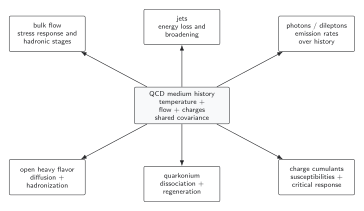
Jet observables depend jointly on the hard production and nuclear baseline, vacuum and medium shower evolution, path-dependent transport kernels, recoil or medium response, hadronization, and reconstruction. The other branches constrain the common temperature and flow history with different operators, so they can reduce degeneracies only through a joint covariance-aware model. The diagram is schematic and not to scale.
The text equivalent is to specify the convention for or other kernels, keep the hard baseline factorized, propagate the full multistage medium and detector response, and compare multiple jet and hadron observables with correlated uncertainties. Posterior constraints remain model-conditional.
Exercises
Section titled “Exercises”1. Spectrum bias. Suppose and every parton loses a fixed . Estimate ignoring geometry.
Solution
Yield observed at came from , so . The same suppression corresponds to different for different spectral slopes .
2. Missing recoil. Which jet observable is especially unsafe to predict if deposited energy is simply deleted?
Solution
Large-angle soft jet shapes, missing- distributions, and jet–hadron correlations are directly sensitive to the redistributed energy. Deleting it violates global energy–momentum accounting and removes the medium response those observables target.
Continue to electromagnetic probes or global inference.
References
Section titled “References”- Apolinário, Liliana, Yen-Jie Lee, and Marta Winn. “Heavy Quarks and Jets as Probes of the QGP.” Progress in Particle and Nuclear Physics 127 (2022): 103990. DOI.
- Burke, Karen M., et al. (JET Collaboration). “Extracting the Jet Transport Coefficient from Jet Quenching in High-Energy Heavy-Ion Collisions.” Physical Review C 90, no. 1 (2014): 014909. DOI.
- Ehlers, Raymond, et al. (JETSCAPE Collaboration). “Bayesian Inference Analysis of Jet Quenching Using Inclusive Jet and Hadron Suppression Measurements.” Physical Review C 111, no. 5 (2025): 054913. DOI.
- Mehtar-Tani, Yacine, José Guilherme Milhano, and Konrad Tywoniuk. “Jet Physics in Heavy-Ion Collisions.” International Journal of Modern Physics A 28, no. 11 (2013): 1340013. DOI.