

Eigenstate Thermalization Hypothesis
The eigenstate thermalization hypothesis (ETH) is an ansatz for matrix elements of suitably simple observables within a resolved chaotic symmetry sector. Its diagonal part makes nearby energy eigenstates locally indistinguishable; its off-diagonal part suppresses late-time fluctuations. ETH can explain why a narrow-energy initial state relaxes to microcanonical values, but it is not a theorem for arbitrary Hamiltonians, eigenstates, or operators.
Required background. Equilibration and dephasing derives the diagonal ensemble whose thermal value ETH must explain. Statistical ensembles define the microcanonical comparison. Helpful background. Prethermalization supplies an important regime in which approximate charges delay the ETH prediction.
The ETH ansatz
Section titled “The ETH ansatz”Let be energy eigenstates within one irreducible symmetry sector, and let be a few-body or local operator. With
the standard ansatz is
is the thermodynamic entropy of the sector and energy window, and are smooth on scales large compared with the level spacing, and is a zero-mean unit-variance fluctuating quantity with Hermiticity correlations. This formulation originated in the random-matrix arguments of Deutsch 1991 and the statistical ansatz of Srednicki 1994.
The formula contains two logically different claims:
- diagonal ETH: approaches a smooth microcanonical function with shrinking fluctuations;
- off-diagonal ETH: has entropy-suppressed magnitude and a frequency envelope tied to equilibrium dynamics.
One can hold while a proposed detailed distribution for the other fails. The entropy factor also depends on whether discrete symmetries and conserved charges have been resolved; mixing sectors produces exact zeros, degeneracies, and artificial multimodality.
From eigenstate matrix elements to a quench prediction
Section titled “From eigenstate matrix elements to a quench prediction”For , the long-time mean is
Suppose the energy distribution is centered at , has width , lies in one sector, and is smooth across that width. Expanding gives
The linear term vanishes by the definition of . If diagonal ETH holds and is thermodynamically narrow, agrees with the microcanonical value up to ensemble and finite-size corrections.
For nondegenerate gaps, the temporal variance is
Off-diagonal ETH makes typical terms exponentially small in entropy. This explains small fluctuations, but the conclusion still depends on effective dimension, gap degeneracies, the support of the initial state, and possible rare matrix elements.
A finite-size ETH test
Section titled “A finite-size ETH test”A reproducible test uses the following order.
- Resolve every exact symmetry and fix boundary conditions.
- Choose energy windows whose thermodynamic width shrinks while their level count grows.
- Compare with a locally smoothed and report residual distributions, not only their mean.
- Test the residual width versus entropy or Hilbert-space dimension at fixed energy density.
- Bin in both and ; test its variance and correlations.
- Propagate the measured diagonal residuals and initial energy width to the predicted quench value.
- Repeat for more than one local operator and inspect rare states separately.
Adjacent-level ratios can help locate an integrability-breaking crossover without unfolding, but Wigner–Dyson statistics are not a substitute for the matrix-element test. Conversely, ETH-like diagonal data for one operator do not establish spectral chaos.
Thermalization and chaos evidence matrix
Section titled “Thermalization and chaos evidence matrix”This table is the canonical structured record for the chapter’s thermalization claims. Every row identifies a distinct observable and its strongest defensible conclusion; later pages link here rather than inventing a second standard.
| Claim | Observable and sector | Limit or contour | Approximation and mandatory checks | Finite-size and reproducibility test | Strongest supported conclusion |
|---|---|---|---|---|---|
| Local equilibration | for declared local and initial state | time window before recurrence; thermodynamic order stated | diagonal ensemble, tolerance, conserved charges | vary volume, window, state, and observable | selected observables spend most times near a stationary value |
| ETH | and in one irreducible sector | fixed energy density, growing volume | smooth window, entropy normalization, rare-state search | collapse residual distributions and propagate uncertainty to a quench | finite-size evidence that the tested operator obeys ETH in that sector |
| Prethermalization | drift of or approximate | controlled small parameter, resonance and remainder tests | scale frequency/coupling, volume, and truncation order | dynamics is governed by an approximate generator during the stated window | |
| Nonthermal scaling | , conserved integral, and flux | expanding time and momentum window | covariance-aware collapse, exponent relation, cutoff separation | held-out times and multiple initial conditions | self-similar transport compatible with the stated cascade |
| OTOC growth | one fully specified regularized four-point function | declared thermal contour and pre-saturation interval | disconnected subtraction, fit alternatives, operator dependence | vary size, contour, operator, and fit window | the chosen correlator has a resolved growth regime; chaos needs triangulation |
| Chaos-bound test | analytic normalized correlator and fitted | dissipation–scrambling separation under theorem hypotheses | strip analyticity, boundedness, small connected correction | demonstrate a parametrically stable window and hypothesis residuals | only for the theorem’s correlator and regime |
| Operator spreading | squared commutator or operator weight at separation | causal/front scaling limit | front marker, broadening model, saturation floor | vary threshold, size, regulator, and operator pair | a butterfly/front velocity and broadening law for the stated system |
| Spectral chaos | spacings and connected form factor in one sector | unfolded/filter-resolved bulk and late-time window | remove disconnected density, handle degeneracies and averaging | grow size and vary filter/unfolding and symmetry resolution | spectral correlations agree with a stated random-matrix class over resolved scales |
No row alone proves universal continuum-QFT chaos. Closed unitary rows have no complete-positivity requirement; open-system guarantees are recorded separately on the master-equation evidence matrix.
Integrability breaking is evidence, not proof
Section titled “Integrability breaking is evidence, not proof”Breaking an integrable Hamiltonian generally removes exact charges and can produce level repulsion, but the crossover scale depends on size, energy density, symmetry, perturbation, and observable. Constrained sectors, emergent conservation, localization, and scar towers can survive. The review by D’Alessio et al. 2016, §§4–7 collects numerical evidence and its finite-size limitations; it does not turn ETH into a general theorem.
The strongest current statement is conditional: many nonintegrable finite many-body models show convergent ETH signatures for broad classes of local observables. Whether a particular continuum limit, gauge sector, or unbounded operator satisfies the required scaling must be established in that theory.
Common failure modes
Section titled “Common failure modes”Mixing symmetry sectors. Exact crossings and degeneracies then mimic nonchaotic statistics and distort matrix-element distributions.
Testing only diagonal means. ETH concerns fluctuations, off-diagonal elements, energy dependence, and operator class.
Ignoring rare states. A vanishing fraction can dominate a specially prepared quench. Report their number, overlap, and stability.
Calling ETH a proof of dynamics. The ansatz predicts outcomes when the initial energy distribution and gap structure cooperate; it does not fix the relaxation time.
Use the figure to place the ETH ansatz beside its principal exceptions and beside diagnostics that answer different questions. On this page, inspect the separation between matrix-element evidence for ETH and dynamical or spectral evidence for chaos.
On a narrow screen, swipe or use the Left and Right arrow keys to pan across the figure. Home and End move to its edges. A full-size link is also available.
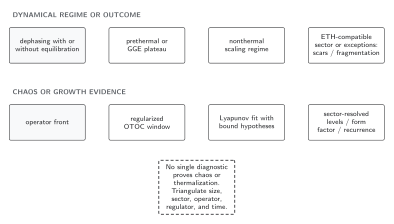
ETH is one possible account of late-time local observables, not a synonym for dephasing or chaos. A convincing ETH test combines diagonal smoothness, off-diagonal scaling, symmetry resolution, and an explicit search for exceptional states. The diagram is schematic: its upper alternatives and lower diagnostics are two independent, arrow-free rows with no universal time ordering.
In text-equivalent form, ETH concerns the energy dependence and entropy scaling of matrix elements. Operator spreading, regularized OTOC growth, level statistics, form factors, and recurrences instead test propagation or spectral correlations, so none substitutes for the matrix-element test.
Exercises
Section titled “Exercises”Show that the off-diagonal ETH scale suppresses the temporal variance for a state spread over comparable levels.
Solution
With and , there are terms, each of size . The total is of order , up to the frequency envelope and correlations. Degenerate gaps or anomalously large elements invalidate this counting and must be tested.
A numerical study finds Gaussian off-diagonal elements but uses the full Hilbert space containing even and odd parity. Diagnose the test.
Solution
It is not an ETH test in a single irreducible sector. Parity selection makes some elements exactly zero and mixes two spectra. Resolve parity, normalize entropy within each sector, and repeat the diagonal and off-diagonal analysis separately.
Continue to exceptions and independent diagnostics
Section titled “Continue to exceptions and independent diagnostics”Scars and fragmentation classify bounded failures of the typical-state expectation. Spectral statistics and OTOCs provide independent spectral and dynamical tests. Model-specific scars, fragmentation, and localization continue in Volume XII.
References
Section titled “References”- D’Alessio, Luca, Yariv Kafri, Anatoli Polkovnikov, and Marcos Rigol. “From Quantum Chaos and Eigenstate Thermalization to Statistical Mechanics and Thermodynamics.” Advances in Physics 65 (2016): 239–362. doi:10.1080/00018732.2016.1198134. Open preprint.
- Deutsch, Josh M. “Quantum Statistical Mechanics in a Closed System.” Physical Review A 43 (1991): 2046–2049. doi:10.1103/PhysRevA.43.2046.
- Rigol, Marcos, Vanja Dunjko, and Maxim Olshanii. “Thermalization and Its Mechanism for Generic Isolated Quantum Systems.” Nature 452 (2008): 854–858. doi:10.1038/nature06838. Open preprint.
- Srednicki, Mark. “Chaos and Quantum Thermalization.” Physical Review E 50 (1994): 888–901. doi:10.1103/PhysRevE.50.888. Open preprint.