

Israel–Stewart, BRSSS, and DNMR Transient Hydrodynamics
Müller–Israel–Stewart, BRSSS, and DNMR are related but nonidentical constructions. MIS promotes dissipative stresses to transient variables constrained by an entropy-current or moment ansatz; BRSSS classifies conformal Landau-frame constitutive data through second order; DNMR derives transient equations and coefficient relations from a specified kinetic moment closure with simultaneous Knudsen and inverse-Reynolds counting.
Required background. Conventional Relativistic Navier–Stokes Instability and Acausality motivates transient completion. Moment Hierarchies and Closure Schemes supplies the kinetic closure logic.
Helpful background. Strong Hyperbolicity, Stability, and Causal Propagation separates the conditions that a transient model must satisfy.
A minimal transient shear channel
Section titled “A minimal transient shear channel”Promote the shear stress to an independent field. In the simplest local rest-frame channel,
while momentum conservation gives
Eliminating yields
The dispersion relation is
At small ,
The hydrodynamic shear pole is preserved, and a nonhydrodynamic relaxation pole appears. The high- characteristic speed in this isolated channel is
Thus and give damping, while causal shear characteristics require . The coupled sound, bulk, heat, and charge sectors impose additional inequalities; this one-channel result is not a complete causality certificate.
Müller–Israel–Stewart
Section titled “Müller–Israel–Stewart”The MIS family introduces independent dissipative quantities such as bulk pressure , heat or diffusion current , and shear stress . Let be the mixed transverse projector and its symmetric transverse-traceless counterpart. Schematically,
The ellipses are not optional decoration. They contain expansion, acceleration, vorticity, cross-coupling, and nonlinear terms whose form depends on the MIS variant and matching assumptions. Israel and Stewart derive a transient thermodynamic/kinetic framework with additional variables and relaxation times Israel and Stewart 1979, §§III–V, pp. 352–372.
“MIS” is therefore a family label. Causality and stability require coefficient and state inequalities; nonlinear well-posedness is established only for particular sectors and formulations. One cannot cite the presence of as a proof.
BRSSS classifies the stress tensor of a conformal fluid in Landau frame through second derivatives. Besides , the flat-space second-order data include a relaxation-type coefficient and nonlinear conformal tensors with coefficients commonly denoted ; curvature response adds . Baier et al. give the complete conformal basis and identify its Kubo and microscopic meaning Baier et al. 2008, §§3–4, pp. 6–17, Open PDF.
As a constitutive gradient expansion, BRSSS does not by itself define an exact hyperbolic evolution equation. A common numerical implementation rewrites part of the constitutive relation as a relaxation equation for . That completion agrees with BRSSS through the declared order but fixes higher-order terms that the second-order basis does not determine.
Consequently:
- BRSSS is conformal; generic bulk dynamics is outside its original scope.
- A BRSSS coefficient is not automatically an MIS entropy-current coefficient with the same name.
- A “BRSSS evolution” must state the particular relaxation completion.
DNMR begins with a relativistic Boltzmann equation and expands the distribution around local equilibrium in irreducible moments. The closure keeps selected dissipative moments as independent variables and counts both
Terms of the same combined order can be lost in a simpler 14-moment or entropy-current truncation. The resulting relaxation times, cross-couplings, and nonlinear coefficients depend on the collision kernel, particle content, moment basis, and truncation. Denicol et al. derive this systematic transient closure and its coefficient relations Denicol et al. 2012, §§II–VI, pp. 2–18, Open PDF.
DNMR is thus a kinetic derivation of a class of transient equations, not a synonym for every second-order hydrodynamic model. Its microscopic origin does not by itself prove nonlinear causality after moment truncation.
Framework dictionary
Section titled “Framework dictionary”| Feature | MIS | BRSSS | DNMR |
|---|---|---|---|
| Primary purpose | Transient irreversible thermodynamics | Complete conformal constitutive basis through second order | Controlled kinetic moment closure |
| Extra variables | Dissipative stresses/fluxes | None in the constitutive classification; often added in a completion | Selected kinetic moments as transient variables |
| Counting | Near-equilibrium/entropy-current or moment assumptions | Derivative expansion and conformal symmetry | Knudsen plus inverse Reynolds |
| Coefficients | Phenomenological or kinetic, variant dependent | Independent conformal transport data | Related by specified collision model and closure |
| Bulk viscosity | Allowed | Zero in conformal theory | Allowed for nonconformal kinetic systems |
| Hyperbolicity | Conditional | Not defined by the gradient basis alone | Conditional after closure |
| Common misuse | Treating one minimal equation as all MIS | Calling any relaxation model BRSSS | Treating kinetic origin as an automatic theorem |
The broader status comparison is in the relativistic hydrodynamic consistency reference.
Bjorken-flow comparison
Section titled “Bjorken-flow comparison”For longitudinal expansion, define the shear correction by
Energy conservation is
A generic transient equation has the structure
Minimal MIS may omit or choose the last terms; a BRSSS completion fixes the conformal second-order combination through its coefficients; DNMR supplies and other terms from the chosen kinetic closure. Matching only and does not make the three evolutions identical.
Use the second and third columns to keep three constructions apart. Inspect which data are independent relaxation variables, which are conformal gradient coefficients, and which arise only after choosing a kinetic or transient closure.
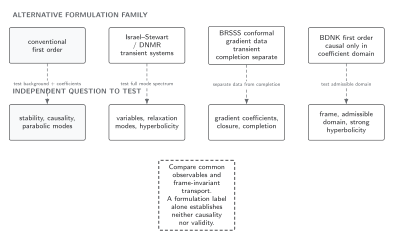
Israel–Stewart promotes dissipative stresses to relaxing variables; BRSSS classifies second-order conformal constitutive data; DNMR derives a particular moment closure and power counting from kinetic theory. A numerical transient implementation of BRSSS adds a completion not fixed by the gradient series alone. The diagram is schematic, and adjacency does not make these frameworks equivalent.
In text: compare the retained variables, counting scheme, relaxation spectrum, nonlinear second-order terms, and coefficient origin. Matching and fixes neither the full transient equations nor their characteristic and stability properties.
Exercise
Section titled “Exercise”For the minimal shear telegrapher system, determine the conditions for damping and subluminal shear characteristics.
Solution
The nonhydrodynamic root at is , so damping requires . The hydrodynamic root is , so with it requires . At large the real part approaches
Hence the isolated shear channel is causal only if
Sound and other channels can impose stronger conditions, so this is necessary for the toy sector, not sufficient for a full theory.
Where this leads
Section titled “Where this leads”BDNK First-Order Causal Hydrodynamics obtains causal characteristics using general-frame constitutive terms rather than independent stress variables. Hydrodynamic Attractors and Asymptotic Gradient Expansions uses transient nonhydrodynamic modes to explain divergent gradient series.
References
Section titled “References”-
Baier, Rudolf, Paul Romatschke, Dam T. Son, Andrei O. Starinets, and Mikhail A. Stephanov. 2008. “Relativistic Viscous Hydrodynamics, Conformal Invariance, and Holography.” Journal of High Energy Physics 2008 (4): 100. DOI. Open PDF.
-
Denicol, Gabriel S., Harri Niemi, Etele Molnár, and Dirk H. Rischke. 2012. “Derivation of Transient Relativistic Fluid Dynamics from the Boltzmann Equation.” Physical Review D 85: 114047. DOI. Open PDF.
-
Israel, Werner, and John M. Stewart. 1979. “Transient Relativistic Thermodynamics and Kinetic Theory.” Annals of Physics 118: 341–372. DOI.