

Conserved Charges and Grand-Canonical States
A conserved charge may enter an equilibrium statistical operator when it is a well-defined physical observable, commutes with the Hamiltonian, and the resulting modular generator is stable enough to define a normalized state. Several ordinary chemical potentials also require a compatible commuting charge family. Gauge constraints, anomalous nonconservation, unbounded charge-to-energy ratios, and superselection can forbid or qualify the construction.
The grand-canonical operator construction and charge-sector assumptions used here are summarized in Kapusta and Gale 2006, chs. 1–2.
Required background. Thermal Density Operators and the KMS Condition supplies Gibbs and KMS equilibrium. Continuous Symmetries, Generators, and Charges fixes charge normalization and conservation. Helpful background. Coupling to Background Gauge Fields and Bundles gives the source interpretation.
The grand-canonical generator
Section titled “The grand-canonical generator”For mutually commuting conserved charges ,
define
The trace exists in a finite regulated system only if is trace class. In practice this requires a stable spectrum: one cannot choose so that states of increasing charge drive without bound. For a relativistic boson carrying charge , this is the origin of the normal-phase threshold before interactions and condensation are treated.
is stationary under both and when all charges commute. Correlation formulas must nevertheless state which generator defines time. Physical real-time response normally uses ; modular or grand-canonical evolution uses and absorbs chemical twists into frequencies.
Thermodynamics and the first law
Section titled “Thermodynamics and the first law”The grand potential
obeys, for a homogeneous equilibrium state,
The Legendre transform gives
These differentials assume a fixed charge basis and fixed external background fields. If charges mix under renormalization or a source changes the Hamiltonian explicitly, the work terms and contact contributions must be included before differentiating.
Which charges are admissible?
Section titled “Which charges are admissible?”Exact conservation. A charge with does not define a stationary chemical potential. An approximately conserved charge can support a prethermal or hydrodynamic variable on bounded timescales, but not an exact equilibrium ensemble without an error estimate.
Gauge constraints. A local gauge generator annihilates physical states by Gauss’s law and is not an ordinary global thermodynamic charge. Chemical potentials couple to genuine global charges, boundary charges, or gauge-invariant conserved numbers after the physical Hilbert space and boundary conditions are fixed.
Anomalies. A classically conserved current may fail quantum mechanically. One may introduce a source for response bookkeeping, but an anomalous charge does not automatically label equilibrium superselection sectors.
Superselection. If observables cannot connect charge sectors, a grand-canonical state is a classical mixture across them. A fixed-charge preparation instead uses the canonical sector; equivalence requires a thermodynamic-limit argument.
Noncommutation. Charges that fail to commute cannot be assigned simultaneous sharp values. A maximum-entropy exponential may still be formed from their expectation constraints, but its interpretation differs and is treated on Noncommuting Charges and Generalized Gibbs States.
Charged scalar stability check
Section titled “Charged scalar stability check”For a free complex scalar, particle and antiparticle modes contribute grand energies
Normalizability of each bosonic geometric series requires both be positive. Since ,
in the uncondensed finite-volume ensemble. Equality makes the lowest occupation diverge in the idealized thermodynamic limit and signals that the assumed phase must be reorganized. The chemical potential has not made a negative-energy particle; it has made the chosen no-condensate grand-canonical description unstable.
The schematic below organizes the relationships used on this page. Inspect it with this question in mind: Which charge structures license chemical potentials or generalized equilibrium states?
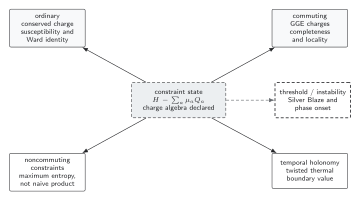
A grand-canonical state requires conserved charges and a declared algebra; commuting integrable charges, noncommuting constraints, temporal holonomies, and density thresholds demand distinct constructions and checks. Connections classify the charge structure and required construction; their direction is organizational, not a causal-time ordering. Dashed marks show qualifications and failure boundaries. The diagram is schematic and not to scale.
The surrounding discussion supplies the relevant equations and checks in text form; the figure is a navigational summary.
Exercise
Section titled “Exercise”Show that adding to and to the chemical potential leaves unchanged. Why can physical real-time spectra still notice the redefinition?
Solution
With and , , so the state is unchanged. Physical time evolution generated by gives a charge-dependent phase relative to . Thus grand-canonical equilibrium is invariant while the convention used to label physical frequencies changes; a charged spectral function must state its generator.
References
Section titled “References”- Kapusta, Joseph I., and Charles Gale. Finite-Temperature Field Theory: Principles and Applications. 2nd ed. Cambridge: Cambridge University Press, 2006. doi:10.1017/CBO9780511535130.
- Le Bellac, Michel. Thermal Field Theory. Cambridge: Cambridge University Press, 1996. doi:10.1017/CBO9780511721700.
- Weinberg, Steven. The Quantum Theory of Fields, Volume II: Modern Applications. Cambridge: Cambridge University Press, 1996. doi:10.1017/CBO9781139644174.