

Transport Sum Rules and Ultraviolet Constraints
A transport sum rule relates an integral of spectral weight to equal-time commutators, Ward identities, thermodynamics, or ultraviolet asymptotics. It is exact only after all required contacts and subtractions are specified and the integral is shown to converge. A sum rule constrains a spectrum; it does not reconstruct the distribution of weight or prove that a truncated peak ansatz is complete.
Required background. Spectral functions and transport peaks distinguishes the singular structures whose weights enter a sum rule. Spectral positivity and sum rules derives the Lehmann and dispersion representations. Helpful background. Free-Field OPE Preview introduces short-distance expansions; interacting Wilson coefficients and operator mixing must be taken from the theory at hand.
Dispersion relations and necessary subtractions
Section titled “Dispersion relations and necessary subtractions”Analyticity of a retarded correlator in the upper half-plane gives
where collects local contacts and subtraction terms required by the large- behavior. If grows too rapidly, an unsubtracted integral is undefined even when its low-frequency part is finite.
A robust strategy is to take a difference between two states or channels whose leading ultraviolet terms cancel. If approaches a finite constant at imaginary infinity and is odd, then
The minus sign follows from the site’s convention. For the physical response , the corresponding sign changes after the contact is included. Romatschke and Son derive thermal stress-channel examples and show explicitly why ultraviolet subtractions are part of the statement Romatschke and Son 2009, §§II–IV, Open PDF.
Moments from commutators and Ward identities
Section titled “Moments from commutators and Ward identities”When the moments converge, expanding at large gives
The same coefficients follow from repeated time derivatives of the commutator and hence from equal-time operator algebra. Conservation laws relate density and current correlators, while gauge and diffeomorphism Ward identities fix longitudinal pieces and some contacts. A regulator must preserve or correctly repair those identities; otherwise a formally convergent numerical moment can have the wrong value.
For a Galilean-invariant continuum of particles of charge , density , and mass , the optical -sum rule is
The integral includes half of a delta function located at the endpoint. On a lattice the right-hand side is instead an expectation value of the kinetic or stress operator; in a multiband system interband weight participates. Reusing the continuum formula in those settings is incorrect Mahan 2000, ch. 3.
Ultraviolet tails from the operator product expansion
Section titled “Ultraviolet tails from the operator product expansion”At large timelike frequency, the short-distance operator product expansion organizes a thermal correlator as
Wilson coefficients determine powers and logarithms of ; state-dependent expectation values determine the thermal correction. Operator mixing, running couplings, and contact terms must be treated in the same scheme. Caron-Huot shows how these asymptotics constrain thermal spectral functions and why vacuum subtraction can expose the leading state-dependent tail Caron-Huot 2009, §§II–IV, Open PDF.
The OPE is asymptotic, not a model for the entire intermediate-frequency spectrum. Matching a low-frequency transport ansatz directly to its leading term without an overlap window and truncation uncertainty can create a fictitious saturation of the sum rule.
Infrared and ultraviolet bookkeeping
Section titled “Infrared and ultraviolet bookkeeping”Split a convergent integral at a scale chosen inside an overlap region,
Hydrodynamics or a resolved transport model controls the first term, the OPE or perturbation theory controls the second, and records the region controlled by neither approximation. Varying within the overlap is a useful check, not a substitute for estimating the truncation errors in both descriptions.
At finite density, new operator expectation values and exact Drude weight can move spectral weight without violating the total constraint. A subtracted channel may also lose positivity even when each underlying diagonal spectrum is positive. Positivity should therefore never be imposed on a difference unless it is independently established.
The transport-extraction covariance reference records the sum rule, subtractions, ultraviolet model, covariance, resolution, continuum limit, and cross-checks used in an extraction.
Failure test: an incomplete peak ansatz
Section titled “Failure test: an incomplete peak ansatz”Suppose a fit uses only
Its positive-frequency area is , independent of . If the exact -sum requires , choosing saturates the integral. This does not prove that the spectrum is a single Drude peak: any interband or ultraviolet weight forces a smaller Drude weight, and many different low-frequency shapes have the same area. The sum rule rejects inconsistent total weight but does not identify its distribution.
Common pitfalls
Section titled “Common pitfalls”Writing an unsubtracted relation from analyticity alone. Analyticity determines the dispersion form only after the behavior at infinity is controlled. Polynomial contacts and OPE tails decide how many subtractions are needed.
Dropping a zero-frequency delta function. Exact conserved overlap contributes to spectral moments. Removing it changes the sum rule unless the right-hand side is modified consistently.
Treating apparent saturation as reconstruction. A model can satisfy several moments while having the wrong dc slope or intermediate-frequency structure. Resolution and mock-data tests remain necessary.
The spectral box in the chain groups the constraints studied here. Inspect its placement before inverse inference: exact moments and ultraviolet asymptotics restrict the admissible spectra supplied to an extraction, but they do not predetermine the low-frequency distribution.
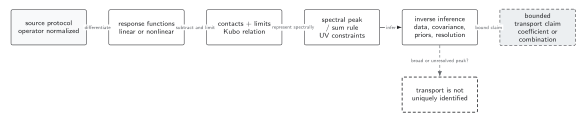
Dispersion relations, commutator moments, Ward identities, and OPE tails constrain an already normalized and contact-subtracted response. They can reject inconsistent spectral weight or bound a smeared combination, but several low-frequency shapes may obey the same constraints. The diagram is schematic and does not encode the number of subtractions or the infrared–ultraviolet matching scale.
In text: determine the asymptotic falloff and required subtractions, derive the exact moment in the same operator convention, separate any Drude delta function, match infrared and ultraviolet descriptions with a varied intermediate scale, and pass the allowed family—not a single presumed peak—to the inverse analysis.
References
Section titled “References”- Caron-Huot, Simon. 2009. “Asymptotics of Thermal Spectral Functions.” Physical Review D 79 (12): 125009. DOI. Open PDF.
- Mahan, Gerald D. 2000. Many-Particle Physics. 3rd ed. New York: Kluwer Academic/Plenum. DOI.
- Romatschke, Paul, and Dam Thanh Son. 2009. “Spectral Sum Rules for the Quark–Gluon Plasma.” Physical Review D 80 (6): 065021. DOI. Open PDF.
Diffusion, Conductivity, and Susceptibility relates the low-frequency pole data to thermodynamic matrices. Transport Extraction, Inverse Problems, and Error Budgets uses sum rules as constraints while testing how much information they actually add.