

Superfluid Hydrodynamics and Goldstone Modes
A relativistic superfluid retains the ordinary temperature, chemical potential, and normal velocity and adds the phase of a spontaneously broken continuous symmetry. Its gauge-covariant gradient carries superflow, the Josephson relation supplies its time evolution, and entrainment couples it to the normal component. Two longitudinal sound branches follow generically; vortices, explicit breaking, and dissipation require additional sectors.
Required background. Goldstone’s Theorem: Hypotheses and Pole Argument supplies the gapless phase. Hydrodynamic Frames and Constitutive Data supplies frame transformations.
Helpful background. Strong Hyperbolicity, Stability, and Causal Propagation supplies the characteristic checks required beyond the ideal modes.
Phase, Josephson relation, and superflow
Section titled “Phase, Josephson relation, and superflow”For a broken with phase , define
A gauge transformation of is compensated by one of . Decompose the phase gradient relative to the normal velocity:
The first equation is the ideal Josephson relation in the phase convention chosen here. With the site’s positive rest-space projector, the second definition gives . Reversing the definition of reverses both and the associated current; physical winding and response are unchanged.
Let
In a useful thermodynamic frame, the ideal first law and constitutive tensors can be written
Here is the superfluid stiffness in this normalization, not a Lorentz-scalar particle count independent of convention. The cross term is entrainment: energy carried by relative superflow prevents a decomposition into two noninteracting fluids. Bhattacharya et al. derive the general relativistic superfluid constitutive system and its frame/entropy constraints Bhattacharya et al. 2014, §§2–4, Open PDF.
Why there are two sounds
Section titled “Why there are two sounds”At zero background superflow, longitudinal normal compression and the Goldstone phase mix. Any stable quadratic ideal theory for the two scalar amplitudes can be put in the form
where is the susceptibility/inertia matrix and is the stiffness matrix obtained from the equation of state and . A plane wave obeys
Let . The two sound speeds are
Positive definite and give real positive speeds; relativistic causality additionally requires both . In the weak-mixing limit, first sound is mainly density/pressure oscillation and second sound mainly counterflow/entropy–phase oscillation. Away from that limit the names label eigenmodes, not pure variables.
Alford et al. compute the entrainment and both sound speeds in a weakly coupled relativistic field theory, illustrating how the abstract thermodynamic matrices are obtained microscopically Alford et al. 2013, §§III–V, Open PDF.
Dissipation, vortices, and explicit breaking
Section titled “Dissipation, vortices, and explicit breaking”First derivative order adds ordinary viscosities plus several superfluid conductivities and Josephson-dissipation terms. Positivity constrains a matrix, not one coefficient. A causal exact evolution also needs a transient or hyperbolic completion; real ideal sound speeds do not supply it.
The smooth-phase description assumes
with no singular vortex contribution. Vortex worldsheets add quantized circulation and mutual-friction dynamics. Weak explicit breaking gives the phase a pinning or relaxation scale and converts strict superfluid hydrodynamics into a quasihydrodynamic theory. Above the superfluid transition and the extra phase is not an independent hydrodynamic variable.
The upper superfluid branch isolates the new variable used on this page. Inspect its Goldstone-phase and Josephson labels, and compare them with the neighboring anomalous branch, which changes Ward identities but does not require the phase.
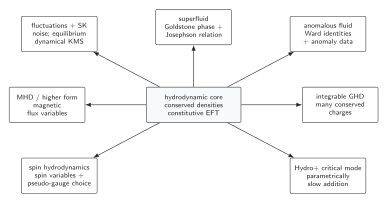
Spontaneous breaking adds the Goldstone phase, its gauge-invariant gradient, and the Josephson equation to the normal-fluid variables. Entrainment then produces two longitudinal sound branches. The diagram is schematic and does not display vortices, explicit breaking, mutual friction, or the disappearance of the phase variable above the transition.
In text: evolve the normal densities and velocity together with , impose at ideal order, close the current and stress with superfluid-density data, and include vortex or pinning dynamics when irrotational Goldstone hydrodynamics fails.
Exercise
Section titled “Exercise”Let and
Find the sound speeds and the stability range.
Solution
The matrix
has trace and determinant . Therefore
Positive definiteness of requires , or . In that range both speeds are positive; the largest is also below one. At the boundary the slower mode softens to zero, signaling loss of thermodynamic stability rather than dissipation.
Common pitfalls
Section titled “Common pitfalls”Adding a second velocity without a Goldstone. The phase and its gauge-covariant gradient are the symmetry reason for superflow.
Calling first and second sound pure density and entropy waves. Entrainment generally mixes them.
Applying the smooth-phase equations through vortices. Defects add singular circulation and new constitutive data.
Where this leads
Section titled “Where this leads”Magnetohydrodynamics and Higher-Form Symmetries treats a different conserved flux sector. The phase-stiffness and vortex realization is developed in Superfluid Order, Stiffness, and Vortices.
References
Section titled “References”-
Alford, Mark G., S. Kumar Mallavarapu, Andreas Schmitt, and Stephan Stetina. 2013. “Relativistic Superfluid Hydrodynamics from Field Theory.” Physical Review D 87: 065010. DOI. Open PDF.
-
Bhattacharya, Jyotirmoy, Sayantani Bhattacharyya, Shiraz Minwalla, and Amos Yarom. 2014. “A Theory of First Order Dissipative Superfluid Dynamics.” Journal of High Energy Physics 2014 (5): 147. DOI. Open PDF.