

Chemical Potentials as Temporal Gauge Fields and Holonomies
A chemical potential is the temporal component of a background connection in the grand-canonical Euclidean action. In the convention , it can be removed locally by a nonperiodic field redefinition; the resulting -free field obeys the inverse-holonomy condition . For imaginary chemical potential the gluing is unitary, and large gauge transformations identify its period according to the faithfully represented charge lattice and global form.
The periodicity and phase structure induced by imaginary temporal holonomy are established by Roberge and Weiss 1986, §§ 2–4, pp. 734–745.
Required background. Chemical Potentials and Finite-Density Ensembles fixes the charge and Euclidean derivative convention. Coupling to Background Gauge Fields and Bundles supplies the geometric source. Helpful background. Global Form, Matter Representations, and the Faithful Gauge Group explains charge-lattice and center identifications.
From the grand-canonical trace to a background connection
Section titled “From the grand-canonical trace to a background connection”For a charged complex scalar, the Euclidean quadratic term is not an ordinary absolute square when is real. A convention displaying the two charge signs is
This convention corresponds to an imaginary Euclidean background gauge field when the covariant derivative is written : namely . Its Wilson line on a charge- representation is . Other Wick-rotation conventions can reverse both signs; the invariant checkpoints are the occupation factor and the relation between the Wilson line and the gluing condition.
Make the nonperiodic change of variables
Then , while an originally periodic boson yields
Thus the -free variable has gluing , not . With the Euclidean expansion , its frequencies are ; equivalently, the periodic variable is acted on by . Reversing the charge convention or the sign in reverses both the twist and the frequency shift. The chapter convention table fixes the choice used when comparing pages.
Imaginary chemical potential and large gauge transformations
Section titled “Imaginary chemical potential and large gauge transformations”Set
The Wilson holonomy seen by charge and the gluing of the -free field are, respectively,
If the smallest faithfully represented charge is , the global- partition function is periodic under
in that charge normalization. A rescaling of changes both and , leaving invariant.
For non-Abelian gauge theory, a gauge transformation that is periodic only up to a center element can act nontrivially on matter boundary conditions. The resulting periodicity depends on the global gauge group and matter representations. In gauge theory with fundamental quarks, Roberge and Weiss found the familiar center-related imaginary-quark-chemical-potential structure Roberge and Weiss 1986; it should not be exported to another global form by slogan.
Holonomy is not always removable
Section titled “Holonomy is not always removable”A constant is locally pure gauge, but the thermal circle is noncontractible. A periodic gauge transformation cannot remove a holonomy outside its large-gauge equivalence class. Thus the Polyakov loop and eigenvalue distribution can carry physical information even when the local field strength vanishes.
If the current is anomalous, the would-be transformation can change the quantum effective action. If the charge is gauged rather than global, Gauss constraints and integration over enforce neutrality conditions. If is real, the holonomy is nonunitary and analytic continuation from imaginary is limited by intervening singularities.
Round-trip checks
Section titled “Round-trip checks”- Derive directly from .
- Gauge away the constant connection and recover the declared twist.
- Fourier expand the twisted field and recover .
- Check invariance under the correct large-gauge period of the faithful charge lattice.
- Continue to real only inside an analyticity domain established independently.
The schematic below organizes the relationships used on this page. Inspect it with this question in mind: Which charge structures license chemical potentials or generalized equilibrium states?
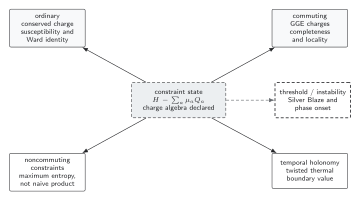
A grand-canonical state requires conserved charges and a declared algebra; commuting integrable charges, noncommuting constraints, temporal holonomies, and density thresholds demand distinct constructions and checks. Connections classify the charge structure and required construction; their direction is organizational, not a causal-time ordering. Dashed marks show qualifications and failure boundaries. The diagram is schematic and not to scale.
The surrounding discussion supplies the relevant equations and checks in text form; the figure is a navigational summary.
Exercise
Section titled “Exercise”A boson satisfies . Find its Euclidean frequencies in the convention .
Solution
The boundary condition requires , so . Shifting by relabels and leaves the spectrum invariant. A different sign in the Fourier exponent reverses the displayed shift but not the holonomy.
References
Section titled “References”- Roberge, André, and Nathan Weiss. “Gauge Theories with Imaginary Chemical Potential and the Phases of QCD.” Nuclear Physics B 275, no. 4 (1986): 734–745. doi:10.1016/0550-3213(86)90196-1.
- Weiss, Nathan. “The Effective Potential for the Order Parameter of Gauge Theories at Finite Temperature.” Physical Review D 24, no. 2 (1981): 475–480. doi:10.1103/PhysRevD.24.475.