

Anomalous Charge Violation, Baryogenesis, and Cosmological Interfaces
Thermal QFT can supply anomalous diffusion rates, thermodynamic functions, wall profiles and velocities, nucleation histories, and transport coefficients. It cannot by itself supply a baryon asymmetry, gravitational-wave spectrum, or successful cosmological history. Those conclusions require separate CP-violating sources, transport and washout equations, magnetohydrodynamics or gravity, and uncertainty propagation.
Required background. Use percolation, reheating, and completion for transition histories and consistent versus covariant anomalies for current normalization.
Helpful background. Ultrasoft color and Bödeker theory controls the nonperturbative real-time gauge sector relevant to hot anomalous diffusion.
What an anomalous rate actually measures
Section titled “What an anomalous rate actually measures”In the electroweak theory, changes of the SU(2) Chern–Simons number satisfy
for fermion generations under the standard current normalization. The equilibrium Chern–Simons diffusion rate is
This is a variance growth rate in an equilibrium ensemble. It describes unbiased diffusion between topological sectors. A directed baryon asymmetry requires a CP-odd bias or chemical potential and a transport network; multiplying by a CP phase without deriving the response coefficient is not sufficient.
In the symmetric high-temperature non-Abelian plasma, the leading weak-coupling rate is governed by ultrasoft classical gauge dynamics with color conductivity, not by a single static sphaleron saddle. Bödeker’s effective theory identifies this hierarchy Bödeker 1998. In the broken phase, a thermally activated sphaleron picture can yield exponential suppression, but its energy, determinant, real-time prefactor, and gauge/EFT control must be treated consistently. Interpolating between regimes is a physics problem, not a choice of fit curve.
CP sources and washout are separate calculations
Section titled “CP sources and washout are separate calculations”During a first-order transition, spacetime-dependent complex masses or interactions across the wall can generate CP-odd sources. Their form depends on wall thickness, coherence, flavor mixing, collision terms, and the basis used to separate densities. Semiclassical-force, vev-insertion, closed-time-path, and density-matrix treatments have different control regimes; agreement cannot be assumed.
A schematic downstream network is
supplemented by anomalous violation and conservation constraints. The final asymmetry depends on the source, diffusion constants, reaction matrix, wall profile and speed, symmetric-phase anomalous rate, broken-phase washout, expansion, and entropy history. Thermal-QFT inputs become a result only after this system is solved and its approximations validated.
The anomaly equation fixes exact charge nonconservation coefficients after conventions are fixed; it does not fix the finite-temperature transition rate. Conversely, a measured diffusion rate does not determine whether the generated charge survives behind the wall.
The last arrow in the diagram is an interface, not an inference shortcut. A completed thermal transition can supply background and wall histories, but anomalous charge violation, CP-odd sources, washout, and any final cosmological observable remain separately model-dependent calculations.
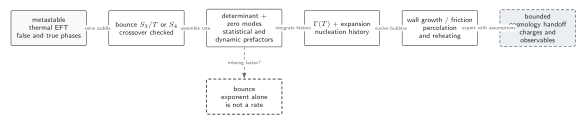
The chain connects nucleation to cosmological predictions: saddle and prefactors determine the rate, expansion and wall dynamics determine completion, and only then may a cosmology calculation import the resulting histories. The final dashed box does not assert baryogenesis, charge survival, or an observable signal; each requires its own transport, washout, model, and uncertainty analysis. The diagram is schematic and not to scale.
The sections What an anomalous rate actually measures, CP sources and washout are separate calculations, and Completion and cosmological boundaries give the same connection and its limits in prose and equations.
Inputs for a cosmological calculation
Section titled “Inputs for a cosmological calculation”Export quantities with physical metadata rather than a benchmark label alone:
| Quantity | Required definition and regime | Uncertainty or covariance | Downstream use | Conclusion not yet established |
|---|---|---|---|---|
| $\Gamma_{\mathrm{CS}}(T)$ | Current normalization, volume/time limit, symmetric or broken regime, coupling scheme | Continuum, volume, matching, statistical, interpolation | Anomalous source and washout terms | Magnitude or sign of a baryon asymmetry |
| Wall profile and $v_w$ | Frame, fields or gauge-invariant variables, temperatures on both sides, friction closure | Equation of state, collision model, gauge/EFT, branch stability | CP source and diffusion residence time | Successful transport or absence of runaway |
| $\Gamma_{\mathrm{nuc}}(T)$ and bubble history | Full prefactor, background history, growth law, overlap convention | Action–prefactor covariance, reheating, percolation model | Source volume, duration, length scales | Transition completion or a signal spectrum unless separately computed |
| Thermodynamics | $p,e,w,c_s$ by phase in one renormalization and gauge-consistent scheme | Scale, matching, lattice/perturbative systematics | Hydrodynamics and cosmological expansion | Efficiency factors or gravitational-wave amplitude |
| Transport matrix | Charge basis, frame, frequency/momentum limit, collision operator | Truncation, coherence, leading-log or nonperturbative range | Diffusion and washout network | Final conserved charge without solving the coupled network |
Each dataset should carry units, normalization, parameter point and allowed range, renormalization scale and scheme, gauge/EFT treatment, numerical cutoff and continuum status, evidence date, and correlations among quantities. The shared thermal transition validity table supplies the upstream checks.
Completion and cosmological boundaries
Section titled “Completion and cosmological boundaries”A cosmological calculation must use the actual temperature and expansion history, including vacuum domination and reheating. A transition that nucleates but does not complete cannot be assigned the same source volume or duration as a completed one. A completed transition still does not guarantee an observable signal: sound-wave lifetime, turbulence, magnetic fields, detector response, and foregrounds are separate layers.
For baryogenesis, the broken-phase anomalous rate must be small enough on the relevant history to avoid washout, but simple background ratios such as are gauge dependent and only proxy the physical suppression. Use a gauge-invariant sphaleron energy or a controlled EFT/lattice criterion when making a survival statement.
Failure tests
Section titled “Failure tests”- Verify the anomaly coefficient and whether the current is consistent or covariant.
- Distinguish equilibrium diffusion from biased nonequilibrium response.
- Match the CP-source method to , collision, and coherence hierarchies.
- Solve the coupled transport network and vary all reaction and diffusion inputs coherently.
- Use the full completion and reheating history.
- Date evolving rate inputs and do not extrapolate beyond their coupling or temperature range.
- State the strongest result that survives upstream and downstream uncertainties; do not promote an input table to a phenomenological detection claim.
Exercise
Section titled “Exercise”If one SU(2) transition changes by one in the Standard Model with , what are , , and ?
Solution
, , and therefore . The anomaly violates but preserves in this sector.
Continue
Section titled “Continue”To predict a cosmological observable, use a separately specified baryogenesis, hydrodynamic-signal, gravitational-wave, or cosmological evolution calculation that consumes the exported quantities and propagates their correlated uncertainties.
References
Section titled “References”- Arnold, P., and McLerran, L. (1987). “Sphalerons, Small Fluctuations, and Baryon-Number Violation in Electroweak Theory.” Physical Review D 36, 581–595. DOI.
- Bödeker, D. (1998). “Effective Dynamics of Soft Non-Abelian Gauge Fields at Finite Temperature.” Physics Letters B 426, 351–360. arXiv:hep-ph/9801430; DOI.
- Klinkhamer, F. R., and Manton, N. S. (1984). “A Saddle-Point Solution in the Weinberg–Salam Theory.” Physical Review D 30, 2212–2220. DOI.