

Conserved-Charge Fluctuations and Criticality
Conserved-charge fluctuations connect QCD thermodynamics to experiment only through a sequence of maps: equilibrium susceptibilities to finite-volume cumulants, conserved charges to measurable proxies, the fireball to a finite detector acceptance, and critical equilibrium fluctuations through nonequilibrium evolution. Higher cumulants are sensitive to criticality, but they are also unusually sensitive to efficiency, volume fluctuations, global conservation, and noncritical correlations.
Required background. Crossover thermodynamics supplies the phase boundary and shared phase-and-charge provenance table. Dynamic universality supplies critical slowing. Helpful background. Hydro+ supplies one controlled language for slow critical modes coupled to expansion.
Evidence status on this page was checked through 10 August 2026.
From susceptibilities to cumulants
Section titled “From susceptibilities to cumulants”For an equilibrium grand-canonical system,
when is the measured conserved charge and conventions are aligned. Volume-independent ratios include
The volume cancellation is exact only for a homogeneous grand-canonical ensemble with fixed volume. A collision centrality bin contains fluctuating geometry and stopping, so residual volume cumulants enter nonlinear combinations. Ratios do not automatically remove them.
Experimental net-proton number is a proxy, not net baryon number. Isospin randomization, unmeasured neutrons, weak-decay feed-down, baryon annihilation, and acceptance affect the map Kitazawa and Asakawa 2012. Net kaons and net charge similarly differ from exact strangeness and electric charge.
Acceptance, efficiency, and baselines
Section titled “Acceptance, efficiency, and baselines”Let an independently detected particle be accepted with probability . Factorial cumulants transform simply as
under the binomial-response assumption. Ordinary cumulants mix orders, and real detectors have momentum-, species-, occupancy-, and run-dependent response. The response model therefore needs closure tests; dividing a high-order cumulant by is justified only for the appropriate factorial quantity under that model.
Acceptance also sets a physical coarse-graining scale. A very small rapidity window approaches Poisson/binomial sampling; a very large one feels exact global charge conservation. Diffusion between chemical and kinetic freeze-out changes correlations across the window. A meaningful energy dependence keeps or models the acceptance consistently.
Useful noncritical baselines include independent Poisson production (Skellam net distribution), binomial baryon conservation, resonance decays, hadronic transport, participant fluctuations, and stopping correlations. Deviating from one baseline rejects that baseline—not all noncritical physics.
Critical scaling and finite time
Section titled “Critical scaling and finite time”Near an equilibrium critical point, the correlation length grows and higher cumulants can scale with high powers of ; for example, schematic static arguments give stronger sensitivity for than Stephanov 2009. But the relaxation time also grows,
so an expanding fireball falls out of equilibrium. Finite lifetime and volume bound ; memory and sign changes can make a measured cumulant differ from its equilibrium value on the same trajectory. A critical interpretation therefore needs a dynamical model, not merely an equilibrium susceptibility curve.
Current beam-energy evidence
Section titled “Current beam-energy evidence”STAR’s Beam Energy Scan I reported nonmonotonic energy dependence of central-collision net-proton within a defined acceptance STAR 2021. That measurement was an important motivation for higher-statistics BES-II analyses, but it did not establish a critical point because alternative baselines, acceptance dependence, and dynamical mapping remained.
In June 2026, STAR published fifth- and sixth-order BES-II (net-)proton results for –27 GeV. Within current uncertainties, the reported high-order ratios and factorial cumulants did not show the sign-alternating two-component pattern tested in that analysis and were compatible with multiple lattice, functional, hadron-resonance-gas, or transport expectations in different energy ranges STAR 2026. Compatibility with several qualitatively different calculations is evidence of limited discrimination, not confirmation of each model.
Thus the defensible status at the cutoff is: conserved-charge measurements constrain the phase diagram and critical dynamics, but no QCD critical point has been discovered.
A comparison protocol
Section titled “A comparison protocol”Before comparing to , record every field in the shared provenance table and then:
- impose the experimental , species, feed-down, and centrality definition on the model;
- propagate efficiency through a validated response;
- include global conservation, volume/stopping fluctuations, and hadronic evolution;
- evolve critical modes with finite relaxation time;
- use a covariance across orders, acceptances, and beam energies;
- compare critical and noncritical models with the same nuisance treatment.
Equilibrium susceptibilities and collision cumulants enter the evidence map at different stages and cannot be equated without a dynamical and acceptance map.
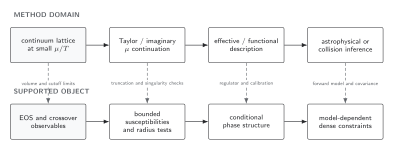
The lower-row susceptibility node is an equilibrium object whose lattice determination requires continuum and truncation tests. Experimental net-particle cumulants lie in the far-right inference domain because they are finite-time, finite-acceptance observables after evolution and detection. A nonmonotonic cumulant ratio therefore does not by itself locate a critical point. The diagram is schematic and does not identify measured proton cumulants with baryon susceptibilities.
The text equivalent is to carry susceptibilities through a declared dynamical evolution, freeze-out prescription, conservation and acceptance corrections, proxy relation, efficiency response, and full covariance. Competing critical and noncritical models must be compared with the same treatment.
The corrected probe map gives conserved-charge cumulants their own branch, distinct from the quarkonium and open-heavy-flavor sectors.
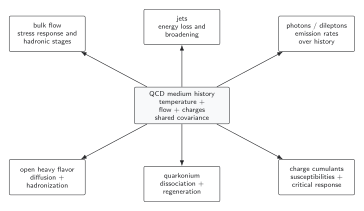
Charge cumulants inherit equilibrium susceptibilities only after critical slowing down, diffusion, conservation, freeze-out, proxy choice, acceptance, and detector response are modeled. The separate quarkonium node concerns bound-state dissociation and regeneration and carries no direct cumulant interpretation. Joint inference can exploit the shared medium history only while preserving each branch’s kernel, nuisance parameters, covariance, and evidence date. The diagram is schematic and not to scale.
In text, the experimental branch begins with event-by-event conserved-charge proxies and ends with efficiency-corrected cumulants; connecting it to the phase diagram requires an explicit dynamical response. Compatibility with a critical calculation is not discovery when noncritical baselines remain viable.
Exercises
Section titled “Exercises”1. Skellam baseline. If protons and antiprotons are independent Poisson variables with means and , find the net-proton cumulants.
Solution
The cumulant generator is . Therefore : odd cumulants are the mean difference and even cumulants are the sum. In particular .
2. Evidence language. A measured ratio disagrees with a Skellam baseline at three standard deviations but agrees with a hadronic transport model. What follows?
Solution
The independent-Poisson baseline is disfavored under the stated covariance. Criticality is not established because a noncritical model describes the result. One must test that model’s other predictions and compare alternatives under common acceptance and nuisance assumptions.
Continue to dense-QCD access for the larger- theory boundary.
References
Section titled “References”- Bzdak, Adam, ShinIchi Esumi, Volker Koch, Jinfeng Liao, Mikhail Stephanov, and Nu Xu. “Mapping the Phases of Quantum Chromodynamics with Beam Energy Scan.” Physics Reports 853 (2020): 1–87. DOI.
- Kitazawa, Masakiyo, and Masayuki Asakawa. “Revealing Baryon Number Fluctuations from Proton Number Fluctuations in Relativistic Heavy Ion Collisions.” Physical Review C 86, no. 2 (2012): 024904. DOI.
- STAR Collaboration. “Measurement of Fifth- and Sixth-Order Fluctuations of (Net-)Proton Number in Au+Au Collisions from Phase II of the Beam Energy Scan Program at RHIC.” Physical Review C 113 (2026): 051901. DOI.
- STAR Collaboration. “Nonmonotonic Energy Dependence of Net-Proton Number Fluctuations.” Nature 589 (2021): 211–215. DOI.
- Stephanov, Mikhail A. “Non-Gaussian Fluctuations near the QCD Critical Point.” Physical Review Letters 102, no. 3 (2009): 032301. DOI.