

Driven-Dissipative Steady States and Criticality
Drive, loss, pumping, and noise can select stationary states and critical behavior with no equilibrium free-energy principle. The decisive objects are the zero modes and low-lying spectrum of the Liouvillian, together with the long-distance Schwinger–Keldysh action. Equilibrium universality is recovered only if the infrared theory develops the relevant detailed-balance or dynamical-KMS symmetry; an apparent low-frequency temperature is not enough.
Required background. Lindblad field dynamics defines the regulated generator and open Schwinger–Keldysh actions organize its response and noise vertices. Helpful background. Universality classes and scaling functions provides the finite-size and RG language used below.
Steady states and the Liouvillian spectrum
Section titled “Steady states and the Liouvillian spectrum”For a time-independent Markov generator,
At finite regulated size, write nonzero eigenvalues as with . The Liouvillian gap
sets the longest exponential relaxation time when the relevant eigenmode has nonzero overlap with the preparation and observable. A small gap can produce long-lived metastability; a dissipative phase transition requires nonanalytic behavior in an explicitly defined thermodynamic or large-occupation limit, normally accompanied by gap closing or degeneracy of stationary sectors.
The order of limits matters. At fixed finite size, a primitive Liouvillian generally has one smooth stationary state. A first-order transition can appear through two metastable manifolds whose switching time grows rapidly with size:
Hysteresis under a finite-rate sweep can diagnose metastable switching, but by itself it is not a thermodynamic singularity. Time-resolved tomography of a superconducting Duffing oscillator, for example, resolved two long-lived components inside a unique finite-system state Chen et al. 2023. A 2025 two-photon Kerr-resonator experiment observed model-specific first- and second-order signatures and critical slowing over a controlled parameter scaling Beaulieu et al. 2025. These results establish those engineered finite-component scaling protocols, not a universal class for arbitrary open fields.
Dark, absorbing, and oscillatory states
Section titled “Dark, absorbing, and oscillatory states”A pure dark state satisfies
Then is stationary. The condition does not prove uniqueness: disconnected dark sectors, symmetries, or conserved quantities can produce a stationary manifold. Preparation determines which component is reached.
An absorbing state is a configuration from which the stochastic or quantum dynamics cannot escape. Near a continuous absorbing transition, the noise often vanishes with the activity, so replacing it by additive white noise changes the universality problem. Directed-percolation scaling is expected only under conditions such as a single scalar order parameter, short-range dynamics, no extra conservation law, and no additional symmetry. Coherent branching, multiple absorbing states, long-range interactions, or constraints can change the fixed point.
An autonomous finite open system with a unique primitive steady state has time-independent late-time density matrix. Persistent limit cycles require additional structure: purely imaginary Liouvillian eigenvalues protected by a decoherence-free sector, explicit periodic drive, noncommuting limits, or a thermodynamic symmetry-breaking mechanism. A long but finite oscillatory transient is not yet a dissipative time crystal.
Keldysh field theory near a transition
Section titled “Keldysh field theory near a transition”A broad class of driven complex order parameters has a Langevin form
with
The corresponding action exposes independent coherent and dissipative couplings. In equilibrium, dissipative drift and noise can be derived from one free-energy functional and obey an Einstein/KMS relation. Generic drive allows the ratios , , and to differ, produces probability currents in configuration space, and breaks that dynamical symmetry.
RG can nevertheless make the symmetry-breaking combinations irrelevant. The driven Bose-condensation analysis of Sieberer et al. 2013 found an infrared regime with effective thermalization of static correlations while retaining a distinct dynamical decoherence exponent. This is precisely why “equilibrium-like” must be attached to the observables and symmetries tested rather than applied to the entire driven theory.
To classify a candidate fixed point:
- derive the most general local action allowed by the microscopic symmetries;
- identify the upper critical dimension and relevant noise vertices;
- follow coherent-to-dissipative ratios under RG;
- test whether a dynamical-KMS transformation emerges;
- compare independent response and correlation functions, not only equal-time exponents.
Finite-size scaling and evidence
Section titled “Finite-size scaling and evidence”At a continuous transition with control parameter ,
For a finite system, a consistent scaling analysis might use
Report boundary conditions, symmetry sector, observable normalization, drive protocol, bath spectrum, time-to-steady-state criterion, and covariance of fitted exponents. Demonstrate that the measurement time exceeds fast relaxation but is compared explicitly with the metastable switching time. A collapse over a narrow size range is compatibility evidence, not a unique exponent determination.
For a first-order transition, track the stationary distribution or low-lying Liouvillian modes, phase weights, switching time, and the sharpening of the order parameter. For a limit-cycle transition, track frequency rigidity, phase diffusion, system-size scaling of coherence time, and perturbation response. In all cases, recheck the open-dynamics consistency and evidence matrix: critical scaling cannot rescue a generator that violates trace, positivity, or its declared constraint algebra.
Equilibrium-emergence test
Section titled “Equilibrium-emergence test”Do not infer equilibrium from a Bose-shaped occupation or one fitted . Require a common temperature across response/noise ratios for the slow operators, the appropriate detailed-balance or dynamical-KMS symmetry of the effective action, and RG irrelevance of symmetry-breaking operators. If only the static distribution is Gibbs-like while response retains independent coherent scaling, say so.
Multiple reservoirs and active feedback often leave entropy production or probability currents at the fixed point. Conversely, a microscopic drive can be nonequilibrium while its long-wavelength order-parameter sector flows to an equilibrium model. The conclusion is sector-specific.
Common failure modes
Section titled “Common failure modes”Calling mean-field bistability two steady states. At finite quantum size, switching can produce one stationary mixture. Inspect the Liouvillian modes and switching time.
Fitting before reaching the relevant regime. Early-time relaxation, metastable plateaus, and the true stationary limit can have different scaling.
Assuming additive noise at an absorbing state. Noise that remains nonzero there destroys absorption and changes the theory.
Using equilibrium exponents without a symmetry test. Similar numerical values over limited sizes do not establish the equilibrium fixed point.
A driven steady-state critical point inherits every approximation used to obtain its generator. Read the diagram from the microscopic split to the consistency tests before interpreting a closing Liouvillian gap.
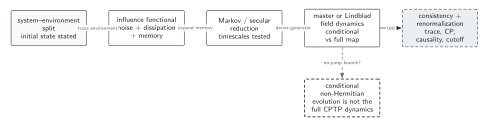
A Liouvillian critical theory is conditional on the open-system reduction that defines it. The solid path shows the derivation from a stated split to a reduced generator and then to independent consistency tests; the dashed branch warns that conditional no-jump evolution is not the full density-matrix dynamics. The diagram is schematic and does not assert that a valid generator has a closing gap or a particular universality class.
In text: first derive or justify the reduced generator, then verify trace, complete positivity, causality, and cutoff control. Only after those checks do finite-size gap closure, scaling collapse, and symmetry identify a driven critical point.
Exercises
Section titled “Exercises”Why must the Liouvillian gap close in a finite-size scaling sequence for a continuous stationary transition with critical slowing down?
Solution
The slowest relaxation time grows as . At criticality a finite system cuts off at , so . Since the relevant decay rate is the real part of the leading nonzero Liouvillian eigenvalue, , provided that mode overlaps the observable.
Give a sufficient reason why a dark state need not be the observed steady state.
Solution
There may be several dark states or another invariant sector fixed by a conserved charge. Then the Liouvillian has a stationary manifold, and the long-time state depends on the initial projection onto its sectors. Showing establishes stationarity, not attraction or uniqueness.
Continue to constraints and running couplings
Section titled “Continue to constraints and running couplings”Trace, positivity, and causal consistency tests the generator before critical interpretation. Renormalization of open effective dynamics follows coherent, dissipative, and noise operators together. Platform-specific condensate, cavity, circuit, and programmable-matter evidence continues in driven-dissipative matter.
References
Section titled “References”- Beaulieu, Guillaume, Fabrizio Minganti, Simone Frasca, Vincenzo Savona, Simone Felicetti, Roberto Di Candia, and Pasquale Scarlino. “Observation of First- and Second-Order Dissipative Phase Transitions in a Two-Photon Driven Kerr Resonator.” Nature Communications 16 (2025): 1954. doi:10.1038/s41467-025-56830-w.
- Chen, Qi-Ming, Michael Fischer, Yuki Nojiri, Michael Renger, Edwar Xie, Matti Partanen, Stefan Pogorzalek, Kirill G. Fedorov, Achim Marx, Frank Deppe, and Rudolf Gross. “Quantum Behavior of the Duffing Oscillator at the Dissipative Phase Transition.” Nature Communications 14 (2023): 2896. doi:10.1038/s41467-023-38217-x.
- Sieberer, Lukas M., Sebastian D. Huber, Ehud Altman, and Sebastian Diehl. “Dynamical Critical Phenomena in Driven-Dissipative Systems.” Physical Review Letters 110 (2013): 195301. doi:10.1103/PhysRevLett.110.195301. Open preprint.
- Sieberer, Lukas M., Michael Buchhold, and Sebastian Diehl. “Keldysh Field Theory for Driven Open Quantum Systems.” Reports on Progress in Physics 79 (2016): 096001. doi:10.1088/0034-4885/79/9/096001. Open preprint.