

Non-Abelian Plasma Instabilities
A momentum-space anisotropy can make a collisionless non-Abelian plasma unstable to exponentially growing chromomagnetic fields. Hard-loop theory determines the linear growth spectrum; nonlinear Yang–Mills evolution, hard-particle backreaction, expansion, collisions, and quantum corrections determine what happens next. The strongest controlled conclusion is therefore about instability and early field growth—not complete thermalization.
Required background. HTL theory supplies hard-loop response, and gauge-theory EKT supplies collisional evolution. Helpful background. Initial conditions and pre-equilibrium evolution explains where anisotropic states arise in collision models.
Evidence status on this page was checked through 10 August 2026.
Anisotropic hard-loop response
Section titled “Anisotropic hard-loop response”For a homogeneous color-singlet distribution , the spatial polarization tensor can be written schematically as
When is isotropic, angular symmetry gives the familiar stable HTL modes. For an oblate distribution, some wave-vector orientations make an eigenvalue of the static inverse propagator negative. A root
then produces exponential growth . Romatschke and Strickland mapped these collective modes for deformed distributions and showed explicitly how unstable branches arise Romatschke and Strickland 2003, §§ III–VI.
The free energy comes from anisotropy, not temperature. A single “anisotropy parameter” is insufficient unless the full functional form, normalization, and hard scale of are also stated. The growth rate and unstable wave-number band depend on those choices.
Nonlinear saturation
Section titled “Nonlinear saturation”Linear hard-loop evolution fails when soft gauge fields become large enough that competes with the unstable gradient . Non-Abelian self-interactions can transfer energy from unstable infrared modes to higher momenta. Fully three-dimensional hard-loop simulations found that exponential growth can cross over to slower growth accompanied by an ultraviolet cascade, rather than continue indefinitely Arnold, Moore, and Yaffe 2005.
Several distinct mechanisms may then limit the instability:
- non-Abelian mode coupling and cascade among soft fields;
- deflection and isotropization of hard particles, which depletes the anisotropy;
- longitudinal expansion, which continually regenerates anisotropy while diluting the system;
- elastic and inelastic collisions;
- quantum corrections once occupancies cease to be classical.
A simulation that freezes the hard distribution can study field saturation but not self-consistent depletion. A classical-statistical Yang–Mills calculation has controlled continuum meaning only while relevant modes are highly occupied and separated from cutoff-dominated ultraviolet modes.
A bounded comparison should track three different diagnostics over the same regulator-safe time window. One possible choice is
diagnoses gauge-invariant soft magnetic-energy growth, diagnoses pressure isotropization, and tests a specified thermal one-particle shape. The weight, fitted charges, momentum range, and ultraviolet stopping time must be declared. None of the three conditions implies the other two.
Expansion and competing time scales
Section titled “Expansion and competing time scales”In a longitudinally expanding system, compare the growth time with the expansion time , the collision time, and the duration of the anisotropic stage. Expansion changes the linear equation from simple growth; in hard-expanding-loop setups the onset can be delayed and growth laws depend on the evolving distribution Romatschke and Rebhan 2006.
Weak-coupling kinetic and classical-statistical studies support a broader picture in which expanding non-Abelian systems can approach universal scaling regimes before thermal equilibrium Berges et al. 2014. Such an attractor is evidence for loss of some initial-state information, not proof of a Gibbs ensemble. Matching to kinetic theory additionally requires occupancies and momenta to enter its validity domain.
What the results establish
Section titled “What the results establish”As of the stated cutoff, the literature establishes:
- anisotropic hard-loop distributions possess unstable modes in controlled weak-coupling setups;
- nonlinear non-Abelian dynamics changes the linear exponential regime and can generate cascades;
- instabilities can contribute to momentum broadening and pressure isotropization in specified models.
It does not establish that plasma instabilities alone thermalize realistic heavy-ion collisions, determine a unique hydrodynamization time, or remain quantitatively dominant at phenomenological coupling. Isotropization of part of the stress tensor is weaker than kinetic equilibration; kinetic equilibration is weaker than chemical equilibration; and all are weaker than demonstrating a thermal density operator. The original “apparent thermalization” proposal itself emphasized rapid isotropization rather than necessarily complete thermalization Arnold, Lenaghan, Moore, and Yaffe 2005.
Numerical evidence checklist
Section titled “Numerical evidence checklist”A credible instability result reports the distribution and seed spectrum; gauge group; volume, spacing, and velocity/angular discretization; expansion law; collision and backreaction terms; energy-transfer residual; gauge-invariant field-energy observables; and the time before ultraviolet cutoff contamination. These requirements are summarized in the hot-gauge plasma validity table.
An anisotropic distribution selects the instability branch of the plasma-state diagram; the growth law is only the beginning of the dynamical question.
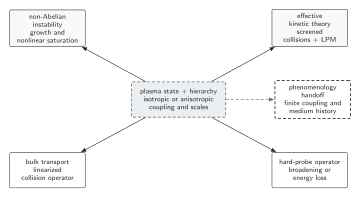
The instability branch is determined by the hard distribution and its scale hierarchy. Linear growth ends when non-Abelian interactions, backreaction, expansion, collisions, or ultraviolet sensitivity become important; the diagram therefore labels both growth and nonlinear saturation. It does not assert thermalization or determine a collision observable. The other branches require separate operator definitions and matching. The diagram is schematic and not to scale.
In text, establish instability through the retarded dispersion relation, then follow gauge-invariant field energy and energy transfer through saturation while varying volume, lattice spacing, angular resolution, seeds, and collision terms. Phenomenological conclusions require a later medium model and uncertainty propagation.
Exercises
Section titled “Exercises”1. Growth versus expansion. If a static-box mode grows as , give a necessary condition for appreciable amplification during an expanding stage of duration .
Solution
One needs an integrated exponent . The static estimate is recovered only when the distribution and growth rate are approximately constant. Comparing instantaneous with alone is not sufficient if the unstable band evolves.
2. Claim classification. A simulation shows rising from to while the one-particle distribution remains nonthermal. What has been demonstrated?
Solution
It demonstrates partial pressure isotropization in that model and time interval. It does not demonstrate full isotropy, a Bose–Einstein/Fermi–Dirac distribution, chemical equilibrium, or thermalization of all correlators.
Continue to initial conditions and pre-equilibrium evolution for the collision-stage interface.
References
Section titled “References”- Arnold, Peter, Jonathan Lenaghan, and Guy D. Moore. “QCD Plasma Instabilities and Bottom-Up Thermalization.” Journal of High Energy Physics 2003, no. 8 (2003): 002. DOI.
- Arnold, Peter, Jonathan Lenaghan, Guy D. Moore, and Laurence G. Yaffe. “Apparent Thermalization Due to Plasma Instabilities in the Quark-Gluon Plasma.” Physical Review Letters 94, no. 7 (2005): 072302. DOI.
- Arnold, Peter, Guy D. Moore, and Laurence G. Yaffe. “The Fate of Non-Abelian Plasma Instabilities in 3+1 Dimensions.” Physical Review D 72, no. 5 (2005): 054003. DOI.
- Berges, Jürgen, Kirill Boguslavski, Sören Schlichting, and Raju Venugopalan. “Universal Attractor in a Highly Occupied Non-Abelian Plasma.” Physical Review D 89, no. 7 (2014): 074011. DOI.
- Romatschke, Paul, and Michael Strickland. “Collective Modes of an Anisotropic Quark-Gluon Plasma.” Physical Review D 68, no. 3 (2003): 036004. DOI.
- Romatschke, Paul, and Anton Rebhan. “Plasma Instabilities in an Anisotropically Expanding Geometry.” Physical Review Letters 97, no. 25 (2006): 252301. DOI.