

Ultrasoft Color Dynamics and Bödeker Theory
Bödeker theory is the overdamped real-time effective theory of non-Abelian gauge fields at momentum and frequency much smaller than . Hard particles and electric-scale fields have already been integrated out; their principal dynamical imprint is a color conductivity and thermal noise. This construction supplies a clock to the magnetostatic equilibrium theory and makes leading-log topological diffusion calculable.
Required background. The magnetostatic sector supplies the fields; HTL theory supplies hard-particle response; Langevin field equations and fluctuation–dissipation relations supply the stochastic consistency condition. Helpful background. Gauge-theory kinetic theory develops the collision language used in matching, while anomalous charge violation supplies the later cosmological interface.
From hard loops to color conductivity
Section titled “From hard loops to color conductivity”At the soft scale, the hard particles carry a color perturbation . Collisions randomize this color on a rate
which is fast compared with ultrasoft evolution. The color Boltzmann equation has the schematic form
The collision operator has a conserved angular zero mode required by gauge covariance; its nonzero modes relax. Solving for in an expansion in ultrasoft frequency and momentum gives Ohm’s law
at leading logarithmic accuracy, where is the relevant eigenvalue of the collision operator. The symbol is sometimes used for several nearby definitions, so a numerical coefficient is meaningful only with the kernel and convention stated.
Gauge-covariant Langevin dynamics
Section titled “Gauge-covariant Langevin dynamics”Neglecting the displacement current at ultrasoft frequencies turns the Yang–Mills equation into
The Gaussian noise is local at leading order,
In temporal gauge, up to the chosen sign convention, and the drift is gradient flow of the three-dimensional magnetic Hamiltonian. The noise normalization is not optional: it makes
stationary. Rescaling the noise without the conductivity would change the equilibrium measure and violate fluctuation–dissipation.
Balancing against gives . With , ultrasoft fields are parametrically overdamped. There is no propagating “magnetic plasmon” in this limit.
Topological diffusion
Section titled “Topological diffusion”The Chern–Simons number changes under gauge-field motion. A gauge-invariant long-time rate is
For weak coupling, Bödeker theory gives the parametric form
with group- and matter-dependent conventions absorbed into and the logarithm. The dimensionless coefficient is obtained by simulating the regulated Langevin theory and matching its lattice time scale to . Arnold, Son, and Yaffe explained the color-conductivity logarithm that changes the earlier parametric estimate Arnold, Son, and Yaffe 1999; Bödeker derived the local Langevin limit Bödeker 1998.
The rate describes diffusion, not a coherent tunneling event count. In electroweak theory it controls anomalous baryon-plus-lepton violation in the symmetric phase. In QCD, analogous topology-changing dynamics relaxes axial charge, but converting into an observable requires the anomaly equation and the relevant hydrodynamic or kinetic evolution.
Regulator and accuracy boundaries
Section titled “Regulator and accuracy boundaries”Classical gauge fields exhibit ultraviolet Rayleigh–Jeans sensitivity. Bödeker theory is meaningful because hard and soft fluctuations have been matched into and the noise, and because the remaining lattice theory is extrapolated consistently. A raw classical Yang–Mills simulation with a lattice cutoff is not automatically the quantum rate.
The local theory is leading logarithmic. Beyond leading log, the collision kernel, scale under the logarithm, memory corrections, and matching of composite topological observables matter. The hot-gauge plasma validity table records the necessary regulator and matching checks.
Bödeker theory adds real time to the magnetic degrees of freedom only after faster color fluctuations have been coarse-grained.
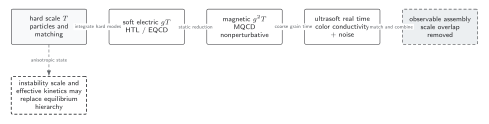
The magnetic fields inherited from MQCD become slowly evolving variables, while hard and semihard modes determine the color conductivity and stochastic noise. Their fluctuation relation is required for the correct thermal stationary measure. The dashed anisotropic branch warns that the equilibrium leading-log construction does not describe generic unstable plasmas. The diagram is schematic and not to scale.
In text, the scale hierarchy supplies the ultrasoft fields, but the real-time theory additionally needs the matched conductivity, Gaussian noise covariance, gauge-covariant evolution, and regulator control for composite observables such as topology change.
The interface diagram distinguishes Bödeker dynamics from the other effective descriptions that share its hard thermal input.
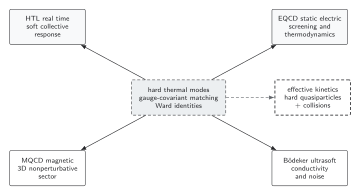
Bödeker theory is the ultrasoft real-time branch: it inherits magnetic gauge fields from the static reduction but obtains its time scale, dissipation, and noise by matching faster modes. It is neither EQCD analytically continued nor a replacement for HTL collective response or hard-quasiparticle kinetics. The branches are schematic and not to scale.
The textual distinction is by observable and scale: use EQCD or MQCD for static quantities, HTL for collisionless soft response, kinetic theory for hard quasiparticles, and Bödeker dynamics for overdamped ultrasoft color evolution at leading logarithmic accuracy.
Exercises
Section titled “Exercises”1. Derive the relaxation scale. Linearize the Langevin equation in an Abelianized Fourier mode and find its relaxation time.
Solution
For a transverse mode, . Ignoring noise, , so and . At this is much longer than .
2. Check equilibrium. For one mode obeying with , find .
Solution
The Ornstein–Uhlenbeck variance obeys . At stationarity , exactly the equipartition result for .
Continue to effective kinetic theory for hard-particle transport.
References
Section titled “References”- Arnold, Peter, Dam T. Son, and Laurence G. Yaffe. “Effective Dynamics of Hot, Soft Non-Abelian Gauge Fields: Color Conductivity and Log(1/) Effects.” Physical Review D 59, no. 10 (1999): 105020. DOI.
- Bödeker, Dietrich. “Effective Dynamics of Soft Non-Abelian Gauge Fields at Finite Temperature.” Physics Letters B 426, no. 3–4 (1998): 351–360. DOI.
- Moore, Guy D. “Sphaleron Rate in the Symmetric Electroweak Phase.” Physical Review D 62, no. 8 (2000): 085011. DOI.
- Moore, Guy D., and Kari Rummukainen. “Classical Sphaleron Rate on Fine Lattices.” Physical Review D 61, no. 10 (2000): 105008. DOI.