

Generalized Gibbs Ensembles for Integrable Charges
An integrable generalized Gibbs ensemble is the maximum-entropy state constrained by a mutually commuting family of conserved local or quasilocal charges. It describes a stationary macrostate only when the chosen charge family is complete for the observables and preparation under study. A truncated GGE is an approximation whose omitted-charge bias must be tested; it is not the same construction as a maximum-entropy state with genuinely noncommuting charges.
The necessity of a charge-complete ensemble in an interacting integrable model is demonstrated by Ilievski et al. 2015, pp. 1–5.
Required background. Conserved Charges and Grand-Canonical States gives the ordinary exponential ensemble. Classical and Quantum Conserved Charges and Thermodynamic Bethe Ansatz and Finite-Size Ground-State Energy supply the integrable charges and macrostate language.
Maximum entropy with commuting charges
Section titled “Maximum entropy with commuting charges”Let satisfy
Maximizing von Neumann entropy subject to gives
The multipliers solve
Ordinary Gibbs equilibrium is the special case containing with and any global commuting charges with . In an integrable theory the additional charges constrain mode or rapidity occupations that a single temperature and chemical potential cannot encode.
From charges to a Bethe macrostate
Section titled “From charges to a Bethe macrostate”In a thermodynamic Bethe-ansatz description, a macrostate is specified by particle and hole root densities and constrained by Bethe equations. Local or quasilocal charges are additive,
Extremizing the generalized free-entropy functional gives pseudoenergies of the schematic form
with statistics- and convention-dependent logarithms. The charge data determine the macrostate only if the functions span the relevant occupation information. Missing quasilocal charges can leave distinct root densities with the same retained constraints.
Completeness and representative-state equivalence
Section titled “Completeness and representative-state equivalence”For local observables after dephasing, one often expects a representative thermodynamic state to reproduce the diagonal ensemble in the thermodynamic limit. This is not automatic. Check:
- exact rather than approximate conservation over the stated timescale;
- locality or controlled quasilocality of each charge;
- functional independence and completeness for all quasiparticle species;
- convergence of and normalizability;
- equivalence of local observables, not equality of full finite-volume density matrices;
- order of the large-volume and late-time limits; and
- sensitivity to charges omitted by a truncation.
The need for quasilocal charges in the XXZ chain is a canonical warning: a GGE built from an incomplete set of familiar local charges can predict the wrong stationary observables Ilievski et al. 2015.
A free-mode example
Section titled “A free-mode example”For a quadratic integrable theory with occupations conserved mode by mode,
For fermionic modes,
Matching only energy would replace the full function by and generally lose the post-quench mode distribution. Conversely, retaining every finite-volume projector is formally complete but destroys locality and predictive compression. The durable GGE question is which local or quasilocal charges determine the thermodynamic macrostate.
What a GGE does not establish
Section titled “What a GGE does not establish”A GGE is a stationary ensemble, not a proof of relaxation into it. Dephasing, initial-state regularity, and thermodynamic limits enter the dynamical claim. Nor does the existence of integrable charges imply generalized hydrodynamics without local-equilibrium and scale-separation assumptions. Those extensions appear in the thermalization and generalized-hydrodynamics chapters.
The schematic below organizes the relationships used on this page. Inspect it with this question in mind: Which charge structures license chemical potentials or generalized equilibrium states?
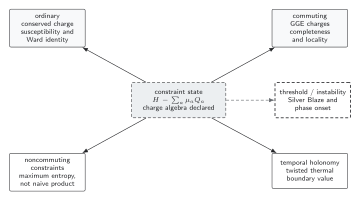
A grand-canonical state requires conserved charges and a declared algebra; commuting integrable charges, noncommuting constraints, temporal holonomies, and density thresholds demand distinct constructions and checks. Connections classify the charge structure and required construction; their direction is organizational, not a causal-time ordering. Dashed marks show qualifications and failure boundaries. The diagram is schematic and not to scale.
The surrounding discussion supplies the relevant equations and checks in text form; the figure is a navigational summary.
Exercise
Section titled “Exercise”For two fermion modes with occupations , compare a charge-complete GGE with a Gibbs ensemble constrained only by .
Solution
The complete GGE has independent multipliers and reproduces both target occupations. A Gibbs state requires for one , which is possible only if . Matching total energy alone does not fix the two occupations.
References
Section titled “References”- Ilievski, Enej, Jacopo De Nardis, Bram Wouters, Jean-Sébastien Caux, Fabian H. L. Essler, and Tomaž Prosen. “Complete Generalized Gibbs Ensembles in an Interacting Theory.” Physical Review Letters 115 (2015): 157201. doi:10.1103/PhysRevLett.115.157201; Open PDF.
- Rigol, Marcos, Vanja Dunjko, Vladimir Yurovsky, and Maxim Olshanii. “Relaxation in a Completely Integrable Many-Body Quantum System: An Ab Initio Study of the Dynamics of the Highly Excited States.” Physical Review Letters 98 (2007): 050405. doi:10.1103/PhysRevLett.98.050405.
- Vidmar, Lev, and Marcos Rigol. “Generalized Gibbs Ensemble in Integrable Lattice Models.” Journal of Statistical Mechanics 2016 (2016): 064007. doi:10.1088/1742-5468/2016/06/064007; Open PDF.