

Collective Modes and Dynamical Screening
The resummed retarded propagator of a hot gauge plasma contains more than a screened Coulomb interaction. It has longitudinal and transverse collective poles, a spacelike Landau-damping continuum, and distinct static electric and magnetic limits. These structures answer different physical questions and must not be compressed into one “thermal mass.”
Required background. HTL effective theory supplies the polarization tensor, while screening and infrared scale separation supplies static screening logic. Helpful background. Wilson and Polyakov loops explains gauge-invariant static diagnostics.
Poles, cuts, and spectral weight
Section titled “Poles, cuts, and spectral weight”In an isotropic plasma, retarded gauge-field response decomposes into transverse and longitudinal sectors. Schematically,
with scalar conventions fixed by these denominators. Each spectral density
splits at collisionless HTL order into pole terms at and a continuum for . The dispersion relations solve
At , both branches begin at the plasma frequency
for the leading isotropic HTL theory. The longitudinal residue decreases at large and its branch approaches the light cone with exponentially small weight. The transverse branch survives and approaches a quasiparticle with asymptotic mass .
The pole width vanishes at strict HTL order because collisions enter at a parametrically finer scale. Assigning a finite Breit–Wigner width while retaining only the collisionless self-energy is an additional model, not an HTL prediction. The collisionless pole/cut decomposition, plasma frequency, and large-momentum limits are developed in Le Bellac 1996, Ch. 6, pp. 114–149.
Landau damping
Section titled “Landau damping”For , a hard particle can satisfy . Energy transfers coherently between the field and resonant particles, producing the logarithmic branch cut in the polarization. The continuum is not a particle pole; it is many-particle spacelike response. Its sign and normalization are constrained by retarded analyticity and spectral sum rules.
Landau damping dynamically suppresses soft fields with nonzero frequency, including transverse magnetic fields. It does not generate a perturbative static magnetic screening mass: at leading order. The asymptotic static magnetic sector remains nonperturbative.
Static electric screening
Section titled “Static electric screening”At leading order, the static longitudinal propagator becomes
so the Fourier transform of a weak static source contains . Beyond leading order, a gauge-invariant screening mass must be attached to a specified operator or symmetry channel. Spatial correlators of gauge-invariant operators admit the spectral form
and the smallest accessible controls the asymptotic falloff. It need not coincide numerically with the parameter obtained from .
The singlet free energy inferred after gauge fixing, the Polyakov-loop correlator, the real-time static potential, and an EQCD screening eigenvalue are related but distinct objects. Their additive renormalizations, operator definitions, and time contours differ. A claim such as “the potential is Debye screened” is meaningful only after those choices are given.
A controlled diagnostic
Section titled “A controlled diagnostic”For a longitudinal external current , the dissipated power per frequency is proportional to
The retarded spectral sign makes for positive in a passive equilibrium medium. A numerical reconstruction that produces negative dissipative weight after conventions are fixed violates causality/positivity or has insufficient resolution. Pole positions, residues, the integrated continuum, and the relevant sum rule should be tested together, not fitted independently.
The common scope and gauge-status fields appear in the hot-gauge plasma validity table.
Limitations
Section titled “Limitations”HTL collective modes assume weak coupling, isotropy, homogeneity, and . Collisions broaden poles; anisotropy can turn a damped mode into an instability; chemical potentials change the hard distribution and ; and the sector is nonperturbative. Gauge-fixed spectral functions may organize a calculation without themselves being directly observable.
Collective poles and Landau cuts belong to the HTL real-time branch; the neighboring static and kinetic branches answer different questions.
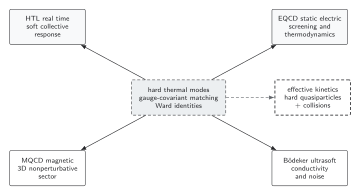
For , the HTL branch organizes longitudinal and transverse poles together with Landau-damping cuts and preserves Ward identities. EQCD can determine static screening but not the frequency dependence of these modes. Collisions, anisotropy, and the nonperturbative magnetic sector require the other branches or further matching. The diagram is schematic and not to scale.
In text, select the retarded HTL self-energy for soft real-time response, locate poles and cuts with a stated analytic prescription, and keep static Debye screening distinct from a universal mass assigned to every gauge excitation.
Exercises
Section titled “Exercises”1. Yukawa screening. Evaluate the three-dimensional Fourier transform of .
Solution
Rotational symmetry gives
The contour integral picks the pole at for .
2. Distinguish two limits. Why do and need not describe the same physics?
Solution
The first probes a homogeneous disturbance evolved slowly in time; the second probes a static field made spatially uniform. Thermal correlators are nonanalytic at because of collective response and the Landau cut. The order of limits selects different response functions, so it must be specified before assigning a “mass.”
Continue to the Linde problem for the static magnetic boundary or Bödeker theory for ultrasoft real-time evolution.
References
Section titled “References”- Arnold, Peter, and Laurence G. Yaffe. “The Non-Abelian Debye Screening Length Beyond Leading Order.” Physical Review D 52, no. 12 (1995): 7208–7219. DOI.
- Braaten, Eric, and Robert D. Pisarski. “Calculation of the Gluon Damping Rate in Hot QCD.” Physical Review D 42, no. 6 (1990): 2156–2160. DOI.
- Le Bellac, Michel. Thermal Field Theory. Cambridge Monographs on Mathematical Physics. Cambridge: Cambridge University Press, 1996. DOI.
- Weldon, H. Arthur. “Covariant Calculations at Finite Temperature: The Relativistic Plasma.” Physical Review D 26, no. 6 (1982): 1394–1407. DOI.