

Viscous Hydrodynamics, Particlization, Afterburners, and Bulk–Flow Observables
Bulk heavy-ion phenomenology is one coupled stage: causal viscous hydrodynamics evolves the conserved fields, particlization converts them into a correlated hadron ensemble, a hadronic transport code rescatters and decays that ensemble, and analysis applies the experimental event and acceptance definitions. Transport coefficients inferred from final spectra or flow are conditional on every link.
Required background. The kinetic-to-hydrodynamic map supplies the initial fields, and Israel–Stewart theory supplies causal transient dynamics. Helpful background. Spin hydrodynamics and pseudo-gauge structure is needed only when spin observables are evolved.
Evidence status on this page was checked through 10 August 2026.
Viscous evolution
Section titled “Viscous evolution”Hydrodynamics solves
with
A second-order theory promotes , and diffusion currents to transient variables. A schematic shear equation is
Dropping relaxation and coupling terms can make the initial-value problem acausal or unstable. Keeping them does not by itself guarantee validity: inverse Reynolds numbers and gradients must remain within the calibrated range, and the numerical method must preserve conservation.
Grid spacing, timestep, reconstruction order, and regulator choices must be varied on representative fluctuating events. A converged physical viscosity cannot be inferred until numerical diffusion is shown to be smaller than the quoted transport and emulator uncertainties.
The EOS controls acceleration and radial flow; damps anisotropic flow; and bulk relaxation affect radial expansion and the switching region. These effects are correlated with initial eccentricities and particlization. A posterior for one coefficient cannot be interpreted independently of the others.
Cooper–Frye particlization
Section titled “Cooper–Frye particlization”On a hypersurface , the mean spectrum of species is
The equilibrium part depends on local . The viscous correction is a matching model constrained by moments:
Many momentum-dependent functions satisfy the same finite set of moment constraints. Grad, Chapman–Enskog, quasiparticle, and regulated prescriptions can therefore give different high- spectra. If , sampling becomes unphysical; clipping changes the matched stress tensor unless compensated. The prescription and its closure residual belong in the inference.
Spacelike surface elements can produce , corresponding to inward flux. Removing negative contributions violates exact flux matching; retaining them requires a transport interface able to handle backflow. The treatment must be stated.
Hadronic afterburner and observables
Section titled “Hadronic afterburner and observables”Below the switching temperature, a hadronic cascade evolves species-dependent elastic and inelastic collisions, annihilation, regeneration, and decays. Its cross-section table, resonance list, detailed-balance implementation, formation times, and stopping criterion can affect proton yields, mean transverse momentum, flow, and fluctuations. SMASH is one documented realization Weil et al. 2016; using another code is a model change, not a technical detail.
Final analysis should reproduce the collaboration’s:
- centrality estimator and binning;
- particle species, weak-decay feed-down, rapidity and cuts;
- event weights and flow estimator, including subevents and nonflow suppression;
- detector response or unfolded particle-level definition;
- covariance across multiplicity, , spectra, and flow harmonics.
The complex flow vector responds approximately to initial eccentricity for lower harmonics,
but both and the nonlinear terms depend on viscosity and the entire evolution.
Current inference status
Section titled “Current inference status”Multisystem Bayesian analyses have constrained parameterized QGP shear and bulk viscosities using soft hadron data Everett et al. 2021. An IP-Glasma-based 2024 analysis inferred initial-state and viscosity parameters using Pb–Pb bulk observables and explored transfer learning and model averaging Heffernan et al. 2024. These are substantial conditional constraints, not direct measurements of a unique .
Particlization prescriptions, initial-state families, hadronic interactions, covariance completion, emulator error, and model discrepancy remain material. The required common record is the heavy-ion global-inference provenance table.
The full collision chain shows where a hydrodynamic transport coefficient becomes entangled with particlization, hadronic evolution, detector selection, and statistical assumptions.
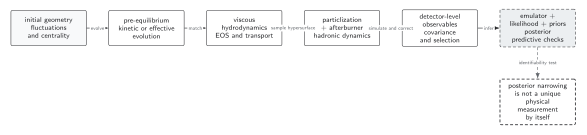
This page centers on the hydrodynamics-to-particle-to-afterburner segment. Conservation and viscous corrections must be controlled at the sampling hypersurface, and hadronic rescattering and decays alter the final observables. Initial-state choices, covariance, emulator error, priors, and model discrepancy remain coupled to the inferred transport parameters. The dashed branch warns that posterior narrowing within this chain is not a unique physical measurement. The diagram is schematic and not to scale.
In text, a transport-coefficient constraint is conditional on the entire named forward model: initial conditions, pre-equilibrium matching, EOS, viscous constitutive form, particlization correction, afterburner, detector treatment, covariance, emulator, likelihood, and priors.
Bulk hadron flow is one branch of the common medium history, while the other probes weight different times, temperatures, and operators.
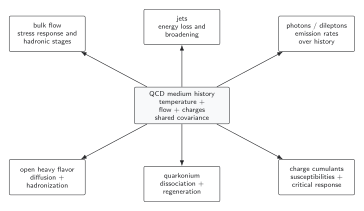
Soft hadron spectra and anisotropic flow constrain the stress response and late hadronic stages most directly within the multistage model. Jets, photons and dileptons, open heavy flavor, quarkonium, and charge cumulants probe the same evolving medium with distinct kernels and time weightings. Their combination can break degeneracies only when shared and branch-specific covariances and discrepancies are retained. The diagram is schematic and not to scale.
The textual lesson is that a bulk-only viscosity fit must not silently absorb missing physics from another probe or stage. A joint analysis should share the same medium history while giving each branch its own validated response, nuisance parameters, acceptance, and validity domain.
Exercises
Section titled “Exercises”1. Moment closure. Why does matching to not determine its full momentum dependence?
Solution
The matching equation fixes finitely many weighted integrals of an unknown function of momentum. Any function orthogonal to those moments can be added without changing . A kinetic ansatz or collision model is needed to choose among them.
2. Correlated degeneracy. Increasing initial eccentricity and increasing shear viscosity can partly offset in final . What data help break the degeneracy?
Solution
Use multiple harmonics, centralities, collision systems and energies, together with multiplicity and mean- observables and their covariance. The two changes have different patterns across this larger observable set. Posterior sensitivity and closure tests must verify the discrimination.
Continue to hard probes or global inference.
References
Section titled “References”- Cooper, Fred, and Graham Frye. “Comment on the Single Particle Distribution in the Hydrodynamic and Statistical Thermodynamic Models of Multiparticle Production.” Physical Review D 10, no. 1 (1974): 186–189. DOI.
- Everett, D., et al. (JETSCAPE Collaboration). “Multisystem Bayesian Constraints on the Transport Coefficients of QCD Matter.” Physical Review C 103, no. 5 (2021): 054904. DOI.
- Heffernan, Matthew, Charles Gale, Sangyong Jeon, and Jean-François Paquet. “Bayesian Quantification of Strongly Interacting Matter with Color Glass Condensate Initial Conditions.” Physical Review C 109, no. 6 (2024): 065207. DOI.
- Israel, Werner, and John M. Stewart. “Transient Relativistic Thermodynamics and Kinetic Theory.” Annals of Physics 118, no. 2 (1979): 341–372. DOI.
- Weil, Jan, et al. “Particle Production and Equilibrium Properties within a New Hadron Transport Approach for Heavy-Ion Collisions.” Physical Review C 94, no. 5 (2016): 054905. DOI.