

Metastability, Spinodals, and Thermal Decay
Metastability is local stability on a finite observation timescale, not a second exact equilibrium state. Nucleation describes rare crossing of a barrier by a critical droplet; spinodal decomposition begins when long-wavelength modes have negative curvature and grow without activation. Supercooling can pass through either regime depending on the cooling history and fluctuation dynamics.
Required background. Use convexity and physical phase criteria and large deviations at coexistence.
Helpful background. Quenches, coarsening, and aging treats the post-instability dynamics that follows spinodal entry.
Local stability, barriers, and observation time
Section titled “Local stability, barriers, and observation time”For a coarse-grained functional , a homogeneous branch is locally stable when the fluctuation operator
has nonnegative spectrum, aside from symmetry zero modes handled separately. A metastable branch is a local minimum with higher free energy than the stable phase and a barrier within the declared coarse-grained description. Its physical relevance requires a lifetime longer than microscopic relaxation and comparable to the experimental or cosmological history.
At a spinodal, the lowest relevant eigenvalue reaches zero. Beyond it, a band of modes has and grows approximately as in inertial dynamics, or with the appropriate relaxational rate in overdamped dynamics. There is no critical-droplet suppression. Close to a spinodal, fluctuations and finite volume can smear mean-field singularities; in short-range systems the sharp spinodal may be replaced by a crossover in decay mechanism.
Nucleation requires a well-defined saddle separating basins and a dilute population of critical droplets. The statistical transition-state construction and its timescale separation are developed in Langer 1969, §§ II–IV. The rate must be slow enough for the metastable background to equilibrate locally, yet fast enough to matter before cooling or expansion moves the parameters appreciably.
The downward branch in the diagram is the essential distinction for metastability: local curvature and a barrier diagnose a branch, while decay requires a saddle, fluctuation factors, and real-time dynamics on the relevant observation timescale.
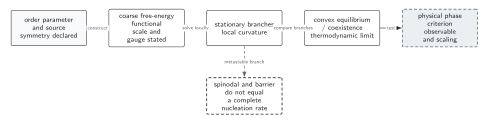
A metastable minimum and a spinodal are local properties of a declared coarse description. They do not determine a lifetime: the nucleation rate, stochastic or real-time dynamics, system volume, and observation time remain separate inputs. Exact equilibrium convexity does not erase the usefulness of the branch, but it limits what the branch alone can prove. The diagram is schematic and not to scale.
The sections Local stability, barriers, and observation time and Cooling, finite volume, and stochastic dynamics give the text and equation equivalent of the solid and dashed branches.
Cubic model regime map
Section titled “Cubic model regime map”For
the nonzero stationary points exist when
is the merger of a nonzero maximum and minimum. Coexistence with the branch occurs instead at . The branch itself loses local stability when . Thus appearance of a second minimum, equality of free energies, and loss of the original minimum are three distinct temperatures.
Between coexistence and the spinodal, decay of the branch can be nucleation controlled if a critical droplet exists and the barrier is large compared with thermal fluctuations. At , long-wavelength modes around are unstable; extrapolating a bounce from the metastable side is no longer the correct description.
Cooling, finite volume, and stochastic dynamics
Section titled “Cooling, finite volume, and stochastic dynamics”Let and be the local relaxation time. Quasistatic nucleation theory requires and a rate varying slowly across one droplet-formation event. Rapid quenches retain memory and can carry the system into the unstable region before appreciable nucleation.
In a finite volume , the probability of no nucleation by time is approximately
only for homogeneous Poisson nucleation with negligible depletion and correlations. This expression concerns first-droplet statistics, not percolation or completion.
The dynamical universality class matters near instability. A nonconserved order parameter, a conserved density, and a gauge field have different growth laws even for the same static free energy. A negative Hessian identifies instability but not its real-time rate.
Failure tests
Section titled “Failure tests”- Compute the lowest fluctuation eigenvalue rather than identifying a spinodal by eye.
- Vary volume and coarse-graining scale to distinguish a sharp thermodynamic limit from finite-size rounding.
- Compare , , and the inferred nucleation time.
- Test the barrier against the fluctuation scale and the first omitted derivative term.
- Do not extrapolate an equilibrium metastable branch beyond its local-stability domain.
- Record all assumptions in the thermal transition validity table.
Exercise
Section titled “Exercise”For overdamped Model-A dynamics linearized around a homogeneous point with , find the unstable momentum band and growth rate.
Solution
Fourier modes obey . Modes with grow, with rate . The static Hessian fixes the band, while the kinetic coefficient fixes the time scale.
Continue
Section titled “Continue”When the branch remains metastable, assemble the saddle and every prefactor on thermal bounces and nucleation rates. If the unstable band has opened, continue instead to quench and coarsening dynamics.