

Distribution Functions and Transport Equations
A scalar phase-space distribution is justified when excitations occupy identifiable, sufficiently narrow spectral branches and internal coherence can be neglected or separately resolved. It is a coarse-grained description of a quantum state, not an exact observable in every interacting or gauge theory.
Required background. Use Hamiltonian and symplectic mechanics for phase-space flow and thermal spectral representations for the relation between excitations and spectral support.
Helpful background. Wigner transformation and gradient expansion explains how phase-space variables arise from two-point functions.
Relativistic distribution and invariant moments
Section titled “Relativistic distribution and invariant moments”For a positive-energy quasiparticle of mass , use the invariant-measure convention of de Groot, van Leeuwen, and van Weert 1980, ch. II:
where counts only the internal states not already carried by species or matrix indices. With this convention,
and , confirming the normalization. Scattering formulas often use ; mixing and without the corresponding factor of two is a common rate error.
For a mean-field force, the covariant Boltzmann equation is schematically
The force must be tangent to the mass shell: when is fixed. For an Abelian Lorentz force, satisfies this automatically. If the mass depends on spacetime, the shell and force terms must be derived together; differentiating at fixed can miss a term.
Streaming as Liouville flow
Section titled “Streaming as Liouville flow”In canonical coordinates, collisionless evolution is
Hamiltonian flow has zero phase-space divergence, so is constant along characteristics. For a free relativistic particle,
Direct substitution verifies the collisionless equation. Integrating over momentum gives a continuity equation if surface terms at vanish.
Taking moments of the full equation yields
Collision invariants make the appropriate right-hand sides vanish only after summing all coupled species and reactions. A species number need not be conserved even when total charge and energy–momentum are.
The hierarchy places a distribution downstream of a Wigner correlator and a controlled shell projection. This page begins with the reduced object; the diagram records the quantum and coherence information that has already been assumed negligible or separately retained.
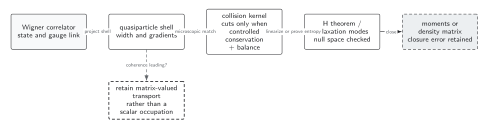
A scalar distribution is a reduced description, not an arbitrary rewriting of a two-point function. Its phase-space moments and Liouville streaming are meaningful only after shell, gradient, state, and gauge-link conventions are controlled. Collision, entropy, and closure boxes are subsequent modeling steps, and microscopic matching may use cuts only in a controlled weak-coupling quasiparticle construction. Leading internal-state coherence instead follows the dashed matrix-valued branch. The diagram is schematic and not to scale.
The sections Relativistic distribution and invariant moments, Streaming as Liouville flow, and Quantum and gauge qualifications give the text and equation equivalent of the distribution-level assumptions.
Quantum and gauge qualifications
Section titled “Quantum and gauge qualifications”Bosonic and fermionic statistics enter collision terms through and ; they do not turn into an exact occupation operator. For gauge-charged particles, a gauge-covariant Wigner transform needs Wilson lines, and the distribution can carry color or flavor indices. Collective modes already included in mean fields must not also be counted as independent particles.
Finite spectral width replaces a sharp shell by a function of . Particle–antiparticle or flavor coherence requires off-diagonal densities. In either case a scalar loses information, and the error must be estimated against a matrix or two-time description.
Failure tests
Section titled “Failure tests”- Verify the measure by reconstructing and .
- Vary the particle basis when spectral peaks overlap; stable observables should not depend strongly on an arbitrary diagonalization.
- Check and gauge covariance.
- Compare widths, branch separations, gradients, and memory times with the scales resolved by .
- Integrate the numerical collision term against every conserved charge and .
- Ensure degeneracies and collective modes are counted exactly once.
Exercise
Section titled “Exercise”Use the free-streaming solution to show that the total particle number is constant when vanishes at spatial infinity.
Solution
The solution translates by a momentum-dependent constant. For each , change variables to ; the Jacobian is one, so the spatial integral equals its initial value. Equivalently, integrate the Liouville equation and discard the boundary flux.
Continue
Section titled “Continue”Derive the distribution from two-time dynamics on Kadanoff–Baym to kinetic theory and build its interactions on collision kernels.
References
Section titled “References”- Boltzmann, L. (1872). “Further Studies on the Thermal Equilibrium of Gas Molecules.” Sitzungsberichte der Kaiserlichen Akademie der Wissenschaften 66, 275–370. English translation.
- de Groot, S. R., van Leeuwen, W. A., and van Weert, C. G. (1980). Relativistic Kinetic Theory: Principles and Applications. Amsterdam: North-Holland. WorldCat record.