

Relativistic Dissipative Hydrodynamics
First-order dissipative hydrodynamics adds shear and bulk stress plus charge/heat transport to the ideal constitutive relations. These terms determine the universal low- attenuation and diffusion coefficients. In conventional Landau form they also make the exact equations parabolic, so their infrared accuracy must be separated from the causal status of a macroscopic initial-value formulation.
Required background. Derivative Expansion and Tensor Decomposition gives the reduced first-order basis. Sound, Shear, and Charge Modes supplies the ideal eigenvectors.
Helpful background. Sources, Linear Response, and Kubo Formulae fixes microscopic transport normalizations.
Parity-even first-order constitutive relations
Section titled “Parity-even first-order constitutive relations”In Landau frame for one charge,
The definitions of and are those in the hydrodynamic frame and tensor reference. In the local rest frame, the spatial viscous stress is
The coefficient is the charge conductivity relative to energy flow. At finite density, heat and charge currents mix; a single symbol called “thermal conductivity” is convention incomplete until the frame and thermodynamic force are stated.
Shear diffusion
Section titled “Shear diffusion”Linearize about homogeneous equilibrium with no sources. For a transverse velocity, energy and charge fluctuations decouple:
The Fourier convention gives
For and , the pole lies in the lower half-plane. This checks the sign of the stress and the normalization of .
Sound attenuation
Section titled “Sound attenuation”For a neutral fluid, the longitudinal linear equations are
With , their determinant is
Expanding at small gives
Sound stability constrains the combination . The local second law constrains shear and bulk channels separately, as the next page shows.
Charge diffusion
Section titled “Charge diffusion”At in a charge-conjugation-symmetric state, charge decouples from energy and momentum. Since
charge conservation gives
This is the Einstein relation. At finite density, the scalar ideal zero mode mixes energy and charge. The diffusion constant is then an eigenvalue of the susceptibility-weighted thermoelectric transport matrix, not generally .
Kovtun derives the neutral sound/shear results and the finite-density response structure with consistent retarded conventions Kovtun 2012, §§2.2–2.5, pp. 22–35, Open PDF.
Relativistic hydrodynamic consistency reference
Section titled “Relativistic hydrodynamic consistency reference”This canonical table states what each framework does and does not establish. “Conditional” means that explicit coefficient, state, and regularity hypotheses are required; it never means automatic.
| Framework | Variables and organization | Entropy/Onsager status | Linear stability | Characteristic causality and hyperbolicity | Nonlinear theorem status | Controlled interpretation |
|---|---|---|---|---|---|---|
| Ideal relativistic fluid | ; zeroth-derivative | Entropy advected for smooth flow | Stable if thermodynamic Hessian is positive and | Symmetric/strongly hyperbolic and causal for a regular EOS with | Local smooth theory established; shocks require weak solutions and entropy admissibility | Long wavelengths before dissipative corrections matter |
| Conventional Landau first order | Same fields; algebraic viscous stress and diffusion | Nonnegative local production for | Rest-frame infrared modes damp; generic boosted formulation is unstable | Parabolic sectors have instantaneous support; not a causal hyperbolic PDE | No causal relativistic initial-value completion as written | Correct low- constitutive expansion, not UV evolution |
| Conventional Eckart first order | Velocity tied to charge flow; algebraic heat flux includes acceleration | Can satisfy local production inequality | Generic exponentially growing mode even about equilibrium | Parabolic/acausal; acceleration heat law worsens initial-value structure | No causal stable completion as written | Historical frame; not a viable exact evolution system |
| Müller–Israel–Stewart family | Promotes bulk, shear, and/or heat stresses to transient variables | Conditional on entropy-current ansatz and coefficient signs | Conditional; hydrodynamic plus nonhydrodynamic modes | Conditional inequalities on relaxation times and state; no guarantee from the name | Established only for particular sectors/variants and hypotheses | Transient completion whose coefficients must be specified |
| BRSSS | Conformal Landau-frame constitutive basis through second order; often embedded in a relaxation equation | Conformal nondissipative/dissipative basis constrained | Depends on chosen transient completion | Original gradient data alone do not define a hyperbolic PDE | Variant dependent | Universal second-order conformal data, not synonymous with MIS |
| DNMR | Kinetic moment closure with Knudsen and inverse-Reynolds counting; transient stresses | Inherits kinetic collision/closure assumptions | Conditional on collision model and coefficients | Conditional; not implied by moment truncation alone | Variant and sector dependent | Microscopic kinetic closure, with model-specific coefficient relations |
| BDNK | only; general-frame first-derivative , yielding higher-time-derivative PDEs | Nonnegative production in its EFT regime under transport conditions | Conditional inequalities give rest and boosted stability | Strongly hyperbolic and causal under explicit strict inequalities | Local well-posedness proved under stated EOS, regularity, coefficient, and boundary assumptions | Causal first-order general-frame theory; not every first-order frame |
The table states what each method establishes; it does not rank the methods. A named implementation must still present its coefficient domain and principal symbol. The BDNK theorem row refers to the explicit nonlinear conditions of Bemfica, Disconzi, and Noronha Bemfica, Disconzi, and Noronha 2022, Theorems I–II and §§IV–V, pp. 18–24, Open PDF.
Constitutive order versus PDE order
Section titled “Constitutive order versus PDE order”“First order” means that and contain one derivative. Substitution into conservation can produce two spacetime derivatives. In Landau frame the leading spatial derivatives give diffusion equations; in a suitable general frame, time-derivative terms in the constitutive tensors can instead change the principal symbol. Conversely, a second-order constitutive theory is not automatically second order in time after a particular transient completion.
The derivative expansion controls the small-, small- series. Treating a finite truncation as an exact PDE adds a separate completion choice that must be tested; the constitutive-versus-evolution distinction is emphasized throughout Romatschke and Romatschke 2019, chs. 2–4.
The comparison below separates a formulation label from the question that must actually be tested. For this page, inspect the first column and then scan across the lower row: shared infrared transport does not fix relaxation variables, conformal closure, frame choice, or hyperbolicity.
On a narrow screen, swipe or use the Left and Right arrow keys to pan across the figure. Home and End move to its edges. A full-size link is also available.
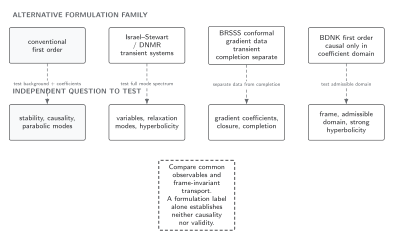
First-order attenuation coefficients are infrared constitutive data; the exact initial-value behavior also depends on variables, frame terms, relaxation equations, and higher-order completion. Each formulation must therefore be tested for its own modes, principal symbol, coefficient domain, and EFT range. The diagram is schematic; its columns are a comparison of alternatives, not a derivation of one formulation from another.
In text: conventional Landau-frame first order gives the universal shear, sound, and charge poles but a parabolic exact truncation; transient theories add independent relaxation variables; BRSSS organizes conformal gradient data; DNMR imports a kinetic closure; and BDNK changes general-frame principal terms. Agreement at small does not identify their high-frequency PDEs.
Exercise
Section titled “Exercise”Derive the shear pole and check dimensions.
Solution
For and velocity , momentum conservation gives
Thus . In natural units, , so has dimensions of time or length and has dimensions of inverse time. Positivity of places the pole below the real axis.
Where this leads
Section titled “Where this leads”Onsager Reciprocity and Entropy Production derives the transport inequalities. Conventional Relativistic Navier–Stokes Instability and Acausality explains why these stable infrared poles do not make the conventional exact PDE causal.
References
Section titled “References”-
Bemfica, Fábio S., Marcelo M. Disconzi, and Jorge Noronha. 2022. “First-Order General-Relativistic Viscous Fluid Dynamics.” Physical Review X 12: 021044. DOI. Open PDF.
-
Kovtun, Pavel. 2012. “Lectures on Hydrodynamic Fluctuations in Relativistic Theories.” Journal of Physics A: Mathematical and Theoretical 45: 473001. DOI. Open PDF.
-
Romatschke, Paul, and Ulrike Romatschke. 2019. Relativistic Fluid Dynamics In and Out of Equilibrium. Cambridge University Press. DOI.