

Percolation, Reheating, and Transition Completion
A first-order transition completes only if nucleation and bubble growth convert the false phase faster than expansion and reheating can preserve it. A bounce action, a nucleation temperature, one bubble per Hubble volume, and geometric percolation are four different diagnostics; none is interchangeable with shrinking physical false-phase volume.
Required background. Use the complete thermal nucleation rate and the validated bubble growth law.
Helpful background. Large deviations and phase coexistence clarifies the statistical assumptions behind independent droplets.
False-phase fraction as a history integral
Section titled “False-phase fraction as a history integral”For homogeneous Poisson nucleation in an expanding Friedmann background, the false-volume construction of Guth and Weinberg 1983, §§ II–III gives the probability that a comoving point remains in the false phase:
with
is the rate per physical volume and time, and is the physical radius at of a bubble born at . The exponential accounts for overlap in the ideal Poisson “extended-volume” approximation. Correlated nucleation, inhomogeneous temperatures, non-spherical growth, or bubble exclusion require a different stochastic geometry.
The converted fraction is , but the physical false-phase volume in a comoving region scales as
Its logarithmic derivative is
A necessary local completion condition is therefore , sustained strongly enough that . In a vacuum-dominated stage, can decrease while the total physical false volume still grows—the graceful-exit failure.
Nucleation, percolation, and completion temperatures
Section titled “Nucleation, percolation, and completion temperatures”A “nucleation temperature” is often defined by an expected number of order one bubbles in a Hubble region,
up to expansion and convention factors. It diagnoses first-bubble abundance, not connectivity or completion.
Geometric percolation is conventionally associated with a chosen threshold of converted volume in an overlapping-sphere model. For uncorrelated spheres, a commonly used benchmark is , corresponding to converted fraction , but the threshold depends on geometry, correlations, expansion, and the property whose connected cluster is tracked. It is not a universal thermodynamic constant.
Completion requires the false-phase fraction to become negligible and its physical volume to shrink. The temperatures assigned to these events depend on the full thermal history and need not be ordered by a simple fixed offset.
The diagram places percolation and reheating after both the nucleation history and the bubble-growth law. This ordering is physical: neither a threshold such as nor a single nucleation temperature replaces the spacetime integral for the converted fraction.
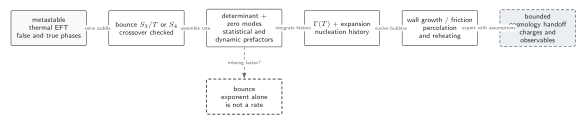
Percolation and completion depend jointly on , the expansion history, and the time-dependent bubble radius; reheating can feed back on all three. The boxes summarize this coupled history and do not identify nucleation, percolation, and completion temperatures with one another. The final cosmology arrow is conditional on a separately stated model interface. The diagram is schematic and not to scale.
The sections False-phase fraction as a history integral, Nucleation, percolation, and completion temperatures, and Reheating and coupled temperature evolution provide the text and equation equivalent of this history.
Checked constant-rate limit
Section titled “Checked constant-rate limit”In Minkowski spacetime with constant , constant , and nucleation beginning at ,
Dimensions check: and gives , so is dimensionless. The characteristic conversion time at is . This fourth-root scaling shows why neither the instantaneous rate nor the wall speed alone fixes completion.
Reheating and coupled temperature evolution
Section titled “Reheating and coupled temperature evolution”Latent heat and wall dissipation reheat the plasma, changing exponentially, the pressure difference, , and . A self-consistent treatment evolves energy conservation together with , schematically
with kinetic, gradient, and bulk-flow energy included according to the approximation. Imposing adiabatic while also releasing substantial latent heat is inconsistent. Reheating can pause nucleation near coexistence and make the transition proceed by growth of existing bubbles rather than continued nucleation.
Spatially inhomogeneous reheating can correlate later nucleation sites. Then a single global temperature and the Poisson exponent can fail; simulations or a controlled inhomogeneous model are needed.
Uncertainty propagation and failure tests
Section titled “Uncertainty propagation and failure tests”depends exponentially on the bounce action, while integrates against a cubic growth radius. Propagate the correlated uncertainties of the action, prefactors, , equation of state, and background history through the full integral. Varying one “” parameter is not enough when the rate is not locally exponential or reheating is strong.
Use the thermal transition validity table, and test:
- direct integration in time rather than a single-temperature criterion;
- sensitivity to rate interpolation and extrapolation outside computed temperatures;
- variable versus constant wall velocity;
- reheating and vacuum domination;
- the percolation threshold and overlap model; and
- the late-time sign of , not only .
Exercise
Section titled “Exercise”In de Sitter expansion with constant , suppose asymptotically . For what does the physical false-phase volume shrink?
Solution
. It shrinks for , remains constant at , and grows for , even though the fraction decreases whenever .
Continue
Section titled “Continue”Export the rate history, wall law, thermodynamics, duration, and completion status—each with its uncertainty—to the anomaly and cosmology interface. Do not export a downstream gravitational-wave or baryogenesis conclusion from completion alone.
References
Section titled “References”- Guth, A. H., and Weinberg, E. J. (1983). “Could the Universe Have Recovered from a Slow First-Order Phase Transition?” Nuclear Physics B 212, 321–364. DOI.
- Turner, M. S., Weinberg, E. J., and Widrow, L. M. (1992). “Bubble Nucleation in First-Order Inflation and Other Cosmological Phase Transitions.” Physical Review D 46, 2384–2403. DOI.