

Entanglement Distribution and State Transfer Through Curved Fields
State transfer through a curved quantum field is a statement about a complete encoded and decoded channel, not about the overlap of one conveniently selected mode. Geometry enters through causal propagation and mode evolution; the receiver’s accessible algebra, redshift compensation, leakage, field state, and success probability determine the operational fidelity. The same channel can distribute entanglement only if it preserves correlations with an external reference.
Required background. From Propagators and Response Functions to Channel Maps supplies the input–output map. Accelerated Detector Communication Channels supplies trajectory and clock effects. Quantum Communication and Entanglement Distribution defines the abstract tasks.
Helpful background. Communication Through Quantum Fields supplies field buses. Relativistic Communication Protocols: Assumptions and Status distinguishes proposals from demonstrated protocols.
Encoding, propagation, and decoding
Section titled “Encoding, propagation, and decoding”Let annihilate a normalized sender wavepacket and let encode an input state into that mode. Linear field propagation and receiver coupling give a Heisenberg relation
The coefficients are determined by the curved mode evolution and detector or optical coupling. A stationary passive link has ; time-dependent geometry or active components can make . Commutation preservation constrains all coefficients together, so retaining only can produce an unphysical reduced map.
Define the unconditional transfer channel
For an input entangled with a reference , entanglement fidelity is
where is a purification. This tests preservation of quantum correlations and is stronger than agreement of one output expectation value.
Static-metric wavepacket transfer
Section titled “Static-metric wavepacket transfer”Consider two static laboratories in
Let the sender prepare a coherent state in a finite-bandwidth bosonic wavepacket. Solve the stationary scattering problem to propagate to a complete output basis. The local-frequency ratio is . A redshift-aware decoder first applies the inverse frequency dilation and then projects onto the propagated spatial/polarization profile.
In a passive vacuum-environment fixture, the accepted mode obeys
where includes scattering, aperture, and residual mode mismatch after redshift compensation. The receiver removes . The output is , and its fidelity with the target is
Before redshift-aware decoding, replace by the overlap with the receiver’s unshifted mode. After decoding, deterministic frequency conversion no longer counts as loss; only residual inaccessible components and noise remain. Report both values to expose what the compensation accomplishes.
For a thermal or otherwise noisy environment with mean occupation , the quadrature covariance has
The coherent-state formula must then be replaced by the Gaussian-state fidelity computed from both mean and covariance. A field-mediated oscillator channel can be reconstructed in exactly this first-moment/covariance form Lapponi et al. 2023, §§ II–IV.
Entanglement distribution
Section titled “Entanglement distribution”To test distribution rather than single-system transfer, let and begin in a two-mode squeezed state with covariance
Apply the measured channel only to and test the partially transposed output covariance. Entanglement survives when its smallest symplectic eigenvalue is below in this normalization. This calculation names the input squeezing, channel noise, accepted modes, and receiver operation. It is not equivalent to saying that a global field state is entangled across two geometric regions.
The resource statement must also specify whether loss events are heralded. Conditional fidelity can be high even when the unconditional distribution rate is small. If a receiver postselects successful detection with probability , report at least the pair and the rate per attempted use.
The selected-mode trap
Section titled “The selected-mode trap”Let project onto the receiver’s accessible one-particle subspace. From a propagated wavefunction , define
The conditional overlap is one by construction. Quoting it alone conceals the probability in inaccessible or rejected modes. Reconstructing the full receiver channel reveals an erasure or loss component and lowers unconditional fidelity. The strongest surviving claim may be “high conditional mode fidelity at success probability ,” not high-fidelity deterministic transfer.
This adversarial test also catches a common horizon error. Restriction to an exterior receiver can reduce , but it does not show that the global evolution destroyed the encoded information.
Domain, limits, and maps
Section titled “Domain, limits, and maps”See Domain and failure conditions. The simple formulas assume a linear bosonic code and Gaussian or vacuum noise. Qubit detector transfer, nonlinear encodings, memory between uses, time-dependent backgrounds, and interacting fields require their own channel reconstruction. A high average fidelity over one narrow ensemble does not imply worst-case or entanglement fidelity.
The structure map shows the complete route from encoding to decoded task. Inspect the receiver restriction: leakage must enter before fidelity is evaluated.

Transfer fidelity is evaluated after deterministic frame conversion, physical scattering, leakage, receiver noise, and decoding have all been included. Schematic; not to scale.
The failure map stops a claim based on one normalized selected mode. The missing probability and orthogonal outputs are part of the channel.
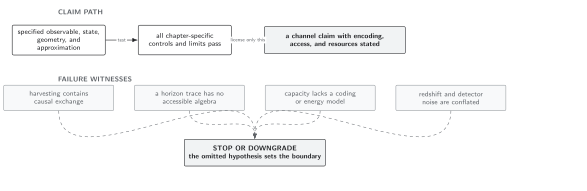
Complete receiver access and unconditional success probability are required before a selected-mode overlap becomes a state-transfer fidelity. Schematic; not to scale.
Related topics
Section titled “Related topics”Energy-Constrained Capacity Under Redshift and Acceleration turns the single-use channel into a coding task. Relativistic Protocols, Clocks, Encoding, and Channel Tomography specifies calibration and uncertainty. Abstract entanglement fidelity and coding remain with Quantum Communication and Entanglement Distribution.
References
Section titled “References”- Barcellos, Ian Bernardes, and André G. S. Landulfo. “Relativistic Quantum Broadcast Channel.” Physical Review D 109 (2024): 065020. DOI. Open PDF.
- Lapponi, Alessio, Dimitris Moustos, David Edward Bruschi, and Stefano Mancini. “Relativistic Quantum Communication between Harmonic Oscillator Detectors.” Physical Review D 107 (2023): 125010. DOI. Open PDF.