

Semiclassical First Laws and Physical-Process Variations
Black-hole “first laws” are linear-response identities with different hypotheses. A stationary Noether-charge law compares nearby stationary solutions; a physical-process law integrates flux through a horizon that settles down; an entanglement first law linearizes relative entropy. Agreement in a shared regime does not erase these distinctions.
Required background. Relative entropy and modular horizon laws supplies ; Noether-charge entropy supplies stationary charges; and stress conservation and backreaction supplies the flux source. Helpful background. Review conical entropy and the entanglement first law.
Three linear statements
Section titled “Three linear statements”For nearby stationary solutions of a diffeomorphism-invariant theory,
This follows from a covariant phase-space identity and requires the background Killing field, linearized constraints, and fixed asymptotic boundary conditions Iyer and Wald 1994, §§III–VI, pp. 851–860.
For a weak pulse crossing a Killing horizon, choose an affine generator with parameter and on the future horizon. Linearizing Raychaudhuri about and using the semiclassical field equation gives
The final stationary boundary condition removes the homogeneous expansion mode. Rotation, charge, higher-curvature terms, and quantum stress require their corresponding charges and entropy functional. Gao and Wald state the physical-process hypotheses and the restrictions needed for charged and rotating holes Gao and Wald 2001, §§II–IV.
This area response is teleological for an event horizon: the final condition determines how its generators begin to expand before the pulse crosses. That is compatible with the integrated first law but should not be mistaken for a local material membrane response. The orientation of , origin of , and normalization of must be matched to the positive Killing-energy flux; changing all consistently leaves the physical equality invariant.
For a state perturbation on one fixed algebra,
This follows because relative entropy is stationary at . It is neither a nonlinear entropy law nor a statement that is local.
First application: compare stationary and process variations
Section titled “First application: compare stationary and process variations”Take a quasi-stationary neutral pulse into Schwarzschild. The stationary comparison gives . The physical-process calculation gives the same relation by integrating , provided the pulse is weak, caustics do not form, the horizon begins and ends near stationary configurations, and second-order shear and expansion are negligible. For a Rindler vacuum reference, the modular first law equates the corresponding weighted boost-energy flux to the matter entropy variation.
These are three derivations of compatible linear coefficients in their overlap. At second order, relative entropy becomes positive, Raychaudhuri contains and , and canonical energy enters stability statements. Equality at first order therefore does not imply reversible dynamics.
A useful conservation check encloses the process between two stationary cuts and spatial infinity. The charge lost or gained at infinity, the matter flux through the horizon, and the horizon entropy term must satisfy the same orientation convention. A leftover boundary term usually indicates that the perturbation changes an asymptotic source or that a gauge charge was omitted.
The structure map displays the three inputs meeting only within a shared perturbative domain.

Noether, physical-process, and entanglement first laws share a linear-response regime but use different state, geometry, and boundary data. Schematic; not to scale.
Domain and failure conditions
Section titled “Domain and failure conditions”Compare the three laws in the chapter’s domain table. Always state the reference solution/state, perturbation parameter, horizon type, asymptotic charges, entropy functional, and retained order.
Adversarial test. Send a violent pulse that generates order-one expansion, shear, or caustics and apply the linear physical-process formula. The discarded and terms are then of leading importance, and no nearby stationary comparison may exist. The correct conclusion is that the first-order formula has lost control—not that the second law fails.
The failure map makes perturbative order the decisive branch.
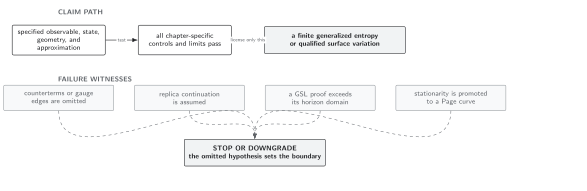
First laws diagnose tangent-space response; finite evolution needs nonlinear horizon dynamics and, for monotonicity, a GSL result with its own hypotheses. Schematic; not to scale.
References
Section titled “References”- Gao, S., and R. M. Wald, “The ‘Physical Process’ Version of the First Law and the Generalized Second Law for Charged and Rotating Black Holes,” Physical Review D 64, 084020 (2001), doi:10.1103/PhysRevD.64.084020.
- Iyer, V., and R. M. Wald, “Some Properties of Noether Charge and a Proposal for Dynamical Black Hole Entropy,” Physical Review D 50, 846–864 (1994), doi:10.1103/PhysRevD.50.846.