

Dispersion Relations, Subtractions, and Qualified Positivity
A dispersion relation reconstructs an analytic function from its discontinuities only after its complex domain, growth at infinity, infrared singularities, and subtraction data are specified. A positive cut can then imply a sign for selected derivatives, but cosmological wavefunction coefficients do not inherit flat-space forward-limit positivity automatically.
Required background. Factorization singularities and cosmological cuts supply the analytic data. Boundary values and dispersion integrals supplies the complex analysis, and subtracted amplitude dispersion relations supplies the flat-space model.
Helpful background. Massless-exchange caveats and EFT positivity and UV consistency show where standard amplitude signs require extra hypotheses.
A subtracted representation
Section titled “A subtracted representation”Let be analytic in the complex plane apart from a cut and any separately listed crossed cuts or poles. Suppose subtractions are sufficient for the large circle to vanish. At a subtraction point off the cuts,
The constants are independent data. They are local contact or boundary coefficients in many cosmological applications. Increasing weakens the growth assumption but enlarges this polynomial ambiguity.
The formula follows from Cauchy’s theorem only if:
are all declared. Knowing where a perturbative tree coefficient has poles is not a nonperturbative polynomial-boundedness theorem.
Cut data and a conditional sign
Section titled “Cut data and a conditional sign”Consider a once-subtracted function with and no crossed cut,
Then
If , the integral converges, the real-axis reflection property holds, and there are no omitted poles or crossed contributions of indefinite sign, then . This is a valid positivity statement because every hypothesis is visible.
For a generic cosmological coefficient, however, is a branch discontinuity of a complex wavefunction object, not an inclusive cross section. A cosmological cut can be a product of lower-point coefficients with phases, helicity contractions, and state weights. Positivity must be established for the particular real observable or projected combination; it does not follow from the word “unitarity.”
Baumann, Green, Lee, and Porto derive an inflationary sum rule assuming Lorentz-invariant short-distance physics and spell out why positivity is not guaranteed for a general nonrelativistic low-energy system (Baumann et al. 2016, abstract and §§ 3–5). Their result is a controlled class of bounds, not a universal cosmological replacement for flat-space positivity.
Boundary-coefficient application
Section titled “Boundary-coefficient application”Take a boundary coefficient whose discontinuity is supplied by a state-appropriate cosmological cut. The reproducible decomposition is
where
and is the local subtraction polynomial. Report these three pieces separately. A cut calculation constrains ; matching or a symmetry may constrain some coefficients of ; neither should be hidden in a numerical contour integral.
Vary the subtraction point. Differentiating the representation shows that the full is invariant when the transform consistently. If a claimed bound changes because were held fixed under a change of scheme, it is a statement about a chosen contact representative.
Massless exchange adversarial test
Section titled “Massless exchange adversarial test”Add a massless exchange contribution with a singularity at the intended expansion point,
and an allowed subtraction polynomial . The derivative is now undefined before infrared separation, while lower derivatives can be shifted by . A valid analysis must either work at finite momentum transfer or mass, subtract the known exchange with a controlled regulator, and apply a sign only to the remaining infrared-safe functional.
Perform the sign test after:
- changing the allowed polynomial coefficients;
- varying the infrared regulator inside its overlap domain;
- adding crossed cuts and helicity channels;
- changing the prepared state within the claimed class.
Reject every positivity claim whose sign changes without violating a stated hypothesis. The surviving result may be a sum rule without a sign, a sign for one projected derivative, or no useful bound.
The structure map places dispersion after cuts and locality. Inspect how the contour reconstructs a nonlocal part while the subtraction branch remains independent.

Subtracted cosmological dispersion and its possible sign information. The diagram is schematic and not to scale; positivity requires a positive projected spectral measure in addition to analyticity and unitarity.
The failure map isolates the missing hypotheses. Inspect the stops for an unbounded large circle, an unsubtracted massless pole, an indefinite state-dependent cut, or a sign shifted by a local polynomial.
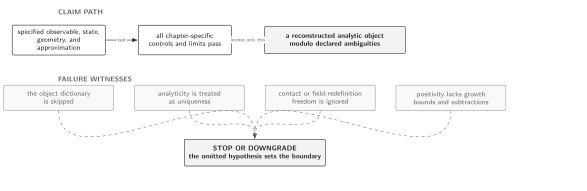
Failure conditions for cosmological dispersion and qualified positivity. The diagram is schematic and not to scale; no flat-space positivity theorem transfers automatically to a boundary wavefunction coefficient.
These conditions refine the chapter’s domain and failure conditions. Their role in a full solution is assessed in reconstruction from singularity data.
Exercise
Section titled “Exercise”Let with . Evaluate the once-subtracted and .
Solution
Substitution gives
Therefore
The constant remains free because one subtraction was used. Adding a linear subtraction would also free , demonstrating that the sign depends on the justified subtraction count.