

Soft Limits and Inflationary Consistency Relations
An inflationary consistency relation is a Ward identity with dynamical hypotheses. A long adiabatic mode can act as a coordinate transformation on short modes only for a single-clock attractor, a compatible state, local evolution, and a soft limit taken after the long mode has become the appropriate adiabatic solution.
Required background. Cubic interactions and bispectrum shapes supplies the three-point normalization; constraint solving and the observable dictionary supplies residual transformations; and soft limits as on-shell constraints supplies the general factorization logic.
Helpful background. Power spectra and freeze-out supplies the spectral tilt, while momentum-space conformal Ward identities supplies the dilation and special-conformal form.
The squeezed scalar relation
Section titled “The squeezed scalar relation”Use the dimensionful power spectrum and primed correlators, with
A constant long mode rescales the local spatial coordinates. Acting on the short two-point function gives
Equivalently, the leading coefficient is . The formula assumes the soft mode is outside the horizon and in the constant adiabatic branch while the hard modes are measured. Maldacena verifies it directly in the canonical single-field bispectrum Maldacena 2003, §4.1, Eqs. (4.6)–(4.12), and Creminelli and Zaldarriaga isolate its single-clock hypotheses Creminelli and Zaldarriaga 2004, §§2–3, Eqs. (4)–(12).
The first application derives the dilation Ward identity by conditioning the hard two-point function on :
Correlating with the long mode reproduces the squeezed relation. A direct in-in evaluation of the cubic action must give the same coefficient after field redefinitions and boundary terms are included.
Hypotheses, subleading terms, and observables
Section titled “Hypotheses, subleading terms, and observables”The leading dilation relation requires one physical clock, an attractor so the long solution is locally removable, a state invariant under the residual symmetry, locality or suitable analyticity, and an observable whose definition transforms with the coordinates. Special-conformal transformations constrain angular dependence at subleading soft order, but gradient long modes and projection effects require care. Late-time observed galaxy or microwave-background squeezed limits also contain transfer and light-cone effects absent from the primordial identity.
The order of limits is part of the theorem. The soft wavelength must be much larger than the hard scale, the soft mode must have reached its adiabatic branch, and the correlator must be evaluated at a common late time before sending to zero. Taking at the action level can erase the physical adiabatic mode, while taking the observation time to infinity before combining in-in branches can manufacture boundary terms. At finite , corrections organize into powers and angular structures whose coefficients contain new physical information rather than violations of the leading identity.
Tensor soft limits provide a parallel example: a long graviton produces an anisotropic rescaling of the hard correlator. Its normalization depends on the two-helicity convention, and its observable interpretation again requires a relational frame. The scalar formula alone does not exhaust the Ward identities.
The structure map shows the soft theorem as a check on the complete state-plus-dynamics correlator, not as an independent interaction rule.

Under single-clock attractor and state-invariance hypotheses, the leading soft scalar mode dilates the hard two-point function and fixes the squeezed bispectrum. Schematic; not to scale.
Two decisive counterexamples
Section titled “Two decisive counterexamples”An excited initial state selects a preferred initial surface and can violate the residual-symmetry Ward identity through boundary terms. A nonattractor phase gives a growing long mode that changes local physical data rather than acting only as a dilation. Compute the squeezed bispectrum in each case and compare it with the actual late-time short-spectrum response; the standard right-hand side need not hold.
Multi-field entropy transfer is a third failure: the long field changes local couplings and conversion history. The result may obey a generalized response relation, but not the universal single-clock expression. See the chapter’s domain and failure conditions.
A productive failure therefore reports the response that replaces the standard right-hand side—for example, a derivative with respect to a local background field or boundary-state parameter—rather than merely announcing that “consistency is violated.”
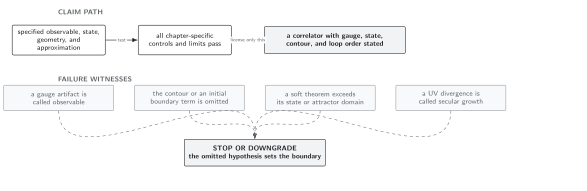
The squeezed identity is rejected or generalized when the state, clock content, attractor behavior, locality, or observable transformation violates its Ward-identity hypotheses. Schematic; not to scale.
References
Section titled “References”- Creminelli, P., and M. Zaldarriaga, “Single-Field Consistency Relation for the 3-Point Function,” Journal of Cosmology and Astroparticle Physics 10, 006 (2004), doi:10.1088/1475-7516/2004/10/006.
- Maldacena, J., “Non-Gaussian Features of Primordial Fluctuations in Single Field Inflationary Models,” Journal of High Energy Physics 05, 013 (2003), doi:10.1088/1126-6708/2003/05/013.