

Graviton and Matter Nonlocal Form Factors
Nonlocal gravitational form factors record propagation over finite separations. Their logarithms and branch cuts are fixed by light fields, while local curvature coefficients retain matching and subtraction information. A scientifically usable result must keep matter loops separate from the combined graviton–ghost sector and must distinguish an in–out form factor from the retarded kernel used in a causal mean equation.
Required background. One-Loop Graviton EFT supplies metric and ghost loops; Matter-Induced Nonlocal Form Factors supplies matter-only kernels; and Matter Contributions to Gravitational Matching supplies threshold bookkeeping.
Helpful background. Retarded, Advanced, and Spectral Correlators fixes causal boundary values, while Spectra, Resolvents, Spectral Measures, and Functional Calculus supplies the operator meaning of a logarithm.
Curvature-bilinear kernels
Section titled “Curvature-bilinear kernels”On a weak, boundaryless four-dimensional background, a parity-even effective action through second order in curvature can be organized schematically as
Equivalent Riemann–Ricci–scalar bases may be used if all local and nonlocal relations are transformed consistently. Boundaries, topology, and terms cubic in curvature obstruct an unqualified use of the four-dimensional Euler identity and require their own basis.
For massless fields, a typical one-loop form factor is
The Lorentzian logarithm is defined by its contour and flat symbol:
Thus is formally in the site Fourier convention. Writing would instead have the wrong flat symbol.
The matter coefficient comes from a determinant at fixed metric. The second coefficient is the sum of the metric Hessian and Faddeev–Popov ghost contributions; its separate pieces need not be gauge independent. If background matter is nonzero, quadratic metric–matter mixing must be diagonalized or treated as an explicitly mixed sector rather than assigned by the appearance of an external leg.
The structure map makes these internal-line definitions visible before the sectors are combined.

Matter and metric–ghost loops share a curvature basis and subtraction scale, but their coefficients, multiplicities, and gauge checks remain separately identifiable. The map is schematic and not to scale.
First application: adding two logarithms
Section titled “First application: adding two logarithms”Consider massless scalar species and the pure metric–ghost sector on a weak background. In a fixed basis define
Then
The coefficients are left symbolic because their numerical values depend on the normalization of the invariant and on the precise field content. Their scaling is already decisive: the matter part grows with , while the pure metric–ghost part is . The running of cancels the explicit scale dependence of the logarithm in a complete response. Barvinsky and Vilkovisky derive the curvature expansion and nonlocal operator form factors in Barvinsky and Vilkovisky 1985, §§6–8, pp. 33–55.
For a field of mass , the logarithm is replaced by a threshold form factor with the same declared boundary value. At it has a local derivative expansion; near and above threshold it develops the appropriate cut. Replacing it by a massless logarithm below threshold would violate decoupling.
Reassigning the ghost term to the matter determinant fails two tests. First, the supposed “matter” coefficient would not scale purely with . Second, varying the gravitational gauge parameter would leave an uncancelled dependence because the ghost determinant cancels gauge directions in the metric Hessian, not in the scalar operator. Only the combined result enters the matched invariant response.
Branch cuts and causal continuation
Section titled “Branch cuts and causal continuation”For the positive Euclidean operator ,
Analytically continuing this resolvent gives the flat Feynman symbol above. Its discontinuity is spectral information from propagating light states; local counterterms are polynomials and have no such cut. An in–out effective action may therefore produce complex matrix elements when channels open.
A causal expectation-value equation is different. Its Schwinger–Keldysh variation replaces the Feynman resolvent by the appropriate retarded combination, schematically
The difference is understood as a regulated distribution and requires initial data and a state. One cannot take a Euclidean or in–out answer, erase , and call the result causal. Donoghue and El-Menoufi display how nonlocal logarithms generate history-dependent causal evolution in Donoghue and El-Menoufi 2014, §§II–III, pp. 104062-2–104062-7.
Checks and limits
Section titled “Checks and limits”The discontinuity must satisfy the relevant unitarity cut; the local scale dependence must cancel; and the full response must obey the background Ward identity. A conformally flat background has , so the term vanishes there even though its coefficient is nonzero. A Ricci-flat gravitational-wave background instead tests the Weyl sector while suppressing .
Form factors are distributions, not pointwise functions of . Zero modes, boundaries, and nonstationary states can change their domain. The curvature expansion also requires that higher powers of curvature remain smaller than the retained bilinear response, even when the logarithm itself is numerically enhanced.
Domain and failure conditions
Section titled “Domain and failure conditions”The chapter comparison table requires the loop sectors, gauge complex, spectrum, masses, state or contour, curvature basis, boundary conditions, subtraction scale, and observable. Matter-only derivations remain in Chapter 8, causal backreaction in Chapter 9, and ultraviolet entire-function models lie outside low-energy EFT.
The failure map tests sector labels by gauge variation, species scaling, and threshold limits.
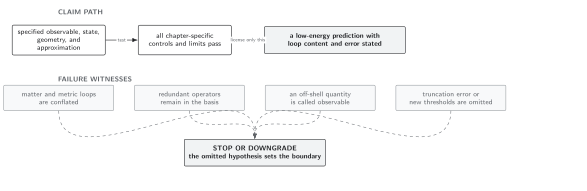
Nonlocal form factors are reliable only when internal-line sectors, analytic continuation, and active thresholds are kept explicit through the final invariant response. The map is schematic and not to scale.
References
Section titled “References”- Barvinsky, A. O., and G. A. Vilkovisky. “The Generalized Schwinger–DeWitt Technique in Gauge Theories and Quantum Gravity.” Physics Reports 119, 1–74 (1985). doi:10.1016/0370-1573(85)90148-6
- Donoghue, J. F., and B. K. El-Menoufi. “Nonlocal Quantum Effects in Cosmology: Quantum Memory, Nonlocal FLRW Equations, and Singularities.” Physical Review D 89, 104062 (2014). doi:10.1103/PhysRevD.89.104062. Open PDF