

Matter-Induced Nonlocal Form Factors
Matter loops generate curvature kernels that depend nonpolynomially on derivatives. These form factors retain thresholds, branch cuts, and long-distance memory that no finite local heat-kernel truncation can contain. Their Euclidean, Feynman, and retarded versions are analytic continuations of related spectral data, but they are not interchangeable observables.
Required background. One-Loop Matter Effective Actions in Curved Space fixes the determinant, Green Operators, Causal Propagators, and State-Dependent Two-Point Functions fixes Green-function types, and Modes, Virtualities, and EFT Scale Separation fixes the momentum regime.
Helpful background. Retarded, Advanced, and Spectral Correlators supplies real-time discontinuities, and Spectra, Resolvents, Spectral Measures, and Functional Calculus supplies operator functions.
Curvature-bilinear kernels
Section titled “Curvature-bilinear kernels”At quadratic order in weak curvatures, a Euclidean matter action has the schematic covariant form
The tensor coefficients depend on spin and curvature coupling. Covariant perturbation theory expands in the number of curvatures while keeping all derivatives in functions such as
thereby complementing the Schwinger–DeWitt expansion, which expands derivatives as well Barvinsky and Vilkovisky 1985, §§ 5–6.
For a massless field, after local subtraction at scale , the characteristic kernel is
It has the resolvent representation
for a positive Euclidean operator , with common regulator understood. This makes nonlocality explicit: each resolvent samples separated points. Changing adds a local curvature-bilinear term; it does not remove the resolvent tail.
First application: logarithm and spectral density
Section titled “First application: logarithm and spectral density”In flat-space momentum variables, analytically continue the Euclidean logarithm to the in–out boundary value
For timelike ,
The discontinuity,
is the massless limit of the multiparticle spectral cut, multiplied in an actual stress channel by its tensor coefficient and threshold density. With the stated ordering of boundary values, the unit logarithm has positive spectral density
for the unit logarithm. A once-subtracted dispersion relation reconstructs the form factor up to a local polynomial. Thus the branch cut is physical spectral information, while the subtraction polynomial is scheme data.
The retarded boundary value is instead
whose imaginary part changes sign with and whose position-space kernel has retarded support. The Feynman kernel is symmetric under time ordering and is not retarded. Both may be obtained from one analytic function, but only after different boundary values have been selected.
Continuation adversary
Section titled “Continuation adversary”Vary the Euclidean or in–out term and insert its Feynman kernel into a proposed mean metric equation. For a compact source switched on at , the Feynman convolution generally has contributions at observation times earlier than the source because it implements vacuum boundary conditions at both temporal ends. The retarded convolution vanishes before the source.
The strongest valid in–out statement is about the vacuum amplitude, time-ordered response, or absorptive spectral density. Causal backreaction requires the closed-time-path action, which produces the retarded boundary value together with initial-state terms. Replacing in a final formula without rederiving the contour can miss contact terms and state dependence.
The structure map separates finite local terms, exact nonlocal form factors, and their real-time continuations. Inspect the contour label before following any arrow to response.

The same spectral function supports different boundary values; local scale shifts and nonlocal branch information remain distinct. Schematic; not to scale.
Domain and failure conditions
Section titled “Domain and failure conditions”The curvature-bilinear expansion requires weak curvature but need not require small derivatives. Higher curvature orders may still matter. A massless logarithm requires infrared boundary data and possible zero-mode subtraction. Causal use requires an in–in derivation. See Domain and failure conditions.
The failure map stops two common claims: a finite local polynomial cannot reproduce a branch cut, and a Feynman kernel cannot be relabeled retarded because both are covariant.
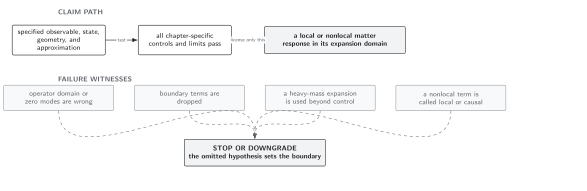
Curvature order, derivative order, subtraction polynomial, spectral cut, and real-time contour are independent controls on a nonlocal result. Schematic; not to scale.
Related topics
Section titled “Related topics”Anomaly-Induced and Nonlocal Actions integrates a specific Weyl variation. Causal mean equations belong to In–In Effective Actions and Causal Backreaction.
References
Section titled “References”- Barvinsky, Andrei O., and Grigori A. Vilkovisky. “The Generalized Schwinger–DeWitt Technique in Gauge Theories and Quantum Gravity.” Physics Reports 119 (1985): 1–74. DOI.
- Barvinsky, Andrei O., and Grigori A. Vilkovisky. “Covariant Perturbation Theory (II). Second Order in the Curvature. General Algorithms.” Nuclear Physics B 333 (1990): 471–511. DOI.
- Vassilevich, Dmitri V. “Heat Kernel Expansion: User’s Manual.” Physics Reports 388 (2003): 279–360, § 8. DOI. Open PDF.