

Redshift, Restricted Access, and Effective Channel Noise
Gravitational redshift is a deterministic relation between frequencies measured by different observers. In a stationary lossless field theory it is not, by itself, decoherence. An effective noisy channel appears only after a receiver selects a mode or algebra, ignores orthogonal outputs, encounters scattering or absorption, or adds detector and environmental noise. The distinction is essential for both communication and metrology.
Required background. Specifying a Quantum Channel in Curved Spacetime fixes the access and task. From Propagators and Response Functions to Channel Maps separates gain and covariance. Channel–State Correspondence in Infinite Dimensions supplies the continuous-variable setting.
Helpful background. Wavepackets, Modes, Frames, and Localization fixes normalized mode subspaces. Tolman Redshift, KMS Structure, and Local Temperature relates local frequency and temperature. Measurement-Induced Energy, Noise, and Backreaction identifies receiver-generated noise.
Frequency conversion in a static spacetime
Section titled “Frequency conversion in a static spacetime”For
the Killing frequency is conserved along stationary propagation. A static observer with four-velocity measures
Thus a wave sent from and received at has
This relation changes local clock rates and the frequency label of a mode; it does not randomize a pure state. In a complete positive-frequency mode space, an ideal frequency dilation is represented by a norm-preserving map
A decoder using recovers the intended mode in this idealized fixture. Curvature can additionally generate scattering by an effective potential, polarization rotation, lensing, or time-dependent Bogoliubov mixing; those are separate propagation mechanisms and must be included in the full mode map.
Reduction to an effective channel
Section titled “Reduction to an effective channel”Let be the propagated normalized mode and the mode accepted by a receiver filter. Complete to an orthonormal output basis and write
If the receiver has access only to and the orthogonal mode is discarded, the reduced map is a loss channel. The loss is relative to that access choice. If both modes remain accessible and the complete transformation is unitary, no entropy has been generated globally.
For quadratures, a useful receiver model is
where represents deterministic redshift-aware mode conversion, is a specified inaccessible or environmental mode, and is detector noise. Only the last two terms contribute effective added noise. A thermal state can make noisy; Tolman’s law then tells different static receivers how to express the same equilibrium state locally, rather than declaring redshift itself stochastic.
Narrow-wavepacket application
Section titled “Narrow-wavepacket application”Approximate a positive-frequency wavepacket by a normalized Gaussian narrow enough that extending the integral to the real line is harmless,
Ideal static propagation gives a received profile centered at with width . A redshift-aware receiver chooses exactly that profile, giving before physical scattering or loss. A receiver that instead retains a Gaussian filter of center and width obtains
This number quantifies mode mismatch, not fundamental decoherence. The first application is completed by reporting separately , the matched and unmatched , any greybody or aperture loss, and the measured receiver covariance. Weak-Earth-field models use such overlaps to estimate communication and metrological effects Bruschi et al. 2014, §§ II–IV.
The effective single-environment-mode representation has a limited domain. A 2026 analysis shows that a proposed finite-mode gravitational-redshift mixer can lose unitarity outside a parameter-dependent small-redshift regime unless enough auxiliary modes are retained Leber et al. 2026, §§ 3–4. This is a model-validity result, not evidence that physical redshift becomes nonunitary.
Restore the full algebra
Section titled “Restore the full algebra”The adversarial claim begins by taking relative to one fixed filter, tracing , and calling the resulting mixed state “curvature-induced decoherence.” Restore the algebra generated by both and and apply the inverse passive mode transformation. In the ideal fixture, the initial pure state is recovered and the global entropy remains zero. The surviving statement is narrower: the chosen receiver filter has mismatch loss. A genuine decoherence claim needs an uncontrolled environment, absorption, fluctuating geometry, time-dependent particle creation with inaccessible partners, or an operationally justified restriction.
Domain, limits, and maps
Section titled “Domain, limits, and maps”The chapter’s comparison is Domain and failure conditions. The dilation model assumes stationary propagation, a shared positive-frequency sector, fixed background geometry, and negligible backreaction. It is not a universal photon model near horizons or in rapidly time-dependent spacetimes. Wavepacket normalization, helicity or polarization, diffraction, and detector bandwidth must be restored for an experimental link.
The structure map places deterministic propagation before receiver restriction. Inspect the transition between them: only a declared loss of access converts reversible mode motion into an effective noisy channel.

Frequency dilation is a propagation and frame transformation; mismatch, discarded modes, absorption, and receiver fluctuations determine effective channel noise. Schematic; not to scale.
The failure map identifies the redshift/noise conflation. Restoring the complete mode algebra is the decisive countertest.
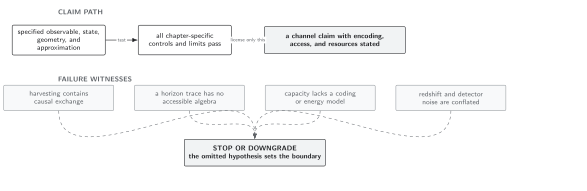
An entropy increase caused solely by tracing mismatched modes licenses a receiver-restriction claim, not intrinsic curvature-induced decoherence. Schematic; not to scale.
Related topics
Section titled “Related topics”Entanglement Distribution and State Transfer Through Curved Fields builds a decoded fidelity from the complete mode map. Energy-Constrained Capacity Under Redshift and Acceleration translates local energy constraints. Tolman Redshift, KMS Structure, and Local Temperature develops equilibrium interpretation.
References
Section titled “References”- Bruschi, David Edward, Timothy C. Ralph, Ivette Fuentes, Thomas Jennewein, and Mohsen Razavi. “Spacetime Effects on Satellite-Based Quantum Communications.” Physical Review D 90 (2014): 045041. DOI. Open PDF.
- Leber, Nils, Luis Adrián Alanís Rodríguez, Alessandro Ferreri, Andreas Wolfgang Schell, and David Edward Bruschi. “Limits to the Validity of Gravitational Redshift as a Quantum-Optical Multimode Mixer.” International Journal of Theoretical Physics 65 (2026): 98. DOI. Open PDF.