

Covariant Algebraic Quantization and Fock Realizations
Covariant quantization fixes an abstract observable algebra before choosing particles, a vacuum, or even a Hilbert-space representation. A real symplectic space gives a CCR algebra, a fermionic Hermitian space gives a CAR algebra, and a state then produces a representation through the GNS construction. A compatible complex structure can yield a Fock space, but on a generic curved spacetime neither that structure nor the resulting particle concept is canonical.
Required background. Covariant Symplectic Structure and Conserved Inner Products supplies the classical phase space; Green Operators, Causal Propagators, and State-Dependent Two-Point Functions supplies the causal pairing; Quantizing the Real Scalar Field supplies the free-field prototype.
Helpful background. Fock Space, Vacuum, and Particle Number develops the flat-space realization; Operator Algebras and Positive Functionals supplies the algebraic language.
CCR and CAR algebras
Section titled “CCR and CAR algebras”Let be the real symplectic space of scalar solutions with suitable support. The polynomial CCR algebra is generated by symbols satisfying
Equivalently, bounded Weyl generators obey
The passage from the causal solution space to Weyl or polynomial CCR algebras, including the equation-of-motion quotient, is developed in Bär, Ginoux, and Pfäffle 2007, Chapter 4.
In the test-function presentation used earlier,
because the surface symplectic form and carry the corresponding fixed sign under the solution map. The equation of motion is built in by .
For a fermion, the positive classical Hermitian form instead determines CAR generators:
Gauge theories require the reduced phase space or a cohomological construction before these relations are imposed. Applying CCR relations directly to a degenerate presymplectic form leaves unphysical null directions.
States, GNS representations, and Fock choices
Section titled “States, GNS representations, and Fock choices”A state is a normalized positive linear functional,
The GNS construction produces a Hilbert space , a representation , and a cyclic vector such that
This separates three objects often conflated in mode quantization: the abstract algebra, the state, and the representation induced by that state.
For a bosonic linear theory, a compatible complex structure on satisfies
It splits the complexified solution space into positive- and negative-frequency subspaces and defines a pure quasifree state and Fock representation. A stationary spacetime with a positive-energy time-translation generator may select such a . A general time-dependent curved spacetime does not.
Two complex structures and can define unitarily inequivalent Fock representations. In a mode description, unitary implementability of their Bogoliubov transformation requires the antilinear coefficient to be Hilbert–Schmidt. This is a representation criterion, not a condition for the underlying CCR algebra to exist.
The separation among algebra, state, and representation—and the resulting caution about particle interpretations in nonstationary spacetimes—is reviewed in Fewster and Rejzner 2019, §§3–4.
First application: one algebra, two mode splittings
Section titled “First application: one algebra, two mode splittings”Consider a scalar on a globally hyperbolic FLRW spacetime. The causal propagator fixes one CCR algebra. Choose normalized mode families and related by
Each family defines annihilation operators and a Fock vacuum. Their number operators differ; in a discrete normalization,
Yet the smeared field commutator, local equations of motion, and algebraic relations are unchanged. If diverges, the two Fock representations are not related by a unitary map, but both remain representations of the same local field algebra.
This comparison is the declared adversarial test: preserve and the CCR algebra while changing . Vacuum, particle number, and perhaps unitary equivalence change; algebraic observables and their causal commutator do not. It is therefore incorrect to call a particular Fock vacuum “the quantization” without naming the additional geometric or state-selection criterion.
Construction and failure maps
Section titled “Construction and failure maps”In the first schematic, inspect the order: symplectic reduction precedes the local algebra, while evaluation in a state comes afterward. For this page, that order is what prevents a convenient complex structure from being mistaken for canonical physics.

The abstract CCR or CAR algebra is fixed before a state-dependent Fock realization; the construction map is schematic and not to scale.
The second schematic should be read here as a claim filter: positivity, the commutator, the field equation, and any unitary-implementability assertion are distinct tests.
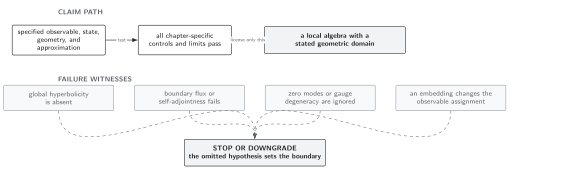
A Fock-space conclusion is licensed only for the declared state and complex structure; failure of a Hilbert–Schmidt test downgrades unitary equivalence, not the algebra itself. Schematic and not to scale.
The chapter-wide comparison is collected in Domain and failure conditions. Here the decisive local data are a nondegenerate reduced pairing and a positive state. Gauge degeneracy blocks the CCR/CAR step; failure of the Bogoliubov implementability criterion blocks only a shared Fock representation.
Check your understanding
Section titled “Check your understanding”Does imply that the two mode choices define different field equations?
Solution
No. The divergence says that the Bogoliubov transformation is not unitarily implementable between the two Fock representations. Both mode families solve the same equation, have the same conserved symplectic normalization, and represent the same CCR algebra. Their vacuum and particle interpretations differ.
Local Field Algebras, Causality, and the Time-Slice Property localizes this algebra by spacetime region. General flat-space quantization remains in Volume II, state admissibility begins in Chapter 2, and theorem-first algebraic constructions and completions remain in Volume XVI.
References
Section titled “References”- Huzihiro Araki, Mathematical Theory of Quantum Fields, Oxford University Press (1999), DOI, Chapters 2–3.
- Christian Bär, Nicolas Ginoux, and Frank Pfäffle, Wave Equations on Lorentzian Manifolds and Quantization, European Mathematical Society (2007), DOI, Open PDF, Chapter 4.
- Christopher J. Fewster and Kasia Rejzner, “Algebraic Quantum Field Theory—An Introduction,” in Progress and Visions in Quantum Theory in View of Gravity, Birkhäuser (2020), 1–61, DOI, arXiv:1904.04051.
- Robert M. Wald, Quantum Field Theory in Curved Spacetime and Black Hole Thermodynamics, University of Chicago Press (1994), publisher record, Chapters 3–4.