

Hawking–Moss Transitions and the Stochastic Crossover
The Hawking–Moss saddle places the field homogeneously at a barrier-top stationary point on a Euclidean four-sphere. Its action difference can agree with a stochastic first-passage exponent in a controlled light-field, slow-background limit, but the two constructions define different intermediate objects. The crossover from a Coleman–De Luccia (CDL) bounce is therefore a branch and observable question, not a universal switch at one number.
Required background. False-vacuum decay with gravity fixes the state and observable. Euclidean gravitational saddles fixes the action difference, and Coleman–De Luccia bounces supplies the inhomogeneous branch to be compared.
Helpful background. Metastability and spinodals distinguishes barrier crossing from loss of metastability.
The homogeneous four-sphere saddle
Section titled “The homogeneous four-sphere saddle”Let , with . If is a false-vacuum minimum and is a stationary barrier top with positive , the homogeneous Euclidean solutions have
Their on-shell actions are
The Hawking–Moss action difference is consequently
This is an action difference between compact saddles in the same Euclidean convention. Interpreting as a decay probability still requires the fluctuation contour and a Lorentzian observable. Hawking and Moss introduced the homogeneous saddle for supercooled cosmological transitions (Hawking and Moss 1982, Eqs. (4)–(9)).
The homogeneous configuration should not be pictured as a whole pre-existing Lorentzian Hubble volume jumping simultaneously in a coordinate-independent instant. A safer statement is that the compact saddle controls a semiclassical barrier-top contribution under specified boundary and state data; later coarse-grained evolution decides whether a region rolls toward the true basin.
Barrier curvature and nearby branches
Section titled “Barrier curvature and nearby branches”On a round four-sphere, a scalar harmonic of angular momentum has the fixed-background eigenvalue
Thus the first inhomogeneous harmonic becomes marginal at
This is a useful local bifurcation diagnostic, not a complete global dominance theorem. Metric constraints alter the physical fluctuation problem, nonlinear terms decide on which side a branch exists, and sufficiently structured potentials admit oscillating solutions with several crossings of the barrier. Hackworth and Weinberg display these additional branches and show why barrier curvature alone does not classify every bounce (Hackworth and Weinberg 2005, §§ II–IV).
A controlled parameter scan therefore records, for every branch,
The dominant candidate is not selected by the smallest action alone if its contour or negative-mode interpretation is absent.
Stochastic first passage and the overlap limit
Section titled “Stochastic first passage and the overlap limit”For a light, slowly rolling spectator-like scalar in an approximately fixed de Sitter background, coarse graining near the Hubble scale gives the Markovian Fokker–Planck equation
With constant , its zero-current stationary weight is
The corresponding small-noise barrier exponent is
For and , expanding gives exactly this leading exponent. Starobinsky and Yokoyama derive the coarse-grained equilibrium distribution and its hypotheses (Starobinsky and Yokoyama 1994, Eqs. (10)–(13)).
The agreement licenses a common leading large-deviation exponent only when the prepared state is de Sitter-like, the coarse-grained field is light, changes slowly across the barrier, sub-Hubble modes decorrelate rapidly enough for a Markovian description, and both calculations ask the same first-passage question. It does not equate a Euclidean determinant with a stochastic prefactor, and it does not establish equality when changes appreciably.
Adversarial crossover scan
Section titled “Adversarial crossover scan”Choose a one-parameter family of potentials for which and the barrier height remain fixed while crosses . For each parameter value:
- continue every regular inhomogeneous Euclidean branch and compute its matched ;
- compute the gauge-reduced physical spectrum rather than the scalar Hessian alone;
- solve the same stochastic first-passage problem with a declared coarse-graining scale and absorbing boundary;
- compare exponents only inside the slow, light, weak-barrier overlap.
A sharp rule such as “use CDL above , Hawking–Moss below ” fails this test if an additional branch persists, if the relevant saddle has extra physical negative modes, or if the stochastic observable has different boundaries. The result should then be reported as branch-resolved saddle evidence or a model-dependent first-passage calculation.
The structure map locates the controlled overlap. Inspect where homogeneous Euclidean activation and stochastic diffusion meet only after their state and observable have been matched.

Three descriptions of barrier crossing and their restricted overlap. The diagram is schematic and not to scale; equality of leading exponents does not identify determinants, contours, or observables.
The failure map supplies the stopping conditions. Loss of Markovianity, substantial variation of , unmatched absorbing boundaries, or an uncontrolled fluctuation spectrum prevents a universal crossover claim.
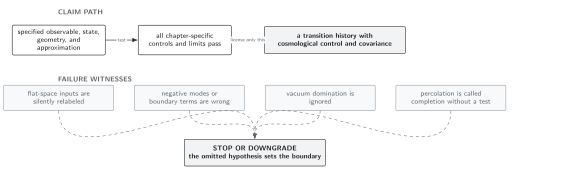
Failure conditions for homogeneous and stochastic transition descriptions. The diagram is schematic and not to scale; the barrier-curvature ratio is a local diagnostic rather than a universal phase boundary.
These restrictions specialize the chapter’s domain and failure conditions. The fluctuation question continues in negative modes, determinants, and prefactors, and a prepared Lorentzian state is treated in real-time vacuum decay.
Exercise
Section titled “Exercise”Show that reduces to the fixed- stochastic exponent at first order in .
Solution
Put . Then
Because ,
The calculation establishes agreement of the leading exponent under the fixed- approximation; it says nothing about equality of prefactors.
References
Section titled “References”- Hackworth, J. C., and E. J. Weinberg. “Oscillating Bounce Solutions and Vacuum Tunneling in de Sitter Spacetime.” Physical Review D 71 (2005): 044014. DOI. Open PDF.
- Hawking, S. W., and I. G. Moss. “Supercooled Phase Transitions in the Very Early Universe.” Physics Letters B 110 (1982): 35–38. DOI.
- Starobinsky, A. A., and J. Yokoyama. “Equilibrium State of a Self-Interacting Scalar Field in the de Sitter Background.” Physical Review D 50 (1994): 6357–6368. DOI. Open PDF.