

Interacting Stress Tensors and Ward Identities
The interacting stress tensor is both a composite operator and the response of the renormalized theory to the metric. Those definitions agree only when the finite action counterterms, insertion counterterms, and contact terms are chosen together. The relevant statement is a distributional diffeomorphism Ward identity; conservation at separated points is necessary but weaker.
Required background. Curvature counterterms and operator mixing gives the allowed finite tensors, background splitting and perturbative agreement controls metric response, and localized Ward identities supplies the source derivation.
Helpful background. Protected currents and improvements distinguishes normalization freedom from conservation, while contact terms and insertions explains why delta-supported terms cannot be dropped.
Metric variation fixes the insertion
Section titled “Metric variation fixes the insertion”For the renormalized action or effective action, use
with all background fields transformed under diffeomorphisms. The scalar action contributes the canonical and improvement terms, while variations of
produce the corresponding finite local tensor ambiguities. The geometric variations are covariantly conserved identically when they arise from diffeomorphism-invariant local actions. This integrability condition is stronger than adding an arbitrary conserved tensor directly to an insertion.
For a renormalized 1PI functional , infinitesimal diffeomorphism invariance gives the convention-stable functional identity
On the quantum equation of motion, the second term vanishes and the stress tensor is conserved. Differentiating before setting sources to zero generates contact terms at every field insertion. Their factors of depend on whether one defines Lorentzian correlators from , , or time-ordered operator products; the functional identity fixes them unambiguously within any one convention.
Hollands and Wald show that in spacetime dimension greater than two the time-ordered products can be normalized to satisfy the metric-variation and field-equation conditions needed for conservation for arbitrary polynomial interactions (Hollands and Wald 2005, Theorems 5.1 and 5.3).
The construction map locates the stress tensor at the joint counterterm-and-Ward stage. Inspect the last two boxes: metric variation must act on the same finite local action that defines the correlator before the result can be called an interacting conserved insertion.

Position of the diffeomorphism Ward identity in the construction. This schematic, not-to-scale map emphasizes the correlated metric variation of products, counterterms, and insertions.
For this page, failure is witnessed by a conservation or contact mismatch. The lower map should be applied distributionally: passing away from coincidence while failing on delta-supported contacts does not license the full Ward identity.
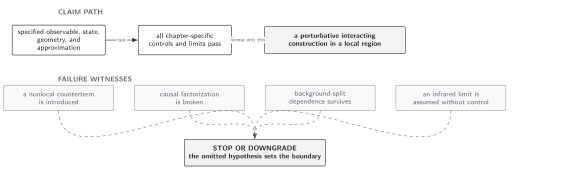
Validity path for an interacting stress insertion. The diagram is schematic and not to scale; omitted contact terms downgrade the result to separated-point conservation, not a complete diffeomorphism Ward identity.
Application: a stress insertion in the scalar two-point function
Section titled “Application: a stress insertion in the scalar two-point function”Introduce a scalar source and define connected time-ordered correlators by differentiating . Diffeomorphism invariance, with transforming as a scalar source density in the source term, yields
Differentiate twice with respect to and , then set . In a convention where and the metric derivative inserts with its standard Lorentzian factor, the identity has the schematic but distributionally precise form
where the single constant is fixed by the declared generating-functional convention. There can also be representation terms for tensor or spinor insertions. The key check is not the printed value of in isolation; it is that the same convention reproduces both contacts by differentiating the functional identity.
At first order in , compute the two-point function from the tadpole-corrected kernel and construct the stress insertion by varying the same renormalized diagrams and counterterm action. Away from , the divergence vanishes after using the renormalized field equation. On the diagonals, derivatives acting on the time ordering and Green functions produce exactly the two delta terms. Metric variations of , , and the composite subtraction are necessary for this equality.
A reproducible check therefore reports the action convention, definition of , correlator-generating convention fixing , counterterm basis, perturbative order, and equality as a smeared distribution. Checking a few separated numerical points cannot test the contact terms.
Adversarial test: independent finite choices
Section titled “Adversarial test: independent finite choices”Suppose the action contains a finite term, but the stress insertion is renormalized independently and its metric variation is omitted. The two-point equation then contains the contribution while the insertion does not. Taking the divergence leaves a local mismatch proportional to derivatives of and delta-supported insertion terms. Conversely, adding an improvement tensor to without the corresponding source/action change alters contacts and background response.
The mismatch is not necessarily an anomaly. A genuine anomaly is a local obstruction that satisfies the consistency condition but cannot be removed by an allowed finite counterterm. Here the discrepancy is cohomologically trivial: correlate the finite action and insertion choices and it disappears. Until that is done, the strongest claim is conservation away from insertions in the restricted background where the mismatch happens to vanish.
Domain and failure conditions
Section titled “Domain and failure conditions”The chapter comparison table gives the shared domain. Here the inputs are one renormalized action, its metric-variation definition of , the correlator convention fixing contact factors, and every local geometric counterterm. They license the distributional Ward identity through the computed order. The decisive check is the smeared divergence including all insertion diagonals. If only the separated-point divergence vanishes, the claim is downgraded to conservation off contact; a mismatch removable by a correlated finite action term is not an anomaly, while a nonremovable consistent obstruction requires an anomaly analysis.
Checks and limits
Section titled “Checks and limits”- Define by metric variation of the same renormalized functional used for correlators.
- Test the identity after smearing, including all partial diagonals.
- Distinguish trace anomalies from diffeomorphism conservation; a nonzero trace does not imply .
- Boundaries add flux and boundary-stress terms. The bulk identity assumes compactly supported variations or separately controlled boundary conditions.
- In two dimensions, the general existence argument has exceptional features; the stated Hollands–Wald result applies in dimension greater than two.
Exercise
Section titled “Exercise”Let . Explain why adding its metric variation to the stress tensor cannot violate the integrated diffeomorphism Ward identity.
Solution
is a diffeomorphism-invariant local functional when and transform together. Its infinitesimal variation therefore vanishes. Integrating by parts gives
Thus its stress contribution and its change to the scalar equation of motion satisfy the Ward identity as a pair. Adding only one member of the pair is precisely the inconsistent choice exposed above.
Related topics
Section titled “Related topics”Diffeomorphisms are background symmetries of the scalar theory. Interacting gauge fields require an additional cohomological reduction: renormalized products must satisfy the BRST/BV master identity before their observables can be called gauge independent.
References
Section titled “References”- Hollands, Stefan, and Robert M. Wald. “Conservation of the Stress Tensor in Perturbative Interacting Quantum Field Theory in Curved Spacetimes.” Reviews in Mathematical Physics 17 (2005): 227–312. doi:10.1142/S0129055X05002340.
- Hollands, Stefan, and Robert M. Wald. “Quantum Fields in Curved Spacetime.” Physics Reports 574 (2015): 1–35. doi:10.1016/j.physrep.2015.02.001.