

Wormholes, Chronology, and Superluminal-Travel Constraints
Traversable wormholes require stress that defocuses null rays near the throat, but that fact is only the start of a quantum-field-theoretic constraint. A useful test must match the geometry to a theorem’s sampling curve, state class, boundary conditions, affine normalization, and semiclassical regime. Quantum energy inequalities (QEIs), achronal ANEC results, chronology-horizon obstructions, and effective-cone causality constrain different questions and cannot be combined into a universal prohibition without their separate hypotheses.
Required background. Quantum energy inequalities in curved spacetime supplies worldline bounds; ANEC supplies complete-null-curve hypotheses; and global hyperbolicity fixes the causal setting.
Helpful background. Relativistic causality distinguishes metric and effective causal cones, while quantum interest explains why a negative pulse cannot usually be specified without its compensating history.
Stress required at a static throat
Section titled “Stress required at a static throat”Consider the Morris–Thorne form, in the site’s convention,
A regular throat at has
The second inequality is the flare-out condition. In an orthonormal frame, the radial null projection is . Einstein’s equation gives at the throat
for the explicit orthonormal-frame choice , equivalently . Thus a static flare-out throat violates pointwise NEC. Morris and Thorne derive the geometric and stress requirements explicitly (Morris and Thorne 1988, §§ II–III).
The normalization qualifier matters: rescales with , while the sign does not. The displayed magnitude also assumes the ordinary semiclassical Einstein equation without higher-curvature terms of comparable size. If terms contribute at order , moving them between the geometric and stress sides changes the apparent “exotic matter” budget while leaving the full equation unchanged.
The structure map places this geometric requirement before the choice of a timelike sampler or a complete null generator. Those choices lead to different results.

From throat geometry to quantum constraints. The diagram is schematic and not to scale; the local flare-out equation does not by itself select a sampling theorem, complete null curve, boundary condition, or backreacted solution.
A curved-QEI scale test
Section titled “A curved-QEI scale test”Suppose a freely falling observer crosses a slowly varying throat and sees an approximately constant negative density
during a proper interval , with . For a four-dimensional free field, a theorem-appropriate compactly supported smooth sampler has a short-duration bound of the schematic form
where , depends on the sampling profile and field, is the local curvature scale, and is the observer acceleration. The exact curved-space lower bound, rather than this scaling form, must be used for a quantitative exclusion.
If the density is nearly constant across the sampler and
the leading comparison gives
This familiar small-throat estimate is conditional. It weakens if is tuned small, if the sampling time does not remain within the approximately static region, if acceleration or boundaries alter the QEI, or if the stress is not produced by a field and state in the theorem’s domain. Ford and Roman’s wormhole analysis makes precisely this sampling-scale logic, including its geometric qualifications (Ford and Roman 1996, §§ II–IV). The estimate does not construct a self-consistent state, nor does it prove that every macroscopic throat is impossible.
Complete null curves and topology
Section titled “Complete null curves and topology”The radial null integral asks a different question:
An achronal ANEC theorem applies only if is complete, achronal, lies in an allowed geometry and state class, and the integral converges with a fixed affine normalization. In asymptotically flat globally hyperbolic settings, topological-censorship arguments use an averaged null convergence condition to show that causal curves from infinity cannot probe nontrivial topology (Friedman, Schleich, and Witt 1993, theorem and pp. 1486–1489). Translating that result to renormalized quantum matter requires an ANEC theorem with matching hypotheses.
The adversarial test adds a reflecting timelike boundary or truncates the generator at the throat. The integral is then neither the complete boundary-free ANEC observable nor automatically achronal. A negative answer may be physically interesting, but it does not contradict the theorem. Boundary ANEC, half-line inequalities, and complete achronal ANEC are separate statements.
Chronology horizons and effective superluminality
Section titled “Chronology horizons and effective superluminality”A chronology horizon is not merely a region of negative energy. For compactly generated Cauchy horizons, Kay, Radzikowski, and Wald prove that the two-point function inherited from an initially Hadamard state fails the required Hadamard form at certain horizon points, so the usual renormalized stress tensor cannot be defined there (Kay, Radzikowski, and Wald 1997, Theorems 1–2). This is a sharp obstruction to the standard semiclassical description at those points. It is not a proof that backreaction always destroys every chronology horizon, and it does not cover arbitrary noncompactly generated constructions.
Effective superluminality is different again. A low-energy fluctuation may propagate outside the background metric cone because its principal symbol defines an effective cone. Whether this permits a controllable time advance, a closed causal curve, or an ultraviolet completion depends on hyperbolicity, interactions, the global geometry, and the EFT cutoff. Flat-space analyticity and positivity constraints can diagnose some effective theories (Adams et al. 2006, §§ 2–4), but they are not QEIs and do not turn a wormhole stress estimate into an S-matrix theorem.
The failure map keeps these obstructions separate: changing the curve can invalidate ANEC, changing the boundary can invalidate a QEI, and reaching a chronology horizon can invalidate the stress observable itself.
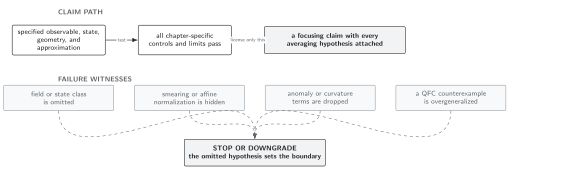
Failure conditions for exotic-geometry constraints. The diagram is schematic and not to scale; timelike QEIs, complete achronal ANEC, chronology-horizon regularity, and effective-cone consistency test distinct data.
Domain and failure conditions
Section titled “Domain and failure conditions”See the chapter domain and failure-conditions table. The throat calculation assumes a static Morris–Thorne geometry and the two-derivative semiclassical Einstein equation. The QEI estimate additionally assumes a smooth compact sampler, a theorem-covered state and field, and a duration short compared with curvature, state-variation, and boundary scales. ANEC and topological-censorship conclusions require complete achronal generators and their own asymptotic and causal hypotheses. None of these fixed-background tests is a self-consistent backreaction solution.
Exercise
Section titled “Exercise”Under at fixed dimensionless throat shape and , compare the scaling of the required negative density and the short-sampling QEI lower bound.
Solution
The throat equation gives , while makes the QEI magnitude scale as . Their ratio scales as
At fixed shape and sampling fraction, enlarging the throat makes the required negative density fall more slowly than the available QEI magnitude. This scaling motivates the constraint, but the omitted profile, curvature, boundary, and state terms decide any numerical bound.
References
Section titled “References”- Adams, A., N. Arkani-Hamed, S. Dubovsky, A. Nicolis, and R. Rattazzi. “Causality, Analyticity and an IR Obstruction to UV Completion.” Journal of High Energy Physics 2006, no. 10 (2006): 014. DOI.
- Ford, L. H., and T. A. Roman. “Quantum Field Theory Constrains Traversable Wormhole Geometries.” Physical Review D 53 (1996): 5496–5507. DOI.
- Friedman, J. L., K. Schleich, and D. M. Witt. “Topological Censorship.” Physical Review Letters 71 (1993): 1486–1489; erratum 75 (1995): 1872. DOI.
- Kay, B. S., M. J. Radzikowski, and R. M. Wald. “Quantum Field Theory on Spacetimes with a Compactly Generated Cauchy Horizon.” Communications in Mathematical Physics 183 (1997): 533–556. DOI.
- Morris, M. S., and K. S. Thorne. “Wormholes in Spacetime and Their Use for Interstellar Travel: A Tool for Teaching General Relativity.” American Journal of Physics 56 (1988): 395–412. DOI.