

Renormalized Stress and Backreaction in FLRW
Semiclassical FLRW backreaction is a coupled initial-value problem: the state determines a renormalized local stress tensor, that stress changes the scale factor, and the new geometry changes subsequent state evolution. Neither an instantaneous particle number nor a stress tensor evaluated only on the uncorrected background closes this loop.
Required background. Adiabatic subtraction supplies the renormalized source; the semiclassical Einstein equation fixes finite gravitational couplings; constraints and the Bianchi identity fix consistency; and cosmological benchmarks fix comparison tests. Helpful background. Review mode matching and the numerical error budget.
The reduced semiclassical system
Section titled “The reduced semiclassical system”In cosmic time, write the declared finite-coupling equation schematically as
together with
Here are the conserved metric variations of the declared curvature-squared operators, using the site’s gravitational conventions. Their finite coefficients are inputs measured or matched in a renormalization prescription. A shift of the matter stress by a permitted conserved local tensor must be accompanied by the opposite shift of these couplings; varying only one side compares different theories.
Curvature-squared terms introduce higher derivatives and extra formal branches. One must state whether the full higher-derivative initial-value problem is being solved, whether a perturbative order-reduction prescription selects the low-energy branch, or whether coefficients are set by a UV model. Discarding a runaway after it appears is not a prescription. The retained solution must also keep , , and occupied physical frequencies below the EFT cutoff.
First application: a scalar-driven benchmark
Section titled “First application: a scalar-driven benchmark”Specify , , a fourth-order adiabatic/Hadamard scalar state, and finite satisfying the renormalized Friedmann constraint. Then iterate causally:
- evolve the normalized modes one time step on the current geometry;
- compute fourth-order-subtracted and from the same modes;
- update the metric on the chosen physical branch; and
- repeat until the state, source, and geometry converge together.
Monitor the mode Wronskians, stress continuity, the Friedmann residual,
and changes under time step, momentum cutoff, iteration tolerance, state order, and allowed finite couplings. Parker and Fulling’s conserved adiabatic prescription provides the local scalar source used by this benchmark Parker and Fulling 1974, §§II–IV, pp. 344–352.
Two analytic controls are especially useful. A massless conformally coupled field in a conformal state has no state-dependent production, leaving only the known local vacuum-polarization/anomaly sector. For much larger than curvature scales, the state-dependent response should approach the appropriate local large-mass expansion after finite couplings are matched. Neither control licenses extrapolation into a light-field secular regime.
The structure map closes the loop from geometry through state and renormalized stress back to geometry. Inspect that the local source, rather than a particle count, drives the update.

Self-consistent backreaction couples the state and mean geometry through a conserved renormalized stress tensor with fixed finite gravitational couplings. Schematic; not to scale.
Domain and failure conditions
Section titled “Domain and failure conditions”The chapter’s domain table gives the minimum source and constraint checks. This mean-field calculation assumes a Hadamard state, causal in-in evolution, subcutoff curvatures, controlled stress fluctuations or a regime in which only the mean is claimed, and a stated prescription for higher-derivative branches.
Adversarial test. Vary the admissible finite curvature couplings, initial-state preparation, momentum and time resolution, and coupled-iteration tolerance independently. Require the proposed change in to exceed the combined uncertainty envelope while both and stress nonconservation converge to zero. A small discretized evolution residual is insufficient if the subtraction tail or constraint remains unresolved.
The modern mathematical literature establishes controlled existence results for particular cosmological semiclassical systems, not a theorem that every phenomenological closure is stable Meda 2026, §§2–3, especially Eqs. (16)–(32). Evidence was checked through 10 August 2026. The strongest output here is a mean semiclassical solution over its verified interval; stress variance, metric fluctuations, graviton loops, and any later EFT breakdown are separate questions.
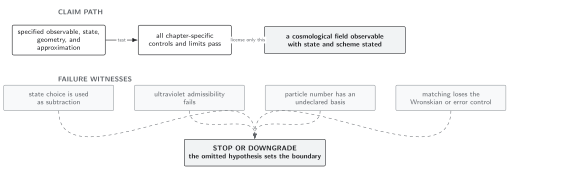
Constraint propagation, conservation, coupled convergence, branch control, and a separated error budget are necessary for a semiclassical FLRW effect. Schematic; not to scale.
References
Section titled “References”- Meda, P., “The Semiclassical Einstein Equations in Cosmological Spacetimes,” International Journal of Theoretical Physics 65, article 137 (2026), doi:10.1007/s10773-026-06339-9.
- Parker, L., and S. A. Fulling, “Adiabatic Regularization of the Energy-Momentum Tensor of a Quantized Field in Homogeneous Spaces,” Physical Review D 9, 341–354 (1974), doi:10.1103/PhysRevD.9.341.