

Proper-Time, Zeta, and Determinant Prescriptions
Proper-time, zeta-function, and spectral-product formulas describe the same one-loop object only after they use the same operator, domain, omitted modes, scale, analytic continuation, and local subtraction. Their formal symbols are short; the equivalence conditions carry the physics.
Required background. One-Loop Matter Effective Actions in Curved Space fixes the matter Hessian, and Heat Kernels, Zeta Functions, and Spectral Determinants supplies Mellin transforms and meromorphic continuation.
Helpful background. Spectra, Resolvents, Spectral Measures, and Functional Calculus clarifies domains and spectral cuts; Dimensional Regularization and Minimal Subtraction provides a comparison scheme.
Three definitions and one spectral problem
Section titled “Three definitions and one spectral problem”Let be a positive self-adjoint Laplace-type operator on a compact Riemannian manifold, with discrete eigenvalues after removing an -dimensional kernel. Then
and, initially for large,
Meromorphic continuation to defines
The regulated proper-time expression removes the same short- asymptotic terms before taking its cutoff away. Hawking’s construction makes the zeta derivative and heat-kernel Mellin transform explicit for curved-space Gaussian integrals Hawking 1977, pp. 133–140; a modern convention-level statement appears in Vassilevich 2003, Eqs. (2.23)–(2.34).
Zero modes do not disappear mathematically. The prime means that the determinant is taken on ; collective coordinates, gauge volume, or a constrained source integral supplies the missing finite-dimensional factor. Introducing a small mass and then taking it to zero gives
so failing to subtract is an observable infrared error, not a choice of ultraviolet scheme.
First application: a compact ultrastatic spectrum
Section titled “First application: a compact ultrastatic spectrum”Take the spatial operator on a circle of circumference ,
For it is positive. Poisson resummation gives
The term is the local infinite-volume contribution; terms are exponentially small as and contain the global finite-size information. Subtract the same term in proper time that analytic continuation removes in the zeta prescription. Differentiating the continued zeta function or integrating the subtracted heat kernel then yields the same finite nonlocal part,
up to the explicitly chosen local normalization. In the massless case, becomes a zero mode and the primed determinant must be used before the limit.
This example exhibits the division cleanly: short proper time fixes local subtraction, whereas winding sectors fix global finite-size dependence. A finite list of Seeley–DeWitt coefficients cannot reconstruct .
Negative eigenvalues and determinant phase
Section titled “Negative eigenvalues and determinant phase”Suppose one eigenvalue crosses from to . A logarithm with cut angle gives
Changing the cut changes the phase by an integer multiple of but does not change ordinary renormalization-scale dependence. The phase can encode a physical in–out instability only when the contour is fixed by the vacuum amplitude and agrees with an independent mode or tunneling calculation. A Euclidean negative mode by itself may instead diagnose that the chosen saddle is not a minimum.
For products of noncommuting pseudodifferential operators, zeta determinants need not satisfy . Any multiplicative anomaly is a prescription-dependent local term controlled by the symbols; factorizing an operator therefore requires a check rather than an algebraic assumption.
The structure map locates proper time and zeta as parallel evaluations of one declared spectrum. The reader should trace both paths through the same zero-mode and subtraction boxes.

Heat traces and zeta functions are Mellin-related representations of one spectral problem; global finite terms survive beyond the local short-time coefficients. Schematic; not to scale.
Domain and failure conditions
Section titled “Domain and failure conditions”The compact positive case licenses a real primed determinant. Noncompact volume divergences require a relative determinant or density; continuous spectra require a spectral measure; boundaries require a self-adjoint elliptic domain; zero modes require collective-coordinate data; negative modes require a cut. Compare these cases in Domain and failure conditions.
The failure map separates three errors often merged into one: retaining a zero eigenvalue makes the determinant vanish, changing a cut changes a phase, and changing changes local finite terms. They need different repairs.
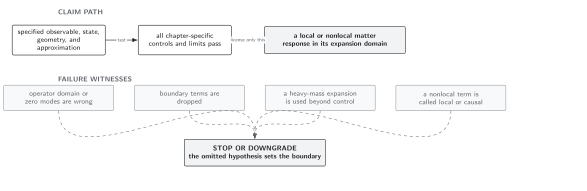
Kernel removal, spectral-cut choice, and ultraviolet renormalization are independent parts of a determinant prescription. Schematic; not to scale.
Exercise
Section titled “Exercise”Show from the small- eigenvalue product that .
Solution
Split the product into the zero eigenvalues and the positive spectrum. Each zero eigenvalue contributes . For every positive , factor . After the same ultraviolet regularization used for the primed product, the second factor tends to one, giving the stated result.
Related topics
Section titled “Related topics”Heat Kernels and the Schwinger–DeWitt Expansion develops the short-time coefficients. Imaginary Effective Actions and Vacuum Instability adds the in–out interpretation of a phase.