

Hadamard States for Fermion and Gauge Fields
Hadamard admissibility extends beyond scalar fields, but the algebra and constraints change. Dirac states obey canonical anticommutation relations and fermionic positivity; gauge fields require a constraint-compatible covariance and positivity only on physical observables or cohomology. A gauge-fixed or ghost two-point function can be a useful intermediate kernel without being a positive physical covariance.
Required background. Spinors, Tetrads, and Spin Connections supplies the Dirac operator and positive Cauchy inner product. Gauge Fields, Gauge Fixing, and Ghosts on Curved Backgrounds supplies constraints and the physical quotient. Hadamard Admissibility and the Two-Point Wavefront Criterion supplies the scalar microlocal model.
Helpful background. The BRST Differential and the Gauge-Fixed Complex organizes gauge and ghost degrees of freedom. Operator Algebras and Positive Functionals supplies positivity language.
Dirac covariances
Section titled “Dirac covariances”On a globally hyperbolic spin spacetime, let
and let . A candidate state must satisfy the Dirac equation in both arguments, the adjoint/reality relations, the CAR normalization with its companion covariance , and positivity on test spinors. On Cauchy data these conditions can be written particularly cleanly:
For a pure quasifree state, is a projection and . The spacetime covariances are obtained by composing these Cauchy operators with Dirac evolution. Squaring helps locate null characteristics, but one must still impose the first-order equation and CAR; solutions of the squared equation alone include unwanted data.
The Hadamard condition has the same future-null geometric relation as for the scalar field, now for a distribution valued in the spinor–cospinor bundle. Bundle polarizations and the Dirac principal symbol relate the spinor amplitudes along the null geodesic. The opposite covariance carries the reversed orientation. Sahlmann and Verch formulate the microlocal spectrum condition for vector-bundle-valued fields and CAR systems in Sahlmann and Verch 2001, Definition 5.3 and Theorem 5.8.
First application: an ultrastatic Dirac ground state
Section titled “First application: an ultrastatic Dirac ground state”On , write the Dirac equation as
where is self-adjoint on the declared Cauchy Hilbert-space domain. Assume zero modes are treated separately. The positive spectral projection
defines the ground-state Cauchy covariance. The checks are now explicit:
- spectral calculus gives and ;
- exact Dirac evolution gives the field equations;
- the sum gives the CAR normalization;
- the positive spectral branch gives the future Hadamard orientation under the usual ellipticity and smoothness hypotheses.
Changing the zero-mode projector can change the global state without changing the ultraviolet class. The spin structure and the domain of are also part of the result. Dappiaggi, Hack, and Pinamonti give the locally covariant Dirac algebra and extended Hadamard observables in this setting Dappiaggi, Hack, and Pinamonti 2009, §§ 2–3.
Gauge fields: physical positivity after constraints
Section titled “Gauge fields: physical positivity after constraints”For Maxwell theory, a covariant gauge makes the potential operator normally hyperbolic and permits a vector-bundle Hadamard parametrix. Its two-point kernel depends on gauge and need not define a positive form on every one-form test function. Physical tests are equivalence classes modulo exact or equation-trivial directions, or gauge-invariant field strengths
Longitudinal changes drop out of this local observable. A viable state must satisfy the equations and constraints, reproduce the physical commutator, be positive on the physical algebra, and have the permitted wavefront orientation. Topological zero modes and boundaries require additional sectors or boundary conditions.
In BRST language, the gauge potential, ghosts, antighosts, and auxiliary fields form a graded complex. Ghost two-point functions enforce determinant and cohomological identities; Grassmann signs and an indefinite intermediate pairing mean that scalar-style positivity is not imposed on each component. Positivity is recovered on the ghost-number-zero physical cohomology if the construction is consistent. The separation between gauge-fixed Hadamard covariances and physical constraints is explicit in Gérard and Wrochna 2015, §§ 2–3.
Adversarial test: a gauge-fixed kernel is not yet a state
Section titled “Adversarial test: a gauge-fixed kernel is not yet a state”Take a Feynman-gauge potential kernel and test it as though it were a positive covariance on all one-form sources. A longitudinal test probes a gauge direction; residual solutions and ghost identities can change or null its pairing. If a boundary is present, the same direction may instead carry boundary charge. The result can fail positivity on the enlarged test space without any failure of the physical field-strength state.
The strongest justified claim from the gauge-fixed Hadamard wavefront set alone is a suitable intermediate parametrix. A physical-state claim additionally requires constraints, residual-gauge and zero-mode treatment, the correct ghost or quotient construction, and positivity on physical observables.
Domain and failure conditions
Section titled “Domain and failure conditions”For fermions and gauge fields, the construction map must be read with the algebra-specific replacement of its scalar checkpoint: CAR positivity for Dirac fields, and constraint or BRST-compatible positivity on physical observables for gauge fields. The Hadamard and propagation stages remain microlocal but are bundle valued.

The controlled path persists beyond scalars only after CCR language is replaced by the correct CAR or physical-quotient conditions. Schematic; not to scale.
A gauge-fixed potential kernel can pass a normally hyperbolic wavefront test yet fail the physical positivity or constraint branch in the failure map. Residual gauge modes, ghosts, topology, and boundary charges determine whether to quotient, add sectors, or stop the state claim.
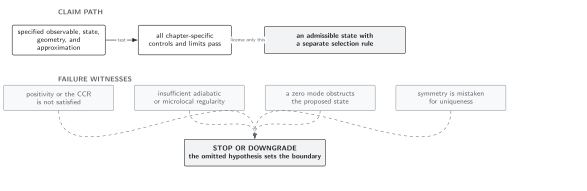
Physical-state status requires the correct algebra, constraints, zero-mode treatment, and positivity; bundle-valued regularity alone is insufficient. Schematic; not to scale.
The scalar and constrained cases are compared in Domain and failure conditions.
Related topics
Section titled “Related topics”Renormalized currents and stress tensors belong to Renormalized Stress Tensor: Axioms and Curvature Ambiguities. Non-Abelian cohomological machinery continues in The BRST Differential and the Gauge-Fixed Complex. Proof-level bundle-valued Hadamard conditions continue in Hadamard States and Wavefront Characterization.
References
Section titled “References”- Dappiaggi, Claudio, Thomas-Paul Hack, and Nicola Pinamonti. “The Extended Algebra of Observables for Dirac Fields and the Trace Anomaly of Their Stress-Energy Tensor.” Reviews in Mathematical Physics 21 (2009): 1241–1312. DOI. Open PDF.
- Gérard, Christian, and Michał Wrochna. “Hadamard States for the Linearized Yang–Mills Equation on Curved Spacetime.” Communications in Mathematical Physics 337 (2015): 253–320. DOI. Open PDF.
- Sahlmann, Hanno, and Rainer Verch. “Microlocal Spectrum Condition and Hadamard Form for Vector-Valued Quantum Fields in Curved Spacetime.” Reviews in Mathematical Physics 13 (2001): 1203–1246. DOI. Open PDF.