

Curvature, Coupling, Loop, Derivative, and Secular Hierarchies
Curved-spacetime calculations often contain several small parameters that do not stay small together. Curvature and derivatives test the local EFT, couplings and loops test perturbation theory, occupation numbers enhance diagrams, and duration produces secular terms. The first hierarchy to cross unity—not the most dramatic-sounding scale—sets the stopping point for a chosen observable.
Required background. Observable-specific validity contracts fixes the error target; semiclassical breakdown diagnostics supplies response and fluctuations; gravitational EFT power counting supplies curvature operators; large-N, loop, and ℏ hierarchies supplies quantum ordering; and cosmological loops and renormalization supplies time dependence.
Helpful background. Infrared resummation and dynamical mass supplies a late-time reorganization, while nonuniform large-N limits supplies order-of-limits tests.
The vector of expansion parameters
Section titled “The vector of expansion parameters”For an observable with characteristic physical energy , duration , coupling , occupation , and apparatus-frame curvature scale , a useful schematic vector is
denotes a Riemann eigenvalue or largest relevant orthonormal-frame component with mass dimension two; the scalar curvature alone is not sufficient. The power in the secular entry is calculated from the perturbative series and observable. Products such as often matter more than either factor separately.
The entries are not always orthogonal. A time-dependent curvature can change particle occupation; large occupation can enhance loops; a secularly generated mass can alter infrared power counting; and threshold crossing can change the Wilson coefficients. The useful object is therefore a dependency graph or sensitivity matrix, not merely a list of small numbers. At each perturbative order, record which parameter multiplies which operator or diagram and which other parameters were held fixed in deriving it.
Local higher-curvature terms generate an expansion in and . Matter loops bring coupling, species, mass-threshold, and occupation factors. Graviton loops bring powers of or curvature over . A large occupation can make a nominally loop-suppressed process classical and nonlinear; a long duration can make a tiny coupling nonuniform without increasing local curvature.
Finite-duration light-field example
Section titled “Finite-duration light-field example”Consider a light scalar correlator during inflation for e-folds. Organize the calculation as
Renormalize the UV terms first. Estimate each retained and omitted contribution in the same norm and at the same observation time. A small can coexist with ; then local EFT remains valid while fixed-order late-time perturbation theory requires resummation. Conversely, invalidates the derivative expansion even over a short duration.
Weinberg’s late-time analysis bounds the growth of a broad interaction class but leaves coefficients and observable cancellations to the actual calculation Weinberg 2006, §§II–IV, Eqs. (7)–(35). The first application tabulates matter loops, graviton corrections, higher-curvature operators, and secular terms for one finite rather than declaring a universal ordering.
Order of limits is part of this table. Taking before , before holding the renormalized Planck mass fixed, or a sharp-feature width to zero before removing a UV cutoff can give inequivalent expansions. A controlled claim states the path through parameter space and demonstrates a common overlap region when comparing methods.
Uncertainty from the first omitted term should be evaluated in the observable norm, not in the Lagrangian coefficient alone. A derivative operator with a modest Wilson coefficient can dominate a highly differentiated observable, whereas a larger potential operator may be invisible in a protected soft limit.
The structure map shows parallel hierarchies converging on one observable error budget.

Cross-expansion control is multidimensional: the calculation stops, reorganizes, or narrows when the first observable-weighted combination becomes order one. Schematic; not to scale.
Independent-deformation test
Section titled “Independent-deformation test”First increase at fixed and coupling; only the secular entry should cross. Then raise curvature at fixed physical energy and duration; the derivative expansion should cross independently. Finally raise occupation at fixed vacuum loop factor. The verdict must identify which hierarchy failed and preserve the others.
Resumming secular terms does not repair a curvature expansion, and adding operators does not resum occupation-enhanced loops. See the chapter’s domain and failure conditions.
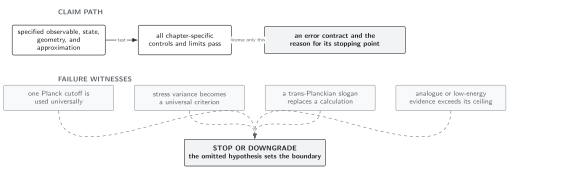
Each hierarchy is varied independently; a remedy for one failed expansion cannot be credited with controlling another without a matched calculation. Schematic; not to scale.
References
Section titled “References”- Weinberg, S., “Quantum Contributions to Cosmological Correlations. II. Can These Corrections Become Large?” Physical Review D 74, 023508 (2006), doi:10.1103/PhysRevD.74.023508.