

Massless Zero Modes and the Invariant-State Obstruction
The massless minimally coupled scalar is not the zero-mass endpoint of the ordinary massive Euclidean construction. Its spatially homogeneous mode has no restoring force, the Euclidean operator has a zero eigenvalue, and the field algebra admits no standard de Sitter-invariant Fock vacuum with a positive two-point function. Derivatives and field differences can nevertheless remove the constant shift sector.
Required background. Euclidean/BD free fields supplies the massive construction; topology and zero modes supplies global sectors; and state-selection failures supplies the admissibility ceiling. Helpful background. Review adiabatic limits and infrared obstructions.
The homogeneous mode
Section titled “The homogeneous mode”Global de Sitter has
For and , the -constant mode obeys
One solution is constant. Its Klein–Gordon norm vanishes, so it cannot be paired with its complex conjugate as an ordinary positive-frequency oscillator. The conjugate degree of freedom is free-particle-like: a normalizable wave packet spreads, while a momentum eigenstate is not a normalizable vacuum. Selecting a packet introduces a scale and breaks full de Sitter invariance.
The Euclidean version is equally direct. On , the constant harmonic has eigenvalue zero. With a small positive effective mass , its contribution to the Euclidean inverse is
This divergence is a projector onto the constant mode, not a short-distance Hadamard singularity. Removing it by hand changes the inverse equation to one with the constant projector subtracted and therefore changes the algebraic problem.
First application: field versus shift-invariant observables
Section titled “First application: field versus shift-invariant observables”Quantize all nonzero global harmonics in their Euclidean modes and treat the homogeneous pair separately. The field two-point function contains the packet-dependent term and is not fully de Sitter invariant for a normalizable choice. By contrast,
annihilates the constant contribution, and the difference is invariant under the global shift . These observables can possess regulator-independent limits even when does not.
Allen proves the absence of a de Sitter-invariant Fock vacuum for the minimally coupled field Allen 1985, §IV, pp. 3144–3147. Allen and Folacci construct normalizable -invariant alternatives and isolate the zero mode Allen and Folacci 1987, §§II–III, pp. 3772–3777. Neither result says that every local shift-invariant observable is infrared divergent.
Compact global slices and a planar finite box regularize different mode decompositions. To compare them, match the same smeared derivative observable in an overlapping region and only then remove the regulator. Comparing unsmeared field variances instead merely compares how the constant sector was chosen.
The structure map separates the zero-mode algebra from nonzero-mode Hadamard propagation and later stochastic long modes.

The invariant-state obstruction belongs to the constant field mode; shift-invariant derivative and difference observables can discard that sector without pretending the full field vacuum exists. Schematic; not to scale.
Domain and failure conditions
Section titled “Domain and failure conditions”The domain table records the algebra change. The conclusion concerns a free massless minimally coupled scalar on exact de Sitter. A positive mass, nonminimal coupling, interaction-generated restoring force, or restriction to the shift-invariant algebra is a different case.
Adversarial test. Compute one smeared derivative correlator using a small mass and using a growing finite spatial volume. Remove the regulators in both orders while holding the smearing region fixed. The observable is licensed as regulator independent only if the limits agree. If agreement occurs only after deleting different constants in the two field two-point functions, narrow the statement to the derivative or difference algebra; do not claim an invariant vacuum for .
The failure map exposes both common shortcuts: calling the projector a local instability and deleting the zero mode without declaring the modified inverse. Interacting claims pass next to secular-regime analysis with the chosen algebra explicit.
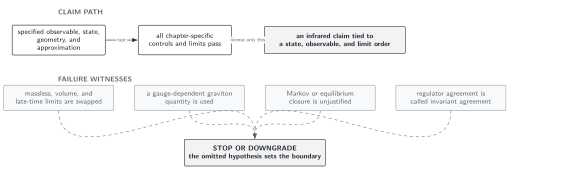
Regulator agreement must be tested on the same shift-invariant observable; it cannot manufacture a standard invariant Fock state for the full field. Schematic; not to scale.
References
Section titled “References”- Allen, B., “Vacuum States in de Sitter Space,” Physical Review D 32, 3136–3149 (1985), doi:10.1103/PhysRevD.32.3136.
- Allen, B., and A. Folacci, “Massless Minimally Coupled Scalar Field in de Sitter Space,” Physical Review D 35, 3771–3778 (1987), doi:10.1103/PhysRevD.35.3771.