

Trace Anomalies and Convention Translation
A classically Weyl-invariant field can have a nonzero renormalized stress trace. In four dimensions the physically stable local information is the coefficient of ; the coefficient of can be shifted by a finite counterterm. A comparison is meaningful only after the curvature, stress-variation, field-normalization, and subtraction conventions have been translated.
Required background. Renormalized Stress Tensor: Axioms and Curvature Ambiguities supplies the finite local freedom; Trace Ward Identities and the Weyl Anomaly supplies the Weyl identity; What Is an Anomaly? distinguishes an anomaly from a removable breaking.
Helpful background. Anomaly Coefficients and Central Charges fixes common CFT normalizations; Wess–Zumino Consistency and Descent explains the cohomological classification.
Weyl variation and the four-dimensional basis
Section titled “Weyl variation and the four-dimensional basis”On this page
For , hence ,
With the site curvature convention , define
For a four-dimensional conformal theory without boundaries, the local trace has the form
The type-A coefficient multiplies the Euler density, the type-B coefficient multiplies the Weyl invariant, and running couplings supply the beta-function terms. The displayed is not another universal central charge. Deser and Schwimmer’s classification separates the Euler and Weyl-invariant classes from removable local terms Deser and Schwimmer 1993, pp. 279–283; Duff gives the field-content coefficients and convention comparisons Duff 1994, §§2–4, pp. 1389–1397.
Adding
changes its Weyl variation by , up to a boundary term. In the stress convention above,
Thus records a finite prescription unless an additional renormalization condition fixes it. By contrast, no four-dimensional local metric counterterm shifts or while preserving the same Ward identities. This statement concerns the local anomaly; the nonlocal action whose Weyl variation reproduces it belongs to Chapter 8.
First application: conformal scalar basis translation
Section titled “First application: conformal scalar basis translation”For a real, massless scalar with the site operator
the common normalization is
Expand the scheme-independent combination:
Therefore a result quoted in the quadratic-curvature basis translates to
The first term is the invariant content. The second must be reported with its finite prescription. In a conformally flat geometry , but the type-A term need not vanish; in flat spacetime all curvature terms vanish. For a massive or nonconformally coupled scalar, explicit mass and improvement terms enter the trace and must not be renamed “the anomaly.”
Adversarial convention translation
Section titled “Adversarial convention translation”Suppose a reference reverses the Riemann tensor, . Then and , while and , being quadratic, are unchanged. Because the metric and were not reversed, . The same local trace is consequently described by
when both authors define the displayed basis with the same overall stress sign. An additional reversal in ‘s functional-derivative convention flips the whole table instead. Comparing the raw coefficient of without these translations creates an apparent disagreement where none exists.
The strongest convention-independent claim is the matched content and the beta-function data in a declared operator normalization. A numerical value of is a scheme result, not a universal anomaly coefficient.
Structure and failure maps
Section titled “Structure and failure maps”The structure map shows where the trace identity is imposed: after local subtraction and finite-term choice, but before exporting a stress tensor or induced action.

The universal comparison keeps separate from the prescription-dependent term; the map is schematic and not to scale.
The failure map is especially useful when two anomaly tables appear to disagree: inspect curvature and stress signs before interpreting a coefficient difference.
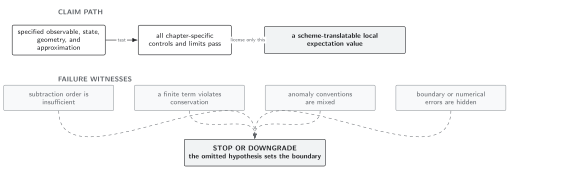
A convention-swapped table and a genuine change of field content are different failure modes; the map is schematic and not to scale.
Use Domain and failure conditions. Record dimension, field multiplicity and reality condition, curvature convention, stress variation, normalization, operator sign, boundary data, and the finite prescription.
Check your understanding
Section titled “Check your understanding”Show directly that the conformal-scalar invariant has no term in the quadratic-curvature basis.
Solution
The coefficient is . The absence is a property of the invariant for this field; a scheme-dependent term may still be present.
Spin, Gauge, and Gravitational-Anomaly Responses applies descent data to current and stress Ward identities. Chapter 8 develops anomaly-induced actions; Volume IX develops extracting as CFT data; Volume XVI develops theorem-level local-covariant scaling.
References
Section titled “References”- Stanley Deser and Andreas Schwimmer, “Geometric Classification of Conformal Anomalies in Arbitrary Dimensions,” Physics Letters B 309 (1993), 279–284, DOI, arXiv:hep-th/9302047.
- Michael J. Duff, “Twenty Years of the Weyl Anomaly,” Classical and Quantum Gravity 11 (1994), 1387–1404, DOI, arXiv:hep-th/9308075.