

One-Loop Graviton EFT
One-loop quantum gravity is predictive at low energy even though Einstein gravity is not perturbatively renormalizable by a finite set of couplings. The loop divergences are local and renormalize higher-curvature operators already required by EFT, while massless propagation produces nonanalytic momentum dependence that no unknown local counterterm can imitate. The calculation must include metric fluctuations and their ghosts, not only matter determinants.
Required background. Curvature Operators and Field-Redefinition Redundancies supplies the local counterterm basis; Background-Field Quantization of Metric Fluctuations supplies the metric–ghost determinant; and Loops, Counterterms, and Closure of an EFT Expansion supplies order-by-order renormalization.
Helpful background. One-Loop Effective Actions in Curved Space treats matter-only determinants, while Dimensional Regularization and Minimal Subtraction fixes the subtraction language.
Metric and ghost loops at one order
Section titled “Metric and ghost loops at one order”Expand , fix background-covariant gauge, and include the Faddeev–Popov ghosts. In dimensional regularization, the one-loop functional has the schematic form
Its ultraviolet pole is local. In four dimensions it can be written, up to total derivatives and equation-of-motion terms, as
The depend on field content and, off shell, on gauge and parametrization. They renormalize the corresponding Wilson coefficients. In pure Einstein gravity with , imposing the vacuum equation makes the one-loop pole vanish modulo the four-dimensional Euler density. This is the celebrated on-shell result of ’t Hooft and Veltman 1974, §§5–6, pp. 84–88. It is not off-shell finiteness, does not survive unchanged when matter or a cosmological constant is present, and does not make the theory ultraviolet renormalizable. At two loops pure gravity has a genuine on-shell curvature-cubed divergence Goroff and Sagnotti 1986, pp. 709–712.
The structure map places this calculation after basis selection and gauge fixing: a determinant without its ghost sector or counterterm space is not a defined graviton-loop result.

At one loop, metric and ghost fluctuations generate local curvature counterterms and nonlocal massless propagation; the latter contains the long-distance information. The map is schematic and not to scale.
First application: a low-energy scattering amplitude
Section titled “First application: a low-energy scattering amplitude”For an on-shell process with a characteristic invariant well below the gravitational cutoff, write one kinematic or helicity component as
The displayed coefficients are placeholders for process-, channel-, and helicity-dependent numbers, not universal constants. Minimal subtraction moves the pole into renormalized local coefficients. Their scale dependence cancels the dependence of the logarithm in the complete amplitude.
The distinction is physical. A finite local change contributes a polynomial in momenta and can alter . It cannot cancel a branch cut such as or a threshold square root throughout momentum space. Consequently, once the light spectrum and low-energy couplings are specified, the nonanalytic term is a low-energy prediction. Donoghue derives this separation for gravitational amplitudes in Donoghue 1994, §§III–IV, pp. 3878–3884.
Changing variables by moves analytic terms among curvature operators and induced matter interactions. Changing background gauge changes individual off-shell Green functions. After external states, ghosts, counterterms, and induced vertices are treated consistently, the on-shell nonanalytic amplitude is unchanged. This is the page’s adversarial test: if its logarithmic coefficient moves under such a change, some diagram, Jacobian, or matching term has been omitted.
Checks and interpretation
Section titled “Checks and interpretation”Three checks are independent. First, the ultraviolet pole must be local and expressible in the retained curvature basis. Second, background Ward identities must hold after summing metric and ghost contributions. Third, the discontinuity across a massless cut must agree with the product of lower-order on-shell amplitudes, fixing the absorptive part without reference to an off-shell effective action.
The on-shell one-loop cancellation for pure gravity concerns the ultraviolet pole; it does not remove finite nonanalytic terms. Conversely, absorbing a pole into and does not predict their finite renormalized coefficients. The EFT prediction is therefore conditional but sharp: at a specified order, local coefficients are measured or matched, while massless nonanalytic pieces follow from the declared light theory.
Domain and failure conditions
Section titled “Domain and failure conditions”The chapter comparison table licenses a one-loop result only after the background, external observable, gauge complex, regulator, active fields, local basis, subtraction condition, and cutoff are declared. Matter-only functional determinants belong to Chapter 8; mixed and pure metric loops belong here. The discussion assumes , curvature invariants, and all relevant thresholds are below the cutoff and does not claim a finite ultraviolet completion.
The failure map emphasizes that an off-shell cancellation or a gauge-specific potential is not a substitute for an invariant amplitude.
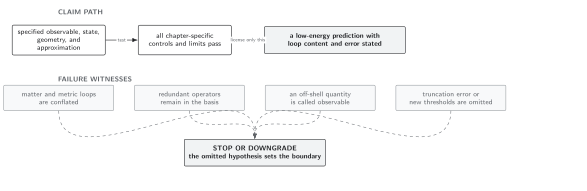
One-loop gravity EFT fails as a prediction when the gauge complex is incomplete, the counterterm basis is not closed, or analytic convention-dependent pieces are confused with nonanalytic on-shell data. The map is schematic and not to scale.
References
Section titled “References”- Donoghue, J. F. “General Relativity as an Effective Field Theory: The Leading Quantum Corrections.” Physical Review D 50, 3874–3888 (1994). doi:10.1103/PhysRevD.50.3874. Open PDF
- Goroff, M. H., and A. Sagnotti. “The Ultraviolet Behavior of Einstein Gravity.” Nuclear Physics B 266, 709–736 (1986). doi:10.1016/0550-3213(86)90193-8
- ’t Hooft, G., and M. Veltman. “One-Loop Divergencies in the Theory of Gravitation.” Annales de l’Institut Henri Poincaré A 20, 69–94 (1974). Stable record and scan