

Background-Field Quantization, Gauge Fixing, and Ghosts
The background-field method makes graviton loops calculable without turning gauge-fixed metric components into observables. A complete one-loop definition contains the metric Hessian, gauge-fixing operator, Faddeev–Popov ghosts, measure/Jacobian choices, and background Ward identity. A matter determinant with no internal metric line remains a different sector.
Required background. Applying EFT Power Counting to Gravity fixes the loop order; The 1PI Effective Action and Mean-Field Equations fixes the Hessian; and Changes of Variables and Regulated Jacobians fixes measure dependence.
Helpful background. Covariant Free-Photon Quantization and Propagator supplies the gauge-fixing analogy, while Regulated Jacobians and Measure Variation supplies the anomaly caution.
Background split and gauge complex
Section titled “Background split and gauge complex”Use
At linear order a quantum diffeomorphism acts as after absorbing the split normalization into . Choose the covariant de Donder functional
and a gauge parameter . The quadratic functional has the form
With the site curvature convention, variation of gives
The curvature sign is fixed directly rather than imported from DeWitt. Indeed, follows from in the site convention. The remaining terms give , establishing the plus sign in .
The anticommuting vector ghosts contribute with the opposite determinant power from the bosonic Hessian:
This is the defining separation from a matter-only .
The structure map places ghosts on the metric-loop branch rather than the matter branch.

Graviton and ghost determinants form one gauge-consistent metric-loop sector; matter determinants are classified separately even though all renormalize the same local curvature basis. The map is schematic and not to scale.
First application: an Einstein background
Section titled “First application: an Einstein background”Let in four dimensions. Define the Lichnerowicz operator
For a transverse-traceless fluctuation, direct variation of gives
Thus the physical spin-two Hessian contains . The trace, longitudinal, and ghost blocks depend on , but their principal symbols are minimal Laplace type at . On the Einstein background the ghost operator reduces to
Two convention checks are immediate. In the flat limit, and the TT equation becomes , while the ghost operator becomes . On a maximally symmetric four-dimensional background, , so the equation reduces to . These round trips verify both signs despite the different Riemann convention used in DeWitt’s source.
These formulas supply three checks: the TT zero modes solve the linearized Einstein equation; the ghost operator is exactly ; and the combined principal-symbol count removes gauge directions. The original background-field construction and covariant gravitational Ward identities are developed in DeWitt 1967, §§2–5.
Background diffeomorphism invariance acts simultaneously on , , and ghosts. The resulting identity may be written schematically as
At vanishing mean fluctuation and ghost fields it reduces to covariant conservation of the background effective equation. BRST invariance supplies the corresponding quantum gauge identity; the Faddeev–Popov construction is the determinant representation of this gauge orbit Faddeev and Popov 1967, pp. 29–30.
Gauge and parametrization test
Section titled “Gauge and parametrization test”Change , or replace the linear split by an exponential metric parametrization. The off-shell Hessian and local coefficients in can change. A matched on-shell amplitude, asymptotic charge, or properly transformed relational observable must not. Failure of that comparison can signal omitted ghosts, a Jacobian, an incomplete counterterm basis, or use of an off-shell metric component as the output.
An Einstein background simplifies the Hessian but does not make its off-shell determinant gauge independent. Zero and negative modes also require a declared contour and collective-coordinate treatment rather than being silently included in .
Domain and failure conditions
Section titled “Domain and failure conditions”The chapter comparison table licenses a metric loop only after split, gauge functional, parameter, ghost boundary conditions, measure, regulator, and observable are stated. Nonperturbative quantum geometry is not inferred from this expansion, and matter-only heat-kernel calculations remain in Chapter 8.
The failure map’s gauge branch is tested by varying and the field parametrization while holding the on-shell matching conditions fixed.
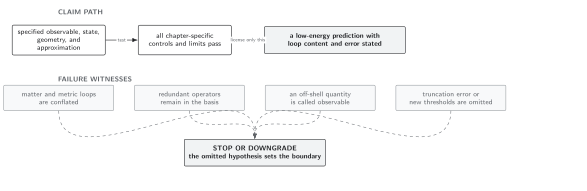
Off-shell effective actions may reorganize across gauges and parametrizations; the declared invariant observable is the quantity required to agree. The map is schematic and not to scale.
References
Section titled “References”- DeWitt, B. S. “Quantum Theory of Gravity. II. The Manifestly Covariant Theory.” Physical Review 162, 1195–1239 (1967). doi:10.1103/PhysRev.162.1195
- Faddeev, L. D., and V. N. Popov. “Feynman Diagrams for the Yang–Mills Field.” Physics Letters B 25, 29–30 (1967). doi:10.1016/0370-2693(67)90067-6