

Decoherence and the Quantum-to-Classical Claim
Inflationary squeezing, decoherence, stochastic predictability, and the occurrence of a definite measurement outcome are different claims. Decoherence is a property of a reduced state after a declared system–environment split and interaction; it can suppress interference in a preferred basis without selecting one member of the resulting ensemble.
Required background. In-in cosmological correlators supplies unitary evolution; contours and initial boundaries supplies the density matrix; system–environment splits and influence functionals supplies reduced dynamics; and secular resummation supplies long-time control.
Helpful background. Trace, positivity, and causal consistency supplies reduced-state checks, while local measurement instruments states what an operational outcome requires.
Squeezing is not yet decoherence
Section titled “Squeezing is not yet decoherence”A superhorizon Gaussian mode becomes highly squeezed: one phase-space quadrature has small uncertainty while its conjugate has large uncertainty. The Wigner function can become narrow around a classical growing-mode trajectory, and the commutator may be small compared with the symmetrized correlation. Yet the full state remains pure under unitary evolution, and coherent phases remain recoverable in principle.
Choose a system field —for example, long modes selected by a window —and trace over environmental modes . For a Hermitian interaction
the quadratic influence action in center/difference variables is
where
The positive noise kernel suppresses histories with large ; supplies causal dissipation or phase shifts. These signs follow the chapter’s plus-source convention.
What a decoherence calculation establishes
Section titled “What a decoherence calculation establishes”For one coarse-grained amplitude, a Gaussian reduced density matrix may take the schematic form
Growth of suppresses off-diagonal matrix elements in the declared field-amplitude basis. A meaningful claim compares the decoherence rate with Hubble evolution and perturbative breakdown, checks trace preservation and positivity, and retains the residual phase . Nelson computes a gravitationally induced inflationary example and its momentum dependence in Nelson 2016, §§2–5, Eqs. (2.1)–(5.9).
The first application traces short modes coupled weakly to a long mode by a cubic interaction. Compute the reduced density matrix, its Wigner transform, and the remaining phase correlations. Compare three times: squeezing, off-diagonal suppression, and loss of perturbative control. They need not coincide. The result licenses an approximately classical probability distribution for a specified set of coarse-grained observables, not a collapse mechanism or a classical metric in every basis.
Basis selection comes from the interaction and dynamics. If the environment couples approximately to field amplitude, the amplitude basis is robust; a derivative coupling can favor a different phase-space combination. The statement that is nearly diagonal is therefore incomplete without the canonical variable and coarse-graining cell. Entanglement entropy is also not a universal decoherence clock: it measures mixedness of the chosen split, while suppression of a particular interference experiment depends on which off-diagonal matrix elements that experiment probes.
Non-Markovian environments require the full two-time kernels. Replacing by white noise and by local friction is controlled only when their correlation time is short compared with the system evolution and when initial correlations have decayed. Inflationary horizon crossing does not automatically establish that hierarchy.
The structure map places tracing and coarse graining after the interaction and state have been fixed.

Squeezing organizes phase space; environmental tracing produces decoherence through an influence functional; neither step by itself selects a measurement outcome. Schematic; not to scale.
Split-dependence adversarial test
Section titled “Split-dependence adversarial test”Vary the system window, its transition width, and the scale separating long and short modes. Run the influence coefficients so that predictions for a fixed coarse observable agree within the truncation error. If the claimed decoherence time changes parametrically under an innocuous split deformation, it is not yet a physical result. Initial system–environment correlations and non-Markovian memory must also be retained when their timescales are comparable to .
Finally specify an instrument or records if a definite-outcome statement is intended. Reduced-state diagonality alone supplies an improper mixture, not an observed outcome. See the chapter’s domain and failure conditions.
A useful operational endpoint is a bound on interference visibility for a declared pair of coarse histories. That quantity can be small and reproducible even while foundational interpretations of individual outcomes remain open.
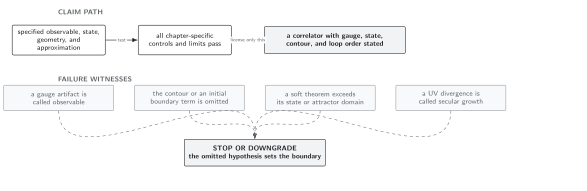
An inflationary classicality claim must state the reduced variables, environment, window, interaction, timescale hierarchy, positivity check, and the narrower conclusion actually established. Schematic; not to scale.
References
Section titled “References”- Nelson, E., “Quantum Decoherence during Inflation from Gravitational Nonlinearities,” Journal of Cosmology and Astroparticle Physics 03, 022 (2016), doi:10.1088/1475-7516/2016/03/022.