

Mode Bases, In/Out States, and Number Operators
A particle basis is controlled when a complete normalized positive-frequency subspace is selected by declared asymptotic or symmetry data. In and out particles are therefore meaningful in backgrounds that approach stationary regimes sufficiently well in the past and future. A time-local diagonalization without such structure defines a useful basis occupation, but not an invariant particle count.
Required background. Bogoliubov Transformations and Unitary Implementability supplies the representation test; Fock Space, Vacuum, and Particle Number supplies number operators; One-Particle States: Mass, Spin, and Relativistic Normalization supplies relativistic normalization.
Helpful background. Wavepackets, Modes, Frames, and Localization supplies finite-resolution packets; Vacuum Ambiguity, Time Flow, and Observer Dependence explains why generic time dependence removes a preferred split.
Normalized mode bases
Section titled “Normalized mode bases”For complex solutions of the Klein–Gordon equation, choose a set satisfying
and a completeness relation on the real solution space. Then
The basis determines the complex structure and hence the operators called annihilation, creation, and number. A phase rotation of changes no number operator; mixing with generally does.
Suppose stationary asymptotic regions select normalized in and out bases. Write
Conservation of the Klein–Gordon product gives
In the in-vacuum,
Parker’s expanding-universe calculation is the prototype of this in/out construction Parker 1968, pp. 562–564.
Wavepacket number and finite resolution
Section titled “Wavepacket number and finite resolution”Plane-wave number in infinite volume is distributionally normalized. A normalized packet,
defines
The packet fixes bandwidth, localization, and detector resolution. For diagonal production,
This is finite when the packet and ultraviolet falloff are adequate even if the formal total number in infinite volume is extensive.
First application: a temporally localized background
Section titled “First application: a temporally localized background”Let a spatially homogeneous scalar mode obey
with as . Normalize
Wronskian conservation gives . A packet centered at with width reports a resolution-weighted out occupation, while the associated out energy above the out vacuum is approximately
The approximation ignores anomalous interference and backreaction only when they are absent or bounded in the stated observable.
Adversarial nonstationary future
Section titled “Adversarial nonstationary future”If never approaches a stationary limit, the symbol has no asymptotic meaning. One can choose an instantaneous WKB basis at a finite time, but different adiabatic orders and canonical variables give different and .
The strongest surviving claim is then basis-qualified occupation or a localized detector/stress observable. An “out particle number” is not licensed. Fulling’s canonical nonuniqueness result is exactly the warning needed here Fulling 1973, pp. 2850–2862.
Construction and failure maps
Section titled “Construction and failure maps”The construction map highlights the two data this page supplies: a normalized basis and a solvable asymptotic limit.

In/out particle number is an asymptotic basis observable with finite-resolution wavepacket and energy controls; the map is schematic and not to scale.
The failure map exposes the decisive misuse: an instantaneous basis is not invariant merely because it diagonalizes a Hamiltonian at one time.
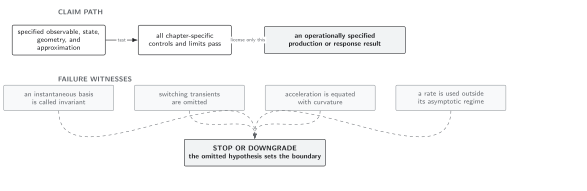
Without an asymptotic positive-frequency split, only a declared basis occupation—not invariant out-particle production—is licensed. Schematic and not to scale.
Use Domain and failure conditions to compare this construction with detector response and stress flux. The decisive checks are the asymptotic time generator, KG normalization, completeness, wavepacket resolution, canonical identities, ultraviolet integrability, and unitary implementability when a shared Fock space is claimed.
Check your understanding
Section titled “Check your understanding”Why does not by itself prove that the in and out Fock representations are unitarily equivalent?
Solution
The identity holds mode by mode because the Klein–Gordon product is conserved. In an infinite system, unitary implementability additionally requires the antilinear map to be Hilbert–Schmidt, schematically after the correct degeneracies and volume interpretation are included.
Particle Creation in Time-Dependent Backgrounds computes the mixing. Localized apparatus readout remains with Detector Response Along Curved and Accelerated Worldlines. General Fock theory remains in Volume II and state selection in Chapter 2.
References
Section titled “References”- N. D. Birrell and P. C. W. Davies, Quantum Fields in Curved Space, Cambridge University Press (1982), DOI, Chapter 3.
- S. A. Fulling, “Nonuniqueness of Canonical Field Quantization in Riemannian Space-Time,” Physical Review D 7 (1973), 2850–2862, DOI.
- Leonard Parker, “Particle Creation in Expanding Universes,” Physical Review Letters 21 (1968), 562–564, DOI.