

Cauchy Horizons, Chronology Horizons, and Loss of Global Hyperbolicity
Global hyperbolicity is the condition that turns local field equations into predictive QFT: it supplies Cauchy surfaces, advanced and retarded propagators, and deterministic algebraic evolution. At a Cauchy or chronology horizon, failure can occur before curvature becomes Planckian because the causal domain, state extension, and Hadamard property cease to be controlled.
Required background. Curved spacetimes and global hyperbolicity supplies the causal construction; semiclassical breakdown diagnostics supplies response tests; wormholes, chronology, and superluminal constraints supplies the energy-condition scope; and renormalized-stress axioms supplies the local observable.
Helpful background. Curved-spacetime quantum energy inequalities supplies smeared bounds, while extremal and late-time limits supplies a nonuniform horizon limit.
What global hyperbolicity had supplied
Section titled “What global hyperbolicity had supplied”For a normally hyperbolic operator , global hyperbolicity gives unique retarded and advanced Green operators and the causal propagator
With the volume convention, . A Cauchy surface carries initial data that determine the field algebra throughout its domain of dependence. A Hadamard state then gives the universal short-distance singularity needed to define Wick products and .
Beyond a Cauchy horizon, local initial data need not determine a unique extension. Boundary conditions at a timelike singularity, data entering from another region, or a choice of self-adjoint extension can change the propagator. The algebra is therefore extension dependent even if the local metric is smooth.
The compactly generated horizon result
Section titled “The compactly generated horizon result”For compactly generated Cauchy horizons, Kay, Radzikowski, and Wald proved that at certain base points the two-point function of a state that is Hadamard in the initial globally hyperbolic region cannot retain the local Hadamard form. The obstruction is microlocal and implies that ordinary point-splitting definitions of the stress tensor are not available at those points Kay, Radzikowski, and Wald 1997, Theorem 2 and Corollary, pp. 545–551.
This theorem is sharper and narrower than “the stress tensor always diverges at every chronology horizon.” It establishes failure of the required singularity structure under its geometric hypotheses. It does not supply a universal numerical divergence, cover every noncompact horizon, or prove that quantum gravity resolves chronology.
A chronology horizon is the boundary of a region containing closed timelike curves, whereas a Cauchy horizon marks the boundary of a domain of dependence; examples can realize both structures, but the notions are not identical. Compact generation is also a substantive global hypothesis. Before invoking the theorem, trace the null generators, identify their past imprisonment properties, and verify that the point being probed lies in the theorem’s base set.
The first application transports a Hadamard two-point function toward a simple compactly generated horizon. At each stage record the globally hyperbolic subregion, the wavefront set, the support of the smearing functions, and the chosen extension. Compute only while the subtraction is defined. Near a base point, the correct verdict may be “the local Wick square or stress is undefined by this construction,” not an arbitrarily assigned infinity.
Local covariance still permits meaningful observables supported in a globally hyperbolic neighborhood strictly before the horizon. Their validity should be preserved even when no global extension is selected. This region-by-region statement is often the strongest extension-independent result.
The structure map shows global causal construction preceding state propagation and local renormalization.

Loss of global hyperbolicity can obstruct unique evolution and renormalized local observables even at sub-Planckian curvature; the precise result depends on horizon geometry and extension data. Schematic; not to scale.
Extension-dependence test
Section titled “Extension-dependence test”Hold the initial data fixed in the common globally hyperbolic region and vary two admissible extensions or boundary conditions. Compare only observables supported where both constructions exist. A divergence, finite limit, or “protection” statement that changes with the extension is not determined by the original data.
Blue-shift instabilities and chronology protection are then separate dynamical questions. They require a state, response kernel, smearing, and backreaction calculation in addition to the causal theorem. See the chapter’s domain and failure conditions.
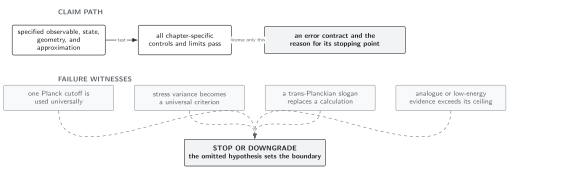
Horizon claims must separate theorem hypotheses, extension dependence, microlocal state failure, and dynamical backreaction; none is a universal substitute for the others. Schematic; not to scale.
References
Section titled “References”- Kay, B. S., M. J. Radzikowski, and R. M. Wald, “Quantum Field Theory on Spacetimes with a Compactly Generated Cauchy Horizon,” Communications in Mathematical Physics 183, 533–556 (1997), doi:10.1007/s002200050042.