

Cross-Regime Trans-Planckian Sensitivity and Universality
Hawking radiation and inflation both redshift low-frequency observables from modes whose traced-back frequencies can exceed a proposed UV scale. Robustness is not automatic: it can be demonstrated only within a class of modified states, dispersions, preferred frames, interactions, and adiabatic histories. The two settings share a question but not one universality theorem.
Required background. Observable-specific validity contracts fixes the low-energy quantity; cross-expansion hierarchies supplies scale ordering; trans-Planckian sensitivity of the Hawking derivation supplies horizon propagation; and trans-Planckian initial-state sensitivity supplies the cosmological state problem.
Helpful background. Modified dispersion and analogue horizons supplies controlled models, while gravitational-EFT validity supplies the operator interpretation.
Matched deformations, different hypotheses
Section titled “Matched deformations, different hypotheses”Introduce a preferred freely falling or cosmological frame and a stable high-frequency dispersion,
with a specified ground or excited state. For a stationary analogue or black-hole horizon, modified-dispersion calculations can recover an approximately thermal low-frequency flux when the near-horizon evolution is adiabatic, the high-frequency state is regular in the preferred frame, and . Unruh demonstrated this robustness in a dispersive sonic model Unruh 1995, §§II–IV, Figs. 1–4; Corley and Jacobson showed both robust and nonthermal branches depending on dispersion and state data Corley and Jacobson 1996, §§II–V, Eqs. (2.1)–(5.12).
For inflation, a mode crosses the new-physics scale at a time depending on . If it is placed in the instantaneous adiabatic state and , corrections are typically suppressed by powers of and slow variation. A finite-time excited state can instead produce oscillatory or folded signatures whose size is set by its Bogoliubov coefficient and boundary-EFT constraints. Backreaction and Hadamard falloff restrict that freedom.
Modified dispersion is only one UV proxy. Dissipation couples the low-energy mode to additional environmental degrees of freedom and requires noise as well as a complex response kernel. Extra branches can carry negative norm or become unstable. A robustness study that varies only the real dispersion relation has not tested these possibilities. Conversely, a local boundary EFT can parameterize initial-state sensitivity without asserting that the microscopic theory literally contains a preferred hard hypersurface.
What the comparison can establish
Section titled “What the comparison can establish”The first application uses the same function in a Hawking calculation and an inflationary two-point calculation. Keep separate:
- the preferred frame: freely falling near a horizon versus cosmological comoving;
- the state: regular infalling ground state versus a state on a new-physics hypersurface;
- the adiabatic measure: versus and slow-roll rates;
- the observable: stationary outgoing flux versus a finite-time primordial correlator.
Agreement of low-frequency outputs under this matched family demonstrates conditional insensitivity to that family. It does not prove invariance under nonadiabatic state preparation, dissipation, interactions, extra modes, or loss of a preferred regular frame. Unruh and Schützhold formulate this distinction as a universality class with explicit assumptions Unruh and Schützhold 2005, §§2–5, Eqs. (4)–(26).
The structure map pairs each deformation with the state and evolution assumptions that make a robustness test meaningful.

Cross-regime universality means robustness within a declared deformation class; horizon and inflationary results retain different state, frame, and observable assumptions. Schematic; not to scale.
Independent-variation test
Section titled “Independent-variation test”Vary the dispersion while holding the state fixed, then vary the state, preferred frame, and adiabaticity one at a time. If thermality or the inflationary spectrum survives only when several changes are correlated, report that restricted family rather than “trans-Planckian universality.” Check stability, norm conservation, backreaction, and the number of propagating branches for every deformation.
Low-energy robustness also does not determine an evaporation endpoint or primordial initial-condition theory. See the chapter’s domain and failure conditions.
Dimensional suppression alone is not sufficient: a correction proportional to can be enhanced by duration, occupation, resonance, or a nonadiabatic event. Those combinations belong in the observable’s cross-expansion contract.
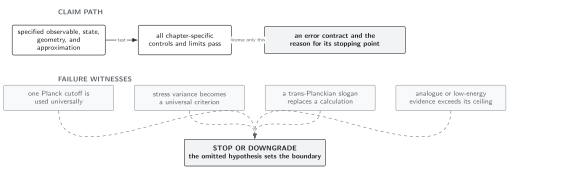
A robustness conclusion is licensed only for independently varied stable dispersions, admissible states, declared frames, and controlled adiabatic evolution at fixed low-energy observable. Schematic; not to scale.
References
Section titled “References”- Corley, S., and T. Jacobson, “Hawking Spectrum and High Frequency Dispersion,” Physical Review D 54, 1568–1586 (1996), doi:10.1103/PhysRevD.54.1568.
- Unruh, W. G., “Sonic Analogue of Black Holes and the Effects of High Frequencies on Black Hole Evaporation,” Physical Review D 51, 2827–2838 (1995), doi:10.1103/PhysRevD.51.2827.
- Unruh, W. G., and R. Schützhold, “Universality of the Hawking Effect,” Physical Review D 71, 024028 (2005), doi:10.1103/PhysRevD.71.024028.