

Heavy Thresholds, Species, and the Gravitational Cutoff
Many quantum fields can enhance gravitational loops, but “the species cutoff” is not one universal number obtained by counting every field in a Lagrangian. The active multiplicity depends on energy, mass thresholds, spin, couplings, and the observable. Perturbative loop breakdown and black-hole or entropy arguments can share the scaling while differing by loop factors, definitions, and hypotheses.
Required background. Applying EFT Power Counting to Gravity supplies the loop parameter; Matter Contributions to Gravitational Matching supplies threshold matching; and Decoupling Theorems and Threshold Corrections supplies active-field counting.
Helpful background. Entropy Bounds, Species, and Regulator Dependence separates entropy arguments, while Mass Thresholds, Decoupling, and Curvature Expansions supplies curved-background qualifications.
A scale-dependent effective multiplicity
Section titled “A scale-dependent effective multiplicity”For a gravitational two-point observable at invariant energy , define
The coefficient includes spin, representation, and the tensor channel being probed. A physical threshold weight is smooth: for in the nonlocal low-energy response and for , up to normalization. A heavy field still leaves local matched Wilson coefficients below threshold; “decoupled” does not mean erased.
The matter polarization corrects a canonically normalized graviton inverse propagator schematically as
Fixed-loop perturbation theory requires for this observable. If is approximately constant, extrapolating this condition suggests
up to spin, channel, and normalization factors. This is a perturbative estimate, not a prediction that new particles must occur exactly there. It can be pre-empted by a heavy threshold, a large Wilson coefficient, strong curvature, or a different partial wave.
The structure map treats thresholds before any cutoff estimate because the relevant is itself an output of matching.

Species enhancement is computed from the fields active in a declared gravitational observable; heavy fields instead contribute matched local coefficients below their thresholds. The map is schematic and not to scale.
First application: separated scalar thresholds
Section titled “First application: separated scalar thresholds”Take minimally coupled real scalars with masses and use the same subtraction and tensor-projector convention for every contribution. The renormalized two-point response may be written
where the nonlocal form factor has a low-energy analytic expansion and develops its physical cut at the pair threshold. Matching transfers the analytic low-energy terms into curvature coefficients. The remaining scale-dependent correction is controlled by
For , an abrupt step approximation may be convenient away from thresholds:
The exact form factor is continuous. Counting all three scalars below gives a falsely low bound; deleting their matched curvature terms gives an equally false low-energy theory. In a mass-independent subtraction scheme, heavy fields do not automatically disappear from beta functions, so threshold matching is what restores decoupling. The original decoupling hypotheses and their momentum expansion are stated in Appelquist and Carazzone 1975, §§II–III, pp. 2858–2866.
What a species scale does and does not assert
Section titled “What a species scale does and does not assert”Black-hole arguments often quote
For example, Dvali and Redi derive such a scaling for distinguishable species under semiclassical black-hole assumptions Dvali and Redi 2008, §§II–III, pp. 045027-2–045027-6. Its missing relative to the elementary loop estimate is not a contradiction: the two estimates use different criteria and suppress order-one conventions. Recent geometric formulations likewise define the scale through the importance of higher-curvature corrections or the smallest black hole described by an Einstein truncation, with moduli- and spectrum-dependent qualifications van de Heisteeg, Vafa, Wiesner, and Wu 2024, §§2–3.
Accordingly, is a regime-dependent estimate supported by several arguments, not a theorem for arbitrary interacting spectra. The count may be weighted, towers may invalidate a four-dimensional description before the estimate is reached, and strong couplings or conserved species labels can change the reasoning. The strongest portable statement is that large active multiplicity enhances specified gravitational quantum corrections and can lower the range where an Einstein-only truncation is controlled.
Evidence boundary (10 August 2026). No generally accepted result fixes one process-independent numerical species cutoff for all UV completions. This page therefore exports parametric scaling and explicit hypotheses, not a universal threshold or a catalog of microscopic completions.
Domain and failure conditions
Section titled “Domain and failure conditions”The chapter comparison table requires masses, threshold prescription, spin weights, observable, background, regulator, matching scale, and cutoff criterion. The loop estimate assumes weak curvature and perturbative couplings; the black-hole estimate additionally assumes an applicable semiclassical gravitational regime.
The failure map’s decisive test is to vary masses while holding the nominal field count fixed.
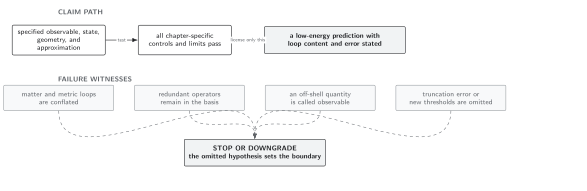
A gravitational validity estimate must use threshold- and observable-weighted active species; an unqualified total field count can fail parametrically. The map is schematic and not to scale.
References
Section titled “References”- Appelquist, T., and J. Carazzone. “Infrared Singularities and Massive Fields.” Physical Review D 11, 2856–2861 (1975). doi:10.1103/PhysRevD.11.2856
- Dvali, G., and M. Redi. “Black Hole Bound on the Number of Species and Quantum Gravity at LHC.” Physical Review D 77, 045027 (2008). doi:10.1103/PhysRevD.77.045027. Open PDF
- van de Heisteeg, L., C. Vafa, M. Wiesner, and D. H. Wu. “Species Scale in Diverse Dimensions.” Journal of High Energy Physics 2024, 112 (2024). doi:10.1007/JHEP05(2024)112. Open PDF