

Accelerated Detector Communication Channels
Acceleration alters a communication protocol through the detector trajectories, proper-time schedules, causal delay, frequency conversion, and response to the field state. None of these effects alone is “the channel noise.” A receiver may exhibit an Unruh response even when no sender is present, while causal gain is determined by how the sender’s intervention propagates to the accelerated interaction region.
Required background. Switching, Smearing, Finite-Time Response, and Transients controls finite detector response. Unruh Effect and Uniformly Accelerated Detectors supplies the stationary accelerated limit. Specifying a Quantum Channel in Curved Spacetime fixes the communication task.
Helpful background. Detector and Instrument Validation separates an ideal response model from a calibrated instrument. Wavepackets, Modes, Frames, and Localization supplies the local mode definitions.
Trajectories, clocks, and kernels
Section titled “Trajectories, clocks, and kernels”For a detector on a worldline with gap and switching , the leading excitation probability in a field state is
This is a local background-response calculation. It does not contain a sender choice. A communication experiment adds a sender coupling and compares receiver probabilities or moments between at least two encodings. The leading difference instead contains
Acceleration enters both formulas by pulling different kernels back to the worldlines, but the kernels retain different meanings.
For uniform proper acceleration in Minkowski spacetime,
In the ideal stationary, eternal-coupling limit, the Minkowski-vacuum response satisfies detailed balance at . This theorem-level detector statement is the Unruh effect Unruh 1976, pp. 885–889. Compact switching introduces transients; finite-time data need not be exactly Planckian and should not be assigned a temperature without the relevant stationarity and scale separation.
Weak coherent modulation
Section titled “Weak coherent modulation”Let inertial sender encode as a small coherent displacement in a localized wavepacket. Let uniformly accelerated receiver couple to the field over compact proper-time support and read a quadrature . In a linear or weak-coupling model,
The gain is the detector-filtered retarded response. is the field-state contribution, is finite switching and mismatch, and is receiver preparation or apparatus noise. The signal-to-noise ratio for a fixed homodyne decision can be written
This expression is operational only after the quadrature normalization, sampling time, and energy of the coherent displacement are fixed.
Acceleration changes the channel in at least four distinguishable ways:
- Causal timing: the proper-time interval during which lies in changes.
- Doppler and mode matching: a wavepacket narrow in the inertial frame is chirped in the accelerated tetrad.
- Background response: the pulled-back Wightman function changes and has the KMS limit under the Unruh hypotheses.
- Access: a uniformly accelerated laboratory remains in one Rindler wedge, so a chosen global wavepacket may have inaccessible support.
These mechanisms can reinforce or offset one another. An increased excitation rate does not determine the sign of the change in or in the final SNR.
Proper-time comparison
Section titled “Proper-time comparison”Compare an inertial receiver and an accelerated receiver using equal proper-time switching duration , equal local gap , equal integrated coupling , and receiver wavepackets defined in each local tetrad. Report separately:
- the earliest and latest causal arrival proper times;
- after the same sender encoding;
- the added covariance at zero sender amplitude;
- the decoded error probability after any redshift or chirp compensation.
Without these matches, a comparison may merely exchange laboratory time for proper time or compare different bandwidths. Exact detector-field channel models likewise require the full evolution and can display memory and strong-coupling behavior beyond the simple response formula; Lapponi et al. 2023, §§ II–IV gives a nonperturbative Gaussian detector-channel treatment in the inertial setting that supplies the relevant control structure.
The Unruh-noise adversarial test
Section titled “The Unruh-noise adversarial test”Set the sender amplitude to zero and measure ; then restore the modulation and estimate from the difference of receiver means. Calling the first number “communication noise” without the second is incomplete. Two counterfixtures make this explicit:
- Choose supports with causally disjoint from . The accelerated detector can click, but and no communication channel is present.
- Choose a receiver observable whose mean responds to a causal coherent source while the field is in a low-noise state and the detector begins in a suitable Gaussian state. The gain can be nonzero even if the background excitation probability is small.
The strongest licensed conclusion from an Unruh response alone is a statement about the detector’s stationary or finite-time noise environment. A channel conclusion requires the signal map and a task.
Domain, limits, and maps
Section titled “Domain, limits, and maps”See Domain and failure conditions. The uniform-acceleration thermal statement assumes the Minkowski vacuum, stationary motion, and the appropriate long-time detector limit. Compact switching, spatial smearing, recoil, finite detector size, interactions, and backreaction can modify the response. A Rindler-mode decomposition is a calculational representation, not an automatic trace prescription for a localized receiver.
The structure map places acceleration in the geometry, state, and local-coupling data, before restriction and decoding. Inspect both the commutator checkpoint and the reference-frame transformation.

Proper-time support and retarded response determine gain, while the pulled-back state covariance and apparatus determine added noise. Schematic; not to scale.
The failure map identifies the forbidden shortcut: a detector response is not a capacity or fidelity and cannot replace the channel calculation.
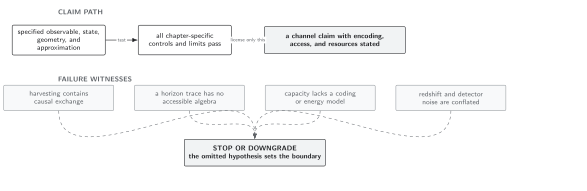
Background clicks and sender-dependent gain are independent operational quantities; both are needed for an accelerated communication claim. Schematic; not to scale.
Related topics
Section titled “Related topics”Redshift, Restricted Access, and Effective Channel Noise separates frequency conversion from reduction. Entanglement Distribution and State Transfer Through Curved Fields adds decoding fidelity. Detector thermality and finite-time corrections remain with Unruh Effect and Uniformly Accelerated Detectors.
References
Section titled “References”- Lapponi, Alessio, Dimitris Moustos, David Edward Bruschi, and Stefano Mancini. “Relativistic Quantum Communication between Harmonic Oscillator Detectors.” Physical Review D 107 (2023): 125010. DOI. Open PDF.
- Unruh, William G. “Notes on Black-Hole Evaporation.” Physical Review D 14 (1976): 870–892. DOI.