

Stress Bi-Tensors and Noise-Kernel Input
The matter input for stochastic gravity is not and not an unsmeared coincident variance. It is the connected, symmetrized stress bi-distribution with indices at two spacetime points, defined in a state and renormalization prescription and tested for symmetry, conservation, covariance positivity, and admissible smearing.
Required background. Wick Polynomials and Hadamard Point Splitting supplies the composite fields; Renormalized Stress Tensor: Axioms and Curvature Ambiguities supplies the one-point tensor; Quasifree States and Two-Point Functions supplies Gaussian factorization.
Helpful background. Green Functions and Causal Propagators separates symmetric and causal kernels; Hadamard Admissibility: The Two-Point Wavefront Criterion supplies the distributional domain.
Connected symmetrized stress bi-distribution
Section titled “Connected symmetrized stress bi-distribution”Use the page-local stress convention
Define the centered stress operator
and the bi-distribution
Primed indices live in and unprimed indices in . No parallel transport is needed to define the bitensor. A propagator is required only when indices are compared or contracted at one point, and its geodesic domain must then be stated.
The subtraction of is essential. Under a finite c-number shift
and hence the separated-point are unchanged. This cancellation does not remove the finite freedom in extending singular products onto the diagonal .
For real compactly supported symmetric test tensors ,
Positivity is therefore a smeared covariance statement. Individual coordinate components of need not be positive.
First application: quasifree scalar state
Section titled “First application: quasifree scalar state”Write the point-split scalar stress as
For a quasifree Hadamard state, Wick’s theorem reduces the connected four-point function to the two cross-contractions. At separated points,
This formula is interpreted distributionally on . It is pointwise smooth only away from the singular support, which includes null-related pairs. The local Hadamard subtractions and finite c-number tensors cancel from the connected separated expression, but they were needed to define each stress operator consistently.
On an ultrastatic background, insert the positive-frequency mode expansion of and smear both arguments with compact test tensors before summing. Then verify:
under simultaneous point and index-pair exchange, and
as distributional identities away from declared contact, background-force, anomaly, and boundary terms. Phillips and Hu give the point-separated Gaussian construction and its coincidence analysis Phillips and Hu 2001, §§II–III, Eqs. (2.1)–(3.29).
Numerically, form a covariance matrix for a finite set of real test tensors. It must be symmetric positive semidefinite within error. A negative eigenvalue larger than the numerical uncertainty signals inconsistent subtraction, quadrature, or state data.
What is not yet a stochastic source
Section titled “What is not yet a stochastic source”contains the symmetrized connected fluctuations. The causal response instead involves the stress commutator, retarded support, and metric-variation contact terms. Neither kernel can be reconstructed from the other without additional stationary/KMS hypotheses, and even then the relation is a fluctuation–dissipation statement with a specified frequency convention Hu and Verdaguer 2020, §§3.1–3.3.
This page does not postulate a classical random stress. Chapter 10 may introduce a Gaussian source whose covariance equals within a controlled approximation. Higher connected stress cumulants and the full quantum metric state are not encoded in that replacement.
Adversarial coincidence test
Section titled “Adversarial coincidence test”Take in the displayed before smearing. Products of two stress tensors are more singular than the one-point stress, so the result generally diverges or requires new contact-term extensions. The finiteness of proves nothing about .
The strongest result without a diagonal extension is the separated bi-distribution and every admissibly smeared covariance it defines. A local “noise amplitude” requires its own smearing or renormalization prescription and cannot be imported as a universal scalar.
Bitensor and failure maps
Section titled “Bitensor and failure maps”The structure map ends this chapter with a typed matter output: a connected symmetric covariance, not yet a metric correlator.

The exported object retains two spacetime arguments, primed indices, state data, and smearing domain; the map is schematic and not to scale.
The failure map blocks the common shortcuts from a finite mean stress to a pointwise variance or full stochastic metric prediction.
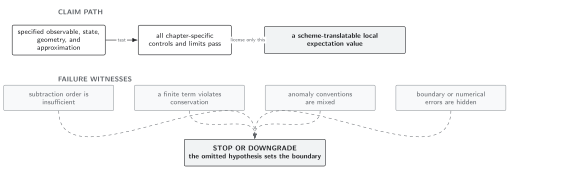
Mean stress, connected symmetric covariance, causal commutator, and metric fluctuations are distinct objects; the map is schematic and not to scale.
Use Domain and failure conditions. Record field and state, stress prescription, connected subtraction, index bundles and transport if used, separated-point domain, contact extensions, boundary terms, test tensors, covariance positivity, and conservation residuals.
Check your understanding
Section titled “Check your understanding”Why does a finite shift cancel from ?
Solution
The same shift appears in the operator and its expectation, so is unchanged. This argument does not constrain contact terms created when two insertions coincide.
Chapter 10 develops the noise-kernel name, influence functional, Einstein–Langevin equation, and stochastic metric response. The result supplied here is only with its state, subtraction, distributional domain, smearing, and checks. The literature basis and this claim boundary were checked through 10 August 2026.
References
Section titled “References”- Bei-Lok Hu and Enric Verdaguer, “Stochastic Gravity: Theory and Applications,” Living Reviews in Relativity 23 (2020), article 3, DOI, arXiv:0802.0658.
- Nicholas G. Phillips and Bei-Lok Hu, “Noise Kernel in Stochastic Gravity and Stress Energy Bi-Tensor of Quantum Fields in Curved Spacetimes,” Physical Review D 63 (2001), 104001, DOI, arXiv:gr-qc/0010019.