

Instantaneous Vacua, Alpha Vacua, Sorkin–Johnston States, and Failure Tests
A proposed vacuum construction must be tested separately for positivity, field equations and commutator, Hadamard ultraviolet form, symmetry, dependence on auxiliary choices, and operational behavior. Instantaneous diagonalization, de Sitter alpha states, and Sorkin–Johnston states each answer a recognizable mathematical question, but none acquires universal physical status from its name. The right conclusion is the strongest property that survives all relevant tests.
Required background. Vacuum Ambiguity, Time Flow, and Observer Dependence separates state from particle language. Hadamard Parametrix and Short-Distance Structure supplies the ultraviolet benchmark.
Helpful background. Adiabatic States, WKB Order, and Regularity supplies the controlled alternative to zeroth-order instantaneous data. Ground, KMS, and Symmetry-Selected States supplies symmetry and thermal tests.
Three constructions and their domains
Section titled “Three constructions and their domains”| Construction | Input that defines it | Property obtained directly | Main unresolved test |
|---|---|---|---|
| Instantaneous ground state | A chosen slice, canonical variables, and Hamiltonian diagonalization | Minimum of that quadratic Hamiltonian at that instant, when positive | High-frequency behavior after evolution and dependence on slice or variables |
| de Sitter alpha state | Antipodal Bogoliubov mixing of a de Sitter-invariant reference state | de Sitter invariance and, for the normalized free-field family, positivity | Extra antipodal singularities and failure of Hadamard form except at the Euclidean member |
| Sorkin–Johnston state | A spacetime region, its volume measure, and the positive spectral part of the commutator operator | A pure quasifree state when the operator construction is well defined | Region and boundary dependence; generic failure of Hadamard form |
The entries are not interchangeable. A construction may be positive but non-Hadamard, symmetric but nonlocal in its auxiliary input, or ultraviolet admissible but nonunique.
Instantaneous diagonalization
Section titled “Instantaneous diagonalization”At time , a homogeneous scalar mode has a quadratic Hamiltonian resembling
Choosing and minimizes this expression when . It does not control derivatives of the geometry beyond that instant. In a rapidly varying background, exact evolution can produce a high- mismatch whose decay is too slow for the required Hadamard or observable regularity. A time-dependent canonical transformation can also change which quadratic form is being diagonalized.
The first comparison therefore evolves the instantaneous modes exactly, fits the ultraviolet falloff relative to a Hadamard or sufficiently high-order adiabatic reference, and checks stability under shifting . The Sobolev meaning of finite adiabatic order is given by Junker and Schrohe 2002, Definition 3.2. A later detector response is an additional operational test, not the definition of the state.
Alpha states in de Sitter space
Section titled “Alpha states in de Sitter space”For a free scalar, a normalized antipodal Bogoliubov mixture can be written schematically as
where denotes the Euclidean, or Bunch–Davies, modes and in a common parametrization. The family analyzed by Allen is de Sitter invariant Allen 1985, §§ II–III, pp. 3138–3144. Except for the Euclidean limit, its two-point function includes the opposite-frequency branch and antipodal singularities. It therefore fails the local Hadamard wavefront criterion even though the free quasifree construction can remain positive and symmetric.
This is the second part of the declared comparison: test field equation, commutator, positivity, de Sitter invariance, and wavefront set independently. Symmetry survives; Hadamard admissibility does not. Interacting perturbation theory and detector response face further difficulties, but those are not needed to establish the ultraviolet failure.
The Sorkin–Johnston spectral prescription
Section titled “The Sorkin–Johnston spectral prescription”Let be the Pauli–Jordan kernel, so the site commutator is . On a spacetime region , regard
as a self-adjoint operator on an appropriate domain, when this is possible. Its positive part
defines the Sorkin–Johnston two-point operator. The construction depends on the region, its measure, operator domain, and boundary behavior. Fewster and Verch proved that it is well defined and pure in a broad bounded-region setting, but is not generally Hadamard even for ultrastatic slabs Fewster and Verch 2012, Propositions 3.1–3.2 and Theorem 4.2.
A finite matrix approximation is automatically spectrally tame. That does not establish convergence of its continuum wavefront set.
Remove the auxiliary choice
Section titled “Remove the auxiliary choice”Every regulator or finite-region claim should be tested as a family. Let denote a state built in region size with cutoff . Check, in a fixed interior region:
- positivity and the exact commutator as the discretization is refined;
- convergence of smeared two-point functions, not only eigenvalues;
- stability of the Hadamard difference against a reference state;
- independence, or declared dependence, on boundary shape and cutoff profile;
- convergence of the physical observable being claimed.
Tuning until a finite calculation looks smooth proves only a regulated statement. If the interior kernels fail to converge or retain reflected and antipodal singularities, the auxiliary-choice-independent state claim must be withdrawn.
A reusable failure test
Section titled “A reusable failure test”For any proposed selector, record the answer to six questions: Is it a positive state? Does it solve the field equation with the correct commutator? Is it Hadamard? Which symmetry or variational property selects it? Which slice, observer, region, boundary condition, or regulator enters? Which operational predictions remain stable when those auxiliary inputs are varied? Passing one question never supplies the others.
Domain and failure conditions
Section titled “Domain and failure conditions”The construction map locates the central mistake shared by overstrong vacuum claims: a mathematical prescription for modes or a spectral kernel is treated as though it had already passed positivity, Hadamard, global-construction, and physical-selection tests. Each arrow must instead be justified for the declared instantaneous, alpha, or Sorkin–Johnston state.

Instantaneous, alpha, and Sorkin–Johnston prescriptions answer different construction questions and acquire no universal status without the intervening controls. Schematic; not to scale.
The failure map is the operational summary for this page. Instantaneous data can fail adiabatic regularity, finite-region spectral states can retain zero-mode or boundary dependence, and de Sitter invariance can be mistaken for uniqueness or Hadamard form. Any one witness fixes the strongest defensible downgrade.
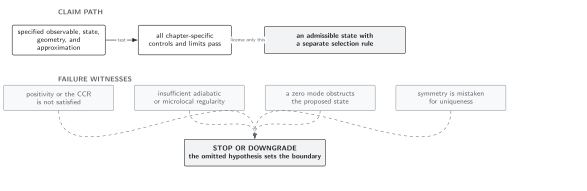
A regulated or symmetric construction is accepted only for the observables and limits that pass; an omitted hypothesis determines the boundary. Schematic; not to scale.
The canonical comparison of all chapter state classes is Domain and failure conditions.
Related topics
Section titled “Related topics”Detector response and particle production belong to Particles, Detectors, and Nonadiabatic Production. Detailed de Sitter state physics belongs to Euclidean and Bunch–Davies Free Fields in de Sitter. The theorem-level obstruction to a universal locally covariant selector continues in No Natural States and Covariant State Spaces.
References
Section titled “References”- Allen, Bruce. “Vacuum States in de Sitter Space.” Physical Review D 32 (1985): 3136–3149. DOI.
- Fewster, Christopher J., and Rainer Verch. “On a Recent Construction of ‘Vacuum-like’ Quantum Field States in Curved Spacetime.” Classical and Quantum Gravity 29 (2012): 205017. DOI. Open PDF.
- Junker, Wolfgang, and Elmar Schrohe. “Adiabatic Vacuum States on General Spacetime Manifolds: Definition, Construction, and Physical Properties.” Annales Henri Poincaré 3 (2002): 1113–1181. DOI.