

Wick Polynomials and Hadamard Point Splitting
Wick powers on curved spacetime are defined by removing the universal Hadamard singularity before the points coincide. This is a local construction: it uses the metric and field operator near the evaluation point, preserves the smooth state-dependent remainder, and leaves a finite family of curvature terms fixed only by renormalization conditions.
Required background. Hadamard Parametrix and Short-Distance Structure supplies ; Hadamard Admissibility and the Two-Point Wavefront Criterion licenses the required products and restrictions; Free Wick Products and Point Splitting supplies the flat-space construction.
Helpful background. Renormalized Composite-Operator Insertions gives the general mixing problem; Products, Scaling Degree, and Extensions of Singular Distributions explains the coincidence obstruction.
Hadamard subtraction and Wick powers
Section titled “Hadamard subtraction and Wick powers”Let be the two-point distribution of a Hadamard state. In a convex normal neighborhood,
where is built locally from the geometry, , and a reference length ; is smooth. For a real scalar, the renormalized Wick square expectation is
The coincidence limit is taken only after subtraction. The constants and are the four-dimensional finite freedom allowed by locality, covariance, dimension, and smooth scaling. They do not depend on . Changing changes the smooth local remainder and is compensated by a change of these coefficients. Hollands and Wald prove the corresponding locally covariant classification for Wick powers under their stated hypotheses Hollands and Wald 2001, Theorem 5.1.
At operator level, one may define by the same split and then smear it with a compactly supported test function. The point symbol is distributional notation, not permission to multiply arbitrary field distributions at coincidence.
First application: a renormalized field square
Section titled “First application: a renormalized field square”Choose a four-dimensional Hadamard state and a geodesically convex neighborhood of . Compute the biscalar
Three checks make the limit reproducible.
- Approach coincidence along two different geodesic directions and recover the same scalar.
- Replace by another Hadamard state and verify
so all state-independent finite terms cancel. 3. Change and compensate with the calculated local and shift.
In Minkowski spacetime, choosing the Minkowski vacuum to set the flat reference value to zero fixes one combination. Curvature still permits the term unless an additional condition—such as conformal covariance for a specified massless theory—fixes it. The flat limit therefore checks the construction but does not remove all curved-space freedom.
Adversarial reference-state subtraction
Section titled “Adversarial reference-state subtraction”Suppose one defines the observable by for a particular global state . The difference is smooth and finite, but it has subtracted the full polarization of , not only the universal singularity. It can depend on global topology, boundaries, or a preferred time flow and need not be locally covariant under an embedding into another spacetime.
The surviving statement is only a state difference relative to that chosen reference. It is not a universal definition of . Kay and Wald emphasize that admissibility of a state and selection of a preferred state are distinct issues Kay and Wald 1991, §§2–3.
Point-splitting controls
Section titled “Point-splitting controls”The structure map locates the state-independent subtraction before finite curvature choices. Inspect the checkpoint: state differences and the flat limit test different parts of the definition.

Point splitting removes only universal short-distance data; the smooth remainder and finite local curvature terms determine the renormalized Wick square. Schematic and not to scale.
The failure map identifies the decisive downgrade: subtracting too little leaves a singularity, while subtracting an entire reference state removes physical state dependence.
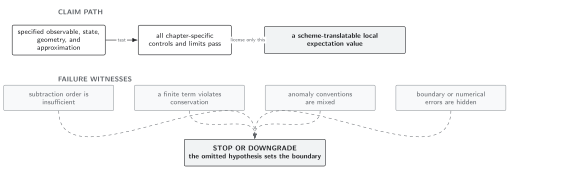
A local Wick square is licensed only with Hadamard input, covariant subtraction, controlled coincidence, and explicit finite freedom; the map is schematic and not to scale.
Use Domain and failure conditions for scheme comparisons. This page’s local checks are wavefront admissibility, geodesic uniqueness, subtraction scale, path-independent coincidence, engineering dimension, state-difference cancellation, and the field equation modulo known local terms.
Check your understanding
Section titled “Check your understanding”Why is less scheme dependent than either expectation separately?
Solution
The allowed shift is state independent. It appears equally in both expectations and cancels. The difference of two Hadamard two-point functions is smooth, so its coincidence limit needs no singular subtraction.
Renormalized Stress Tensor: Axioms and Curvature Ambiguities differentiates the split object and adds conservation. Volume V develops generic composite mixing; Volume XVI develops the full microlocal uniqueness theorem.
References
Section titled “References”- Stefan Hollands and Robert M. Wald, “Local Wick Polynomials and Time Ordered Products of Quantum Fields in Curved Spacetime,” Communications in Mathematical Physics 223 (2001), 289–326, DOI, arXiv:gr-qc/0103074.
- Bernard S. Kay and Robert M. Wald, “Theorems on the Uniqueness and Thermal Properties of Stationary, Nonsingular, Quasifree States on Spacetimes with a Bifurcate Killing Horizon,” Physics Reports 207 (1991), 49–136, DOI.