

Running Couplings and Curvature Couplings
Scale dependence on a curved background acts on a larger coupling space than in flat spacetime. Besides masses and matter self-couplings, it moves the nonminimal coupling and the coefficients of local curvature invariants. The components of that flow depend on the chosen coupling coordinates, while matched observables and the isomorphism class of the interacting local theory do not.
Required background. Curvature counterterms and operator mixing defines the local basis, and beta functions, mass running, and anomalous dimensions supplies the general RG equations.
Helpful background. Renormalization schemes and finite parts explains finite coordinate changes, and observable and off-shell matching identifies comparison quantities that survive them.
Scaling a locally covariant theory
Section titled “Scaling a locally covariant theory”Under a constant metric rescaling , lengths scale by , masses by , and local fields by their engineering dimensions plus logarithmic corrections. A fixed renormalization prescription on is related to one on by a finite local renormalization. Hollands and Wald show that the corresponding interacting algebras are isomorphic after the couplings are replaced by running parameters (Hollands and Wald 2003, §§ 3–4).
In a local operator basis , write
and allow operator mixing
Scale independence of a renormalized observable follows from the combined running of coefficients, insertions, and state/matching data, not from any one coefficient being constant.
One-loop scalar flow in the site convention
Section titled “One-loop scalar flow in the site convention”Fix four dimensions, minimal subtraction, one real scalar, and
With the site’s curvature convention the conformal value is . At one loop,
Many references write with conformal . The translation is , which turns their into the above. Quoting the formula without the operator and curvature convention is therefore ambiguous.
The last equation can be read directly from operator mixing. A logarithmic scale change in the coincident two-point subtraction is proportional to
Inserting this local term into the one-loop tadpole produces an logarithm. Requiring the bare coefficient of to be scale independent gives the stated . Integrating to leading-log accuracy while treating as constant over the interval gives
The conformal value is a one-loop fixed line for the nonminimal coupling in the massless theory, but mass terms, anomalies, additional fields, and higher loops qualify any statement of conformal invariance.
The same heat-kernel coefficient that produces the matter flow also generates running coefficients for and an equivalent quadratic-curvature basis. Their numerical beta functions depend on the field content, normalization, Euler-density convention, and whether total derivatives are retained. They are required for scale independence of the effective action and stress tensor even when the metric is external.
The construction map places running inside the finite local counterterm stage. Inspect the arrow from causal products to Ward-compatible observables: a scale change must transform the full local basis rather than alter a single coupling in isolation.

Scale flow as a finite local renormalization of the controlled construction. The diagram is schematic and not to scale; beta functions are coordinates on this transformation, while matched observables pass through the entire chain.
For a scale claim, the failure map tests whether all coupling and operator coordinates were translated. A changed component beta function with an unchanged matched observable is not a failure; unexplained residual scale dependence after consistent translation is.
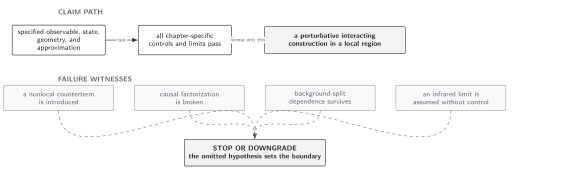
Validity path for curved-space running. This schematic, not-to-scale map downgrades an untranslated coefficient comparison to a scheme-specific statement rather than treating it as a physical disagreement.
Finite redefinitions and invariant comparisons
Section titled “Finite redefinitions and invariant comparisons”Let a second scheme use coordinates
where is finite and local. The beta vector transforms by the chain rule,
For example, choose
Then
so the two-loop and higher coefficients—and, with more general redefinitions, components at the first non-protected order—change. Simultaneously the operator coupled to and the finite term change. A matched two-point function or stress-tensor matrix element remains the same through the calculated order after this transformation.
This is the adversarial comparison: holding the operator basis fixed while changing only the printed beta coefficient manufactures a disagreement. A valid comparison translates couplings, operators, matching conditions, and scale. Universal claims are therefore attached to the RG vector field modulo such reparametrizations, to critical exponents where defined, or to scale dependence of matched observables—not to an isolated component in unnamed coordinates.
Domain and failure conditions
Section titled “Domain and failure conditions”Refer to the chapter domain and failure-conditions table for the shared comparison. Here the required data are the normalization of , the sign in , the subtraction scheme, local operator basis, and matching conditions. They license the displayed one-loop beta vector and scale translation only in those coordinates. The decisive check is invariance of a matched correlator or stress response after couplings and operators transform together. If an isolated coefficient changes under a finite redefinition, only that coordinate statement is downgraded; unexplained residual dependence of the matched observable prevents a consistent background-split or benchmark comparison.
Checks and limitations
Section titled “Checks and limitations”- State the interaction factorial and the sign of the curvature term before giving .
- Include curvature-only couplings when varying the effective action with respect to .
- Do not infer a physical time evolution from RG scale evolution; labels the subtraction description.
- Threshold matching and decoupling require a mass-dependent treatment or explicit EFT matching; minimal-subtraction beta functions do not implement decoupling automatically.
- Formal local RG flow does not establish convergence of perturbation theory.
Exercise
Section titled “Exercise”Using the one-loop equations above, show that the ratio is scale independent to one-loop order.
Solution
Taking logarithmic derivatives,
Their difference vanishes up to terms beyond one loop, so is constant to this accuracy. The statement uses precisely the chosen normalization and scheme.
Related topics
Section titled “Related topics”Scale changes compare renormalization prescriptions. Background splitting compares two assignments of the same quadratic term between the free propagator and interaction; consistency requires a related finite local map called perturbative agreement.
References
Section titled “References”- Hollands, Stefan, and Robert M. Wald. “On the Renormalization Group in Curved Spacetime.” Communications in Mathematical Physics 237 (2003): 123–160. doi:10.1007/s00220-003-0837-1.
- Parker, Leonard, and David J. Toms. Quantum Field Theory in Curved Spacetime: Quantized Fields and Gravity. Cambridge: Cambridge University Press, 2009. doi:10.1017/CBO9780511813924.