

Heat Kernels and the Schwinger–DeWitt Expansion
The Schwinger–DeWitt expansion is a short-proper-time asymptotic expansion of a heat kernel. It determines local ultraviolet divergences and, with a mass hierarchy, a local large-mass expansion. It does not by itself determine global spectra, late proper time, quantum state, absorptive parts, or causal response.
Required background. One-Loop Matter Effective Actions in Curved Space supplies the Hessian; Proper-Time, Zeta, and Determinant Prescriptions supplies the heat trace; and Asymptotic Scales, Remainders, Uniformity, and Optimal Truncation supplies the meaning of an asymptotic rather than convergent series.
Helpful background. Dimensional Regularization and Minimal Subtraction connects coefficients to poles, and Levi–Civita Connections, Geodesics, and Riemann Curvature fixes the geometric tensors.
The off-diagonal heat kernel
Section titled “The off-diagonal heat kernel”Let
act on a vector bundle over a smooth Riemannian manifold without boundary. Its heat kernel solves
Inside a convex normal neighborhood the parametrix has the form
where is one-half the squared geodesic distance and is the Van Vleck determinant. Substitution into the heat equation gives transport equations along the geodesic, beginning with after the displayed has been factored. Coincidence limits are local polynomials in , bundle curvature, Riemann curvature, and covariant derivatives. The general Laplace-type construction and its locality are reviewed in Vassilevich 2003, §§ 2.1 and 4.1.
Taking the trace gives
Some literature labels these integrated terms by mass dimension. This chapter labels the coefficient multiplying by ; thus its is Vassilevich’s .
First application: poles through curvature squared
Section titled “First application: poles through curvature squared”For the scalar operator
the mass factor is exact:
In four dimensions, only the combinations , , and multiply the ultraviolet pole. For a scalar bundle with vanishing connection curvature,
This follows directly from the universal coefficients Vassilevich 2003, Eqs. (4.26)–(4.28). The bundle case adds . The coefficient dimensions give an immediate check: in mass units.
The expansion also yields the local large-mass series after termwise proper-time integration,
with poles and logarithms treated by renormalization. Its control parameters are not merely “large ” but
for the curvatures and momenta retained.
Exact circle check and the large-s failure
Section titled “Exact circle check and the large-s failure”For on a circle of length ,
At fixed , every term is smaller than any power of as . Therefore all local coefficients equal their line values, yet the exact determinant knows about through the winding terms. At large , the lowest eigenvalue controls the trace and the local series is not an approximation. This is an explicit adversarial case: a perfect match of every power-series coefficient still fails to reconstruct the global infrared determinant.
The structure map places local heat-kernel asymptotics on only one branch of the determinant. Inspect the separate arrows to thresholds, nonlocal form factors, and imaginary parts.

The Schwinger–DeWitt series controls the local branch; topology, large- behavior, spectral cuts, and real-time response require additional data. Schematic; not to scale.
Domain and failure conditions
Section titled “Domain and failure conditions”The displayed expansion assumes a smooth Laplace-type operator and a local convex neighborhood. Boundaries generate half-integer terms; cones may generate tip terms and logarithms; nonminimal operators require reduction; zero modes dominate large ; and Lorentzian state data are absent. See the canonical Domain and failure conditions.
The failure map’s local-expansion branch is decisive: extending a truncated series through or into the infrared has no asymptotic warrant unless an independent uniform remainder estimate is supplied.
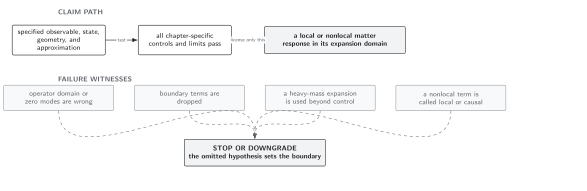
Small proper time and a controlled curvature or mass hierarchy license local coefficients; large proper time and global spectral sectors do not. Schematic; not to scale.
Related topics
Section titled “Related topics”Seeley–DeWitt Coefficients and Curvature Invariants derives the transport recursion. Heat Kernels with Boundaries and Conical Singularities changes the domain and asymptotic structure. Matter-Induced Nonlocal Form Factors retains the momentum dependence that a finite local series discards.